
By Riaan de Villiers
A while ago, in the middle of winter, I spent a weekend in the Overberg village of Napier, in Maryanne’s house at the back of the town. It looks out over a gravel road, a treeline, and a wide field of grass.
Beyond that, stretching down into the folds of a shallow valley, is the former ‘coloured’ township of Nuwerus, mostly made up of breeze block houses. At its western end is an informal settlement, largely inhabited by the town’s burgeoning African population.
People from the settlement cross the field along various diagonal pathways, or walk up and down the gravel road, to and from the centre of town.
On the Sunday afternoon, Uberwachung security guards — dressed in black combat gear, their cars embossed with red eagles — were parked at the top end of the gravel road from where they could survey the whole border between township and town.
Then I noticed a bunch of kids on the other side of the treeline. They were squatting, and doing something on the ground. Whatever it was took a lot of concentration. At one point I could hear the percussion of stones.
I could their clear voices in the winter air. Now and then there was a peal of laughter. Whatever they were doing was a lot of fun.
But what could it be? And would the security guards chase them away? At first, I thought I wouldn’t interfere, but I remained curious. So – also perhaps to help legitimise their presence — I eventually drifted down, said hey, guys, how are things, and what are you doing?
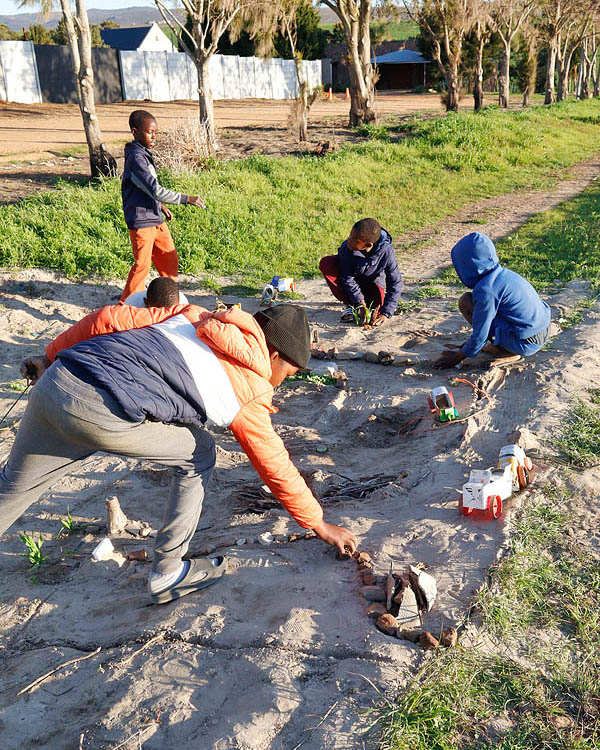

Soon, I was looking at an astounding fantasy world, laid out in a sandy track beyond the trees — a miniature rural settlement, built from sticks, stones, veld plants and bits of glass — comprising a number of homesteads, nestled in a system of access and perimeter roads.
The homesteads – consisting of dwellings, cattle kraals, gateways and driveways — were ranged up against the far side of the track, with their boundaries drawn in the sand. The driveways were bordered with sticks or stones, and the gateways were flanked with ‘trees’. There were some miniature bridges too.
The settlement was traversed by a range of vehicles — bakkies, tractors, buses and cars — crafted out of milk and other cartons, with plastic screw tops as wheels. They weren’t only pushed, but also towed along with wire or string. Now and then, they turned off a perimeter road into a homestead. The builders and operators were five young people, four boys and a girl, anywhere between the ages of eight and 12.


I watched, spellbound, as one completed the gateway to a settlement. Unhurriedly, and with great precision, suitable veld plants were placed on each side of a tiny stone gateway. Then came the magic moment when the first vehicles travelled through the gateway and up the driveway.
I took some pictures, and the youngsters clustered around me as we looked at a video on the screen on the back of my camera. Then I left them to it. They played on until the early evening.


Thanks for sharing, guys – we could hardly speak to one another, but we shared a moment beyond age, language and culture: the visceral thrill of a handmade vehicle driving, for the first time, through a stone gateway flanked with plants, and up a sandy driveway to a miniature house made of sticks and stones. I will carry this moment with me for a long time.
PS: Maryanne, who lives there, says I shouldn’t get too PC about the security guards. They know all the kids and their families, and play a valuable community role. Among other things, they don’t routinely chase them out of town. Sometimes, in holidays, the kids also build tree houses in the trees across the road. I think one of the things they really need is a communal swimming pool.