

By Destine Nde
On 1 October 1960, Nigeria was released from British colonial rule and became an independent and sovereign federal state. Since then, this day has been a public holiday in Nigeria, known as Independence Day. It is usually celebrated with religious rites, traditional dances, cultural exhibitions, military parades, feasts and speeches infused with patriotic fervour.
This year’s theme was Nigeria@65: All Hands on Deck for a Greater Nation. According to a statement, the Minister of Interior Affairs, Dr Olubunmi Yunji-Ojo, congratulated Nigerians and urged them to uphold the patriotic spirit, unity and resilience that have sustained the nation since 1960. ‘Keep faith in the Renewed Hope Agenda of President Bola Tinubu, which is anchored in national rebirth, economic transformation and collective prosperity,’ he stated.
He added that ‘with the cooperation of all Nigerians, the country will continue to grow stronger in piece, progress and development’.
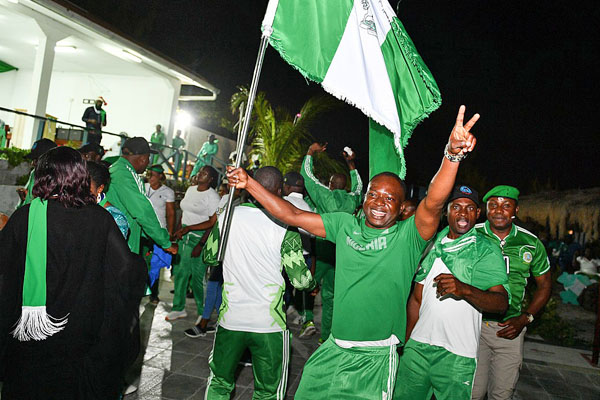
Nigerians serving in the African Union Mission in Somalia (AMISOM) celebrate Nigeria’s 61st independence anniversary in Mogadishu, Somalia, on October 2021. (AMISOM Photo/Mukhtar Nuur on Wikimedia Commons)
Nigeria’s independence from the UK remains a milestone in the country’s history. The journey to independence was long and bloody. Ahmadu Bello, Obafemi Awolowo and Nnamdi Azikiwe are some of the leaders who championed the fight for self-governance. In fact, Azikiwe went on to serve as Governor-General under Queen Elizabeth II, from 1960 to 1963, and became the first president of the Federal Republic of Nigeria in 1963.
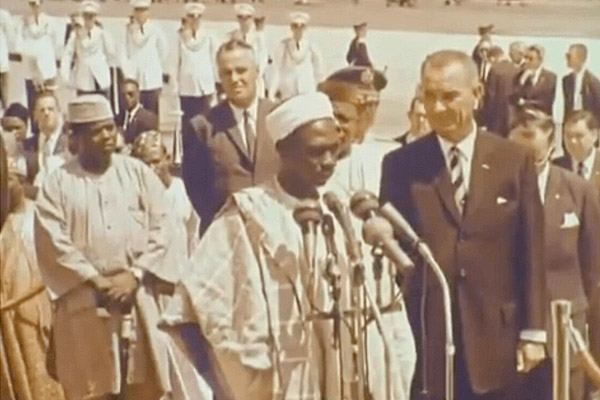
Another view of Nigeria’s first prime minister, Abubakar Tafawa Balewa, delivering his keynote speech on Nigeria’s Independence Day, 1 October 1960 (Wikimedia Commons)
All this is good and praiseworthy. However, nothing can be written about Nigeria’s post-independence history without mentioning the momentous Nigeria-Biafra War, a fierce war that changed the course of the country’s history.
In an article in the Journal of Genocide Research (vol. 16, 2014), Lasse Heerteen and A. Dirk Moses wrote: ‘The Nigeria-Biafra war that raged between 1967 and 1970 made headlines around the world … It was a genuinely global event. Yet, by the late 1970s, it was seldom talked about outside Nigeria. Since then, it barely features in scholarly and popular accounts of the period. The conflict is also virtually entirely absent from the field of genocide studies.’
The territorial boundary of Nigeria, as claimed by the UK at the notorious Berlin Conference in 1884-5, encompassed three different nations: the Hausa in the North, the Yoruba in the South West, and the Ibo in the South East. They had very differernt, almost incompatible cultures. The Ibos, for example, were a very industrious and sedentary people, who believed in their ancestors and practised typical African religions; whereas the Hausas were pastoral nomads who were even ‘religiously attached to their cattle’ and practised Islamism with impeccable fidelity. In spite of this, the British concentrated the political and economic headquarters in the north, making Hausa land the Capital of Nigeria.
Given their innate industrious disposition, the Ibos started moving up north. There were too many opportunities in the capital to take advantage of; business, academic, and political. Thus, while the Hausas were roaming around with their cattle, the Ibos were opening businesses, studying, and starting exciting careers. As one Ibo became financially secure, he would invited two or three more Ibos to mentor.
When the Hausas finally woke up from their nomadic slumber, they found the Ibos running the capital and driving the country’s economy. The Ibos owned the shops, the banks, the transport systems, the estates and the co-operations, while the Hausas (those not entrenched in the nomadic lifestyle) and the Yorubas owned the jobs. In other words, the first became the bosses, and the second the workers.
On 15 January 1966. Major-General Johnson Aguiyi-Ironso, an Ibo, seized power in a military coup. Incensed by this, the Hausas picked up arms, and vowed to chase the Ibos away. Brutal violence ensued in the capital. Johnson was assassinated on 29 July, six months after seizing power, and the Hausas achieved their goal sooner than expected. They ruled the public sector, and therefore had the army and other government resources at their command, while the Ibos ruled over the private sector, and could only rely on private resources.
Osnce back in Biafra, their homeland, the Ibos became enraged, and on 30 May 1967 unilaterally declared the Independent State of Biafra. The Hausa, emboldened by their recent victory, and knowing full well that they controlled the army, refused the cessation and on 6 July declared war on Biafra instead. The Ibos were decisively crushed.
To hasten Biafra’s surrender, the Federal Military Government of Nigeria placed Biafra under siege — it isolated the nascenbt country from the rest of the world, and prevented any flow of goods. A merciless famine ravaged the land and its people. What followed after has been likened to the Holocaust. Children were starved, women were tortured and raped, men were massacred and mutilated, and whole villages were burnt to ashes. David Reed of Readers Digest wrote: ‘The parallel with the Jews of Europe … is almost complete, except for one thing. The Jews died in many different death camps. All of Biafra has been turned into one big death camp.’
Britain and the West allowed this to happen on the grounds that if Biafra succeeded in breaking away, it would encourage the disastrous Balkanization of other African countries.
To prevent that from happening, Britain and Russia soon found themselves competing to win the favour of Nigeria’s Hausa-dominated government by delivering state-of-the-art weapons to Lagos. Thus the holocaust was repeated on a grander scale. Many books haveb een written about the holocaust, but none, except two or three novels (that I know of) about the Biafra genocide. At least Bruce Willis and Monica Bellucci made a movie about it in 2003, called Tears of the Sun.
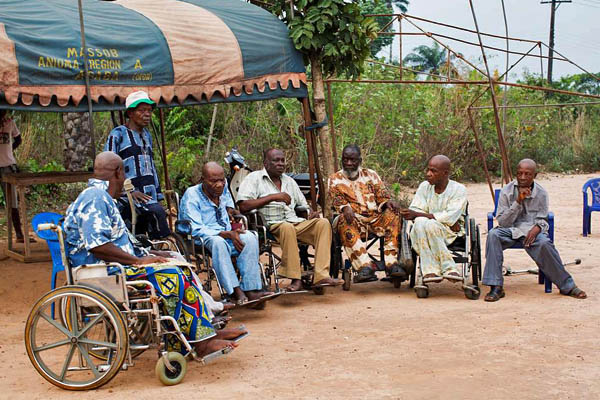
Disabled Biafran war veterans at a gathering in 2017. (Wikimedia Commons)
According to Heerteen and Moses, ‘many defeated Ibo have campaigned since then for their genocidal experience to be recognized and canonized in the field and popular consciousness …. In historiography more broadly, scholars are now focusing on the 1970s as a breakthrough decade for human rights and humanitarianism, and the global concern about the [Nigeria-Biafra War] features as part of this research agenda.’
And in 1967, David wrote: ‘Nigerian “unity” is more a fiction than anything else, and while a further Balkanization of Africa is not a pleasant prospect, a re-ordering of African boundaries will have to be carried out sooner or later. Africa cannot abide by the Berlin Conference for ever.’
It is therefore something of a miracle to see Nigeria still united today, and a giant on the continent, prospering and blazing trails on various fronts. This is indeed a testament to the resilience and determination of Nigerians, which Minister Olubunmi Yunji-Ojo congratulated them for.
FEATURED IMAGE: Nigeria’s first prime minister, Abubakar Tafawa Balewa, delivering his keynote speech on Nigeria’s Independence Day, 1 October 1960 (Wikimedia Commons)
Nice one Destine Nde, reminding one that Africa is our motherland, and that it would be good to be able to introduce our fascinating continent as a more realistic testimony to its relative size and relative variety. Nigeria has also contributed staggeringly impactful novelelists and artists; it would be enlightening to share. Nigeria, soccer apart nonetheless, is a good start to a worthy, and courageously interesting, series.