

By R.W. Johnson
Sir Keir Starmer could be forgiven for looking back at his decision to become an MP at the age of 53 and wondering whether he has made the right choice. At the time he was the Director of Public Prosecutions, a very senior post in the civil service. The trouble was and is that 53 was a very late age at which to start a new and very different career. Part of the problem is that his instincts are still those of a lawyer and a civil servant, not a politician. Most successful politicians start the game young and accumulate a good deal of political experience before becoming a senior minister. But the other part of the problem is that politics in Britain is changing.
Starmer came from a poor family – his mother a nurse, his father a toolmaker. They were a strongly Labour family and Starmer, a bright scholarship boy, never doubted his own Labour affiliation. In the era when he was growing up, British politics had just two large parties, and they were largely based on social class. Labour politicians spoke unaffectedly of representing the working class which in the early post-war period represented at least 60% of the electorate.
By the 1960s that had begun to change with the growth of an increasingly large white collar service class and the decline of heavy industries. More and more women worked, and there was a large and continuously growing immigrant population. There ceased to be a British-owned car industry, and the whole mining industry disappeared.
New professions proliferated, there was a vast expansion of universities and a large growth in temporary “gig” jobs. Gradually the whole class system disassembled. It became too old-fashioned to talk about “the working class” so instead Labour politicians talk about “working people”.
These changes showed up even in social surveys. In the 1960s Peter Pulzer had famously written that class was the basis of British politics and that “all else is embellishment and detail” but in the 2000s political scientists found that class was no longer the best indicator of voting choice. Instead, education was, with the better educated voting Labour. And within that electorate there were now large ethno-religious blocs – immigrant Muslims and those of African or Caribbean descent, not to mention Scottish and Welsh nationalists.
But beyond even that political partisanship of any kind was becoming much weaker. Many of the post-war generation had simply inherited their preferences from class-bound parents – and their children then inherited their preferences. But ultimately merely inherited preferences proved much weaker than preferences enforced by work and life experience. So all political preferences tended to become more fragile and changeable.
And so the whole electorate became far more volatile and far more open to voting for new parties. Thus, almost half of British voters now proclaim preferences for Reform or the Greens and the vast majority which Labour won in 2024 already seems part of ancient history.
Almost the first thing Starmer did when elected was to discard the Tories’ scheme for relocating illegal immigrants to Rwanda, declaring that instead Labour would “smash the gangs” who profited from bringing the migrants in. This was a clear error. Government after government had talked tough about the gangs but they had always prevailed, and even if one gang was smashed, others would always seamlessly take their place.
Australia had faced the same problem with “boat people” from Indonesia illicitly landing on unguarded bits of the Australian coast. In the end the government ordered the Australian navy to stop the boats and the would-be immigrants were turned back, denial of permanent settlement rights for illegal immigrants and offshore processing of those applying for entry – on Nauru or Papua New Guinea, islands that no one was keen to stay on.
This led to a fair amount of humanitarian complaint from the Left, but the big fact was that this policy worked. The boats stopped coming and voters were just happy that the problem had thus gone away, so even when Labour won an election, the policy was maintained.
The moral was clear: what people wanted was a practical solution which made the problem go away. Threats and promises were merely words and if the problem remained or even got worse, voters would rapidly turn against those who had made empty promises. From that point of view it was folly for Starmer to scrap the Rwanda scheme, which might well have worked, unless he had a practical solution to put in its place.
The result has been that less than eighteen months after Starmer’s huge election victory, illegal immigration has not only continued but is at a higher level than ever, showing how completely empty Starmer’s promise of “smashing the gangs” was. As a result, public feeling on the issue has become stronger than ever, and Labour now finds itself down at 21% in the latest polls, with Reform on 34%.
Labour MPs have started to panic, for they know that their own electorate is greatly attracted by Reform’s promises. Inevitably, they have turned on Starmer and his hapless Chancellor, Rachel Reeves. All of which put Starmer in a weak and threatened position as the Labour Conference began in Liverpool.
The events of the last few weeks have considerably increased the pressure on Starmer. First, Nigel Farage came out with a promise to deport 600,000 migrants and to leave the European Convention (and Court) on Human Rights, which has greatly restricted the government’s freedom of action in how it deals with immigration. This has been quickly followed by the Tories promising to deport 750,000 migrants over a five-year term – and they too have now committed themselves to leaving the ECHR.
Given that illegal immigration is currently running at over 200,000 a year from the small boats crossing the Channel, let alone the large numbers who arrive on student or tourist visas and then stay on illegally, there is plenty of scope for such action and there is no doubt that it would be popular. Kemi Badenoch, the Tory leader, has also committed herself to set up a special migration police unit modelled on America’s ICE.
Starmer has responded to this by declaring Reform “the enemy”, saying that Britain must at all costs avoid having a government of the populist Right. Indeed, he has attacked Reform as “immoral” and “racist” and some of his supporters go further still, using terms like “fascist” and “Nazi”.
This is no more likely to work than the Democrats in the US labelling Trump as fascist. Voters have long ago got used to Nigel Farage as a recognisable British type – the saloon bar conservative, full of “cheeky chappie” chirps. The word “Nazi” summons up frightening images of SS torturers but no one feels frightened of Farage.
But above all, Farage and Badenoch are coming up with practical proposals to cut immigrant numbers and Starmer, once again, is merely offering words. In a small overcrowded island like Britain, this is an auction he’s bound to lose.
True, Starmer has said that he intends to study the prevailing laws dealing with immigration and see what he can come up with, but the question is why he didn’t do that while he was in Opposition? And he seems to dismiss out of hand the idea of leaving the ECHR. Yet no less than nine European countries (Denmark, Italy, Latvia, Lithuania, Estonia, Poland, Belgium, Austria and the Czech Republic) have signalled their criticism of the European Court of Human Rights, saying that its rulings on immigration have gone beyond the intentions of the Convention and are making it difficult to “protect their democracies and populations” in an age of mass migration.
Anyone who has dealt with human rights lawyers will find this unsurprising. Their whole profession consists in extending abstract legal principles to the point of over-reach and they are little concerned with the practicalities of government.
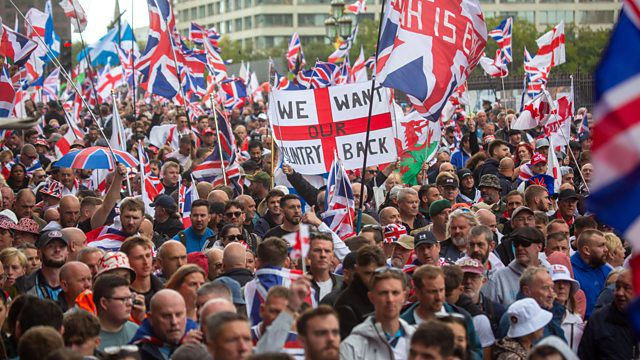
A scene from the ‘Unite the Kingdom’ rally in London on 13 September. (Facebook)
Starmer and other Labour spokesmen were angrily critical of Tommy Robinson’s “Unite the Kingdom” rally in London, denouncing it as “far Right” and “racist” although those at the rally insisted that they are neither far Right or racist. Officially the rally is credited with having attracted 150,000 supporters, but the rally organisers estimate their crowd as up to two million.
The rally was essentially peaceful. There were a few violent incidents when a (much smaller) counter-demonstration clashed with the UTK marchers. What is not in doubt is that this was one of the largest civil demonstrations in recent British history, showing the depth of feeling surrounding the immigration issue.
Then came the shocking events in Manchester in which a number of Jews were killed or hospitalised as a result of an attack by a jihadist Syrian immigrant. As a number of Jewish spokesmen have pointed out, this was not terribly surprising. Ever since 7 October 2023 all the major British cities have seen major pro-Palestinian marches and demonstrations. Inevitably, they draw in large numbers of local Muslims and often feature Islamist extremists who openly support Hamas and Hezbollah, both proscribed terrorist associations. Jews are conscious that the demonstrators seldom distinguish between Israelis and Jews and that they frequently voice anti-semitic as well as anti-Zionist chants and slogans.
These demonstrations quite casually break all laws about hate speech yet no one has intervened to stop or restrain them. And these marches go on every Saturday. Even when Starmer appealed for them to call off marches scheduled for the week of the Manchester atrocities, this was ignored. The impression given is that these marchers, and perhaps Muslims in general, are above and outside the law. For Labour denounced Tommy Robinson’s one-off demonstration but have had not a word to say about these far more threatening and frequent marches.
Little wonder, then, that British Jews – one of the most peaceable communities in the country – say they feel threatened and intimidated by these marches and that they have helped create a climate of virulent anti-semitism, reflected by an ever-increasing number of anti-semitic incidents – of which the Manchester attack is merely the latest. Even the (Muslim) Home Secretary, Shabana Mahmood, agrees that the Jewish community has every reason to feel that they have been let down by Labour.
Meanwhile, the government continues to claim that it is against all extremists, of the Left or Right. But this even-handedness is bogus. The security services confirm that jihadists account for over 90% of all the violent plots or incidents which they have forestalled and MI5 reckons that Britain has let in some 40,000 jihadists among the immigrant throng. The result is that many Jews no longer feel safe in Britain.
Starmer was simply unprepared for this bitter form of communalist politics, but it is part of the new political reality and it won’t easily go away. He has responded to the Manchester attacks by promising the Jewish community that the government will protect them but it is difficult to see how that can be done. Already Jewish schools and synagogues take extensive security precautions of their own and the whole community lives in a sort of defensive crouch. And this is a community which has, despite its small numbers, has contributed massively to the arts, business, science, the law, the academic world and much else besides.
But the fact is that when the Jewish community looks back to what now seems a golden age of security in Britain, it is looking back to a time when the country did not have a Muslim community which now approaches five million. If, after all, a single jihadist can create a major emergency, as in Manchester, how can the Jewish community feel safe while knowing there are 40,000 jihadists in the country ?
The situation is, of course, greatly complicated by the fact that the Labour Party, which has always enjoyed significant support from the Jewish community, is now much more dependent on the Muslim vote. Indeed, many interpreted Starmer’s resort merely to moral rhetoric at a point when both Reform and the Tories are promising large-scale deportations, as an attempt to woo the Muslim vote.
Ironically, Starmer’s weakness at the time of the Labour Conference led to Andy Burnham, the popular mayor of Manchester, making an ill-judged leadership challenge. But Burnham chose to do so on traditional Labour ground, criticising the government for insufficient spending on welfare and housing. He argued that the government had to “get beyond” the problem of “being in hock to the bond markets” and to borrow large amounts of money to build more council houses and to get rid of the two child cap on welfare payments.
In “normal” times this might well have worked. Instead, with the national debt already at 100% of GDP, it was easy for Burnham’s critics to point out that he could hardly “get beyond” being in hock to the bond market if his first move was to borrow even more from that market. There was, indeed, a real possibility that such a move might emulate the crisis created by Liz Truss when she suddenly announced plans to borrow more in order to finance tax cuts. Burnham’s bid failed badly, and he left the Conference early.
In the old days, an appeal to the sacred goals of the Bevanite Left might have succeeded but those goals have lost some of their magnetism in an age when more people are thinking about the communalist politics of the Jewish and Muslim vote, about Gaza and Palestine and about the threatening growth of Reform.
FEATURED IMAGE: Mritish prime minister Keir Starmer gives a speech on state reforms in Hull, March 2025. (Lauren Hurley / No 10 Downing Street on Wikimedia Commons)