

By Destine Nde
Has Cameroon turned into a monarchy, or is it still a republic? This is not just a question many Cameroonians are asking, but a possibility they detest, and are fully resolved to prevent.
On 26 October 2025, the Constitutional Council of Cameroon declared the 92-year-old incumbent, Paul Biya, winner of the recent presidential elections. He is already the world’s oldest and longest ruler. Should he live that long, this victory will give him seven more years in power, until 2031, when the next presidential elections will be held (if the constitution is not revised and the seven-year term extended, as was the case in 1996, when it was extended from five to seven years). Thus his reign has been consolidated for a fifth decade, from 1983 to 2031.
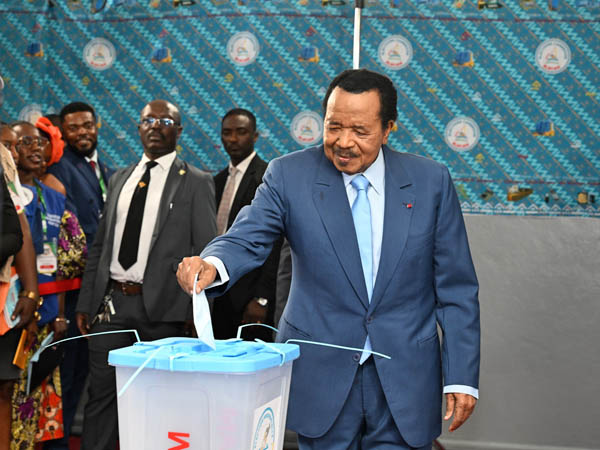
Paul Biya casts his vote in the presidential election. Image: Facebook.
After the polls closed, the constitutional council had up to 15 days to announce the winner. During that time, Cameroon was very tense, seized by anxiety and fear. On the one hand, Biya’s opponents were anxious and afraid that he might win again – they are starved for change. On the other, his supporters were anxious and afraid of what might happen to them if he loses, and willing to secure his victory at any cost.
This ambivalence could be seen all over social media. The stakes were high, the country was flammable, and the votes had already been cast. It was then in the hands of ELECAM, the commission responsible for organising, managing and supervising elections in Cameroon, to announce the results, and this took a full two weeks.
This long period of uncertainty fanned the sparks, eventually turning them into flame. ‘Fire in party office raises tensions as Cameroon awaits election results’, one headline in the New York Times read. ‘The office of the ruling party, CPDM, in the city of Dschang was torched’, reported TRT AFRIKA. ‘Tensions are on the rise after opposition candidate unilaterally declares himself victor, and calls on incumbent 92-year-old Paul Biya to concede’, posted Aljazeera. Social media platforms were teeming with comments.
Some say the waiting period was extended on purpose, to give the ruling party ample time to threaten and intimidate people, and manipulate the vote. Indeed, various accusations were made of interference in the electoral process. ‘Protests broke out in several cities over allegations of electoral fraud, including at the ELECAM headquarters in Douala’, reported another African news channel.
‘Thanks to the presidential election of 2025,’ wrote one activist, ‘I finally discovered how CPDM used to score 100% in polling stations. Through shameless rigging and theft of elector’s votes! Where will some of our ruling party bigwigs hide their heads now? Or have they sold shame and bought disgrace? I bless God for the invention of social media … making manipulation of final results very difficult for ELECAM and other government officials of dubious intentions’.
After the announcement of Biya’s ‘victory’, waves of protest erupted and began to sweep across the country. Cameroonians at home and abroad are extremely disappointed and angered. They cannot believe that those in positions of influence still acquiesced to Biya’s strategy and allowed him to ‘steal’ the election for the eighth time.
They cannot believe that at almost 93, and after so many years of civil unrest, he can still have such a firm on the minds of his subordinates, exacting what now clearly goes beyond loyalty to slavish obedience. Or is it fear? If so, what kinds of threats / fars must he have injected . plangted in their minds? Is it hope: then what sort of alluring promises must he have driven to their hearts, that they would rather let him rule than safe the country?
A comment on Facebook read: ‘In many places during the campaigns, this African leader was unable to personally appear before the people. Instead, his team played recorded messages and displayed his portrait to represent him. Today he was declared the winner. No country has ever gone lower than Cameroon.’
There were altogether 12 contestants this year, of which Issa Tchiroma Bakary’s FSNC (Front for the National Salvation of Cameroon) was the leading opposition party. The 76-year-old Tchiroma said he wished to serve only for one term, after which he would gladly hand the country over to its rightful owners, the younger generations. He announced that his mission was to topple the old regime (in whose executive he served between 1992 and 2025), and usher in a new one: ‘One term, a foundation, a handover to the youth’. This made him a popular candidate.
During the waiting period, the Minister of Territorial Administration, Paul Atanga Nji, declared that ‘any unauthorised release of results will be deemed high treason; only the Constitutional Council can declare a winner’. Tchiroma did just that, and now he has lost the election.
Besides that, he is a deserter who abandoned Biya’s CPDM (Cameroon People’s Democratic Movement) to found his own opposition party. It is almost certain that the government intends to charge him with ‘high treason’ and throw him in jail. Some citizens are determined not to let it happen — a human wall has been surrounding his compound since the results were announced.
‘Supporters of opposition candidate Issa Tchiroma Bakary have defied a ban on protests, setting police cars on fire, barricading roads and burning tyres in the financial capital, Doula … Police fired teargas and water cannon to break up the crowds that came to support Tchiroma’, reported Yashraj Sharma of Aljazeera. ‘Cameroon’s post-election tensions deepen as authorities detain opposition figures, restrict movement, and impose internet disruptions’, according to Thampers Media.
Some interesting comparisons are now being made between Cameroon and other states. Nigeria, for example, has had seven heads of state from 1983 until the present; the US has had eight; and South Africa seven. These are not just different names and persons; they represent different ideologies and world views. Some of the presidents were famous and others were doubtlessly infamous, but they all represented a degree of change.
Political regimes are invariably associated with certain ideologies; therefore, regime changes also bring with them ideological change. Presidents are just the names for and faces on the different eras in a country’s history. In South Africa for example, F.W. de Klerk is associated with that country’s transition to majority rule, while Nelson Mandela is associated with the post-apartheid era.
Ruling ideologies not only influence people politically, but also determine their beliefs, values, norms and tastes. It is a form of ‘political hegemony’: an order in which a certain way of life and thought dominates (in the case of Cameroon, that of the ruling CPDM). Its particular concept of reality has been imprinted on Cameroonian society, informing tastes, morality, customs, religion, and other aspects of social life. As one scholar has put it: ‘Political hegemony goes beyond ideology; it is a lived system of meanings and values.’
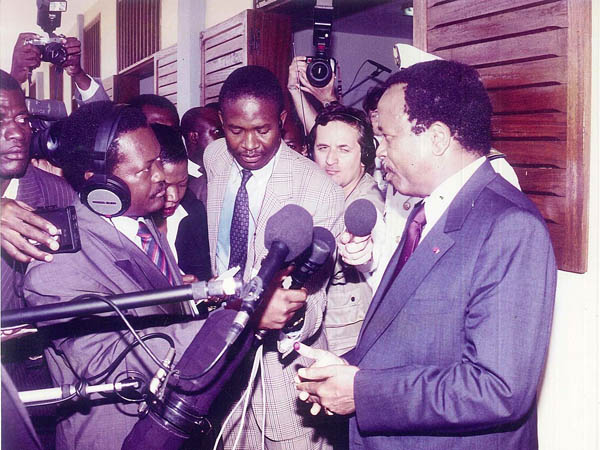
Journalists interview Paul Biya in 1987. Wikimedia Commons.
It can therefore be said that, over five decades, Cameroonians have been Paul Biyanized, knowing only one name, one name and one political culture. Half a century is a very long time for one person to be in power, especially someone whose party claims to be a champion of democracy.
This is why many Cameroonians are frustrated and disillusioned – and have been for some time. As early as 1996, many people were fed up, and all the opposition parties boycotted the election. Biya won with an overwhelming majority, securing over 92.6% of the votes. According to the Constitution, a president could only rule for two terms. Despite this, he revised the constitution in 1996 and ran again in the 2011 presidential elections, on the grounds that it would be ‘undemocratic to limit the people’s choice’.
Now, more and more people believe they have had enough of the Paul Biyanization, and cannot take it any more. Their worst fear – Biya’s return — has come true, while the prayers of Biya’s supporters have been answered.
The fight is on: ‘Cameroon on fire: post-election violence escalates as citizens reject Paul Biya’s victory, wrote The Past and Present. ‘A crackdown by armed forces in Cameroon has killed at least four opposition supporters amid protests over the declared re-election win by President Paul Biya’, reported Aljazeera. ‘Over 100 dead so far in Cameroon, as the protest rages on against the fraudulent re-election of Paul Biya. Where is the AU?’ went another headline.
Among other things, for nearly a decade now, Anglophone Cameroonians have been fighting to secede from the republic and become the independent state of Ambazonia, which Biya and his government have resisted.
It is hard to believe that the citizens of a country marred by nepotism, tribalism, partisan militarism, separatism, corruption, civil wars, and human rights violations would choose the same leader for the eighth time in five decades. However next to change, death is the only other thing with a probability of one. So change will come, but it might still take a while.
FEATURED IMAGE: Channel 7 News on Facebook.