

By Sue Morrell Stewart
Cecil John Rhodes may be buried in Zimbabwe, but he died in a small cottage on Muizenberg Main Road overlooking False Bay at the age of just 48. The cottage is now a museum and a provincial heritage site, which is open to the public.
A past curator, Tony Westby-Nunn, has published a book titled Rhodes Cottage Museum: the story of the cottage where Cecil John Rhodes spent his last days. Richly illustrated, it casts interesting light on the building and its history, as reflected in its displays.
Rhodes bought the cottage in 1899, but it looked very different at that time – among other things, it had a corrugated iron roof which was removed after Rhodes’s death and replaced with thatch. A wider veranda designed by architects in Herbert Baker’s practice was also added.
When Rhodes bought the cottage, it had no running water, and he later swopped the bedroom with the lounge so that he could view the sea from his sickbed. He apparently disliked eating alone, so he usually dined at the Scowen Hotel, which later became the Marine Hotel, and which stood on the present Checkers square.
Rhodes remains a controversial figure, but whatever one’s opinion of him he certainly helped to shape South African history, and made a major contribution to its economy and education. His life is documented in displays on the museum walls, beginning with his birth in the UK and continuing through his sojourns in Durban, Kimberley and Zimbabwe until his death from an aortic aneurism in 1902.
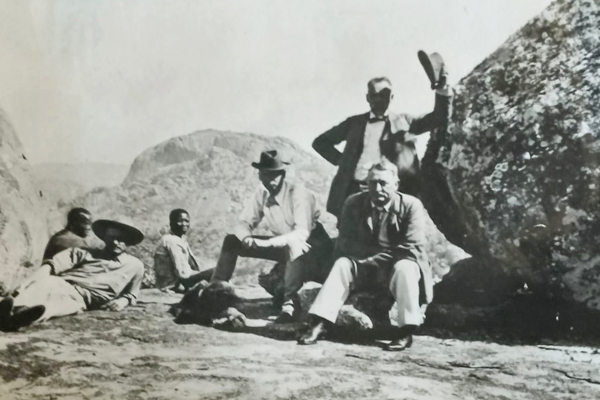
Cecil John Rhodes in the Matopos in southern Zimbabwe (then Rhodesia), where he was buried. Date and photographer unknown. This picture hangs in the manor house at Grootfontein, Sir Abe Bailey’s headquarters in the Nuwe Hantam.
The Rhodes Scholarship – which continues to this day – has played a major role in nurturing academics and leaders in both Africa and America, and the museum has an interesting display of early communications between Rhodes and the Anglican Archbishop of the time planning this.
It shows Rhodes thinking through the requirements for the scholarship and the selection process, finally agreeing that academic prowess was obviously tantamount but that candidates also had to be sporty and show humanity and leadership ability, with the aim of preparing them for ‘public duties’ and better global understanding upon their return.
The book is full of anecdotes resulting from Westby-Nunn’s long association with the cottage, and exposes some of the truths and untruths found in the displays. None of the bedroom furniture is original, and it’s unlikely that the room looked as it does today.
Some items have disappeared over the years, among them some valuable coins and military badges that used to be displayed in a wooden cabinet. The beautiful table in the dining room was only given to the museum by De Beers in the 1950s, and is actually an impressively designed diamond sorting table with eight drawers which could be locked when necessary.
The displays include amusing cartoons and caricatures reflecting both Rhodes’s fame and notoriety, as well as his relationships with literary figures such as Olive Schreiner and Rudyard Kipling. His mysterious relationship with the self-seeking Princess Catherine Radziwill is also touched on and is something that Westby-Nunn is presently researching and would intends to write more about in the future.
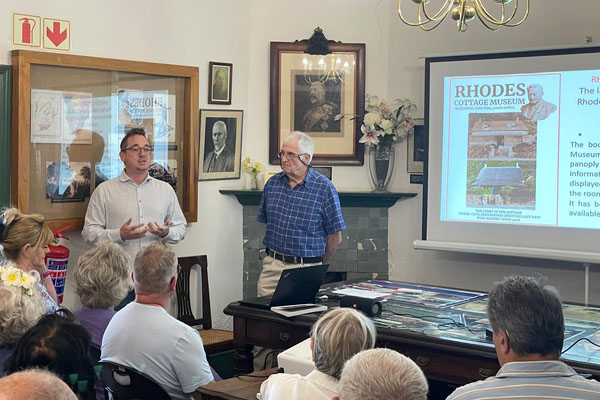
The chairman of the Muizenberg Historical Conservation Society, Brett McDougall (left), introduces author Tony Westby-Nunn at the book launch.
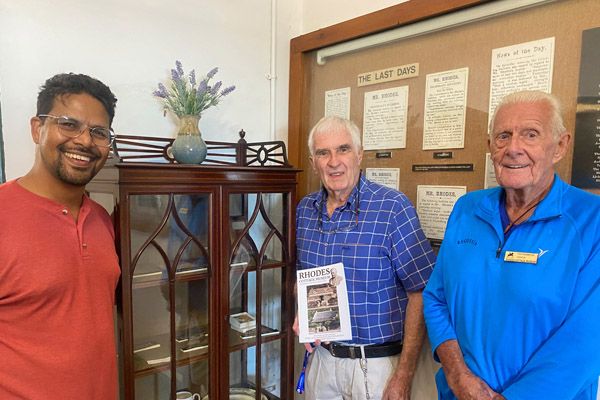
Tony Westby-Nunn (centre) and Rhodes Cottage Museum volunteers Ryan Green left) and Tony Rozemeyer at the wooden cabinet in the bedroom from which valuable coins and badges disappeared a few years ago. Image: the author.
The Rhodes Cottage Museum is owned by the City of Cape Town and managed by the Muizenberg Historical Conservation Society (MHCS). Copies of the book are available at the museum. Otherwise, write to the author at tony@tonywestbynunn.com.
Featured image: The Rhodes Cottage Museum in Muizenberg. (Rhodes Cottage Museum website)
This is an edited version of an article written for the Muizenberg Heritage Society.
Thanks Sue for a very interesting piece of writing and for a copy of the book on Rhodes . I am looking forward to a good read..
Good to come across this review and forum, Sue. Welcome back.