

By Maeder Osler
‘Place Names: “Maccaserfontein”. Named after the oily looking water that emerged from a natural fountain above the homestead. This being a well-known brand of hair oil at the time. The shortest route from Port Elizabeth to Kimberley, and later on, Johannesburg, passed close to the homestead with all the ox wagon transport and passenger horse-drawn vehicles passing by night and day. The road went direct to Platberg and on route the post car threw off any mail for “Pienaars” who lived some distance away, the farm subsequently being known as “Pienaar’s Post”. A direct route to Colesberg from Jakkalsfontein was cut by the “pioneers” over the mountain range facing Arundel, passing the farm Ruigtefontein, and emerging at Ebenezer – to meet the main road at this station.’
Thus another extract from notes made by Morton William Barnes-Webb, founding manager of the 45 farms bought by the Rhodes/Beit/Bailey (RBB) syndicate in the Nuwe Hantam area of the grassy Karoo in the late 19th century.
As written previously, the notes form part of the Bailey Collection in the Nuwe Hantam Archive — an extensive collection of hitherto unpublished documents donated to Toverview by Barnes-Webb’s grandson, Peter Barnes-Webb, who farmed in the district until recently.
Some notes and observations
A name, as we all know, is a portal for all sorts of close and intimate things, positive and negative, including ‘identities’, and everything that goes with this. This evocative extract from the Bailey Collection provides me with a charming standing point from which to wander off into rambles about names and places, people’s attachment to them, and their sense of place and belonging.
Readers will immediately see that the list of place names is highly selective, and also that they are associated with transport routes – as vital then as they are today. Specifically, very few of the 40-plus RBB farms are named.
We still need to remind ourselves that Port Elizabeth is now Gqeberhba, pronounced ke-‘bearxa’ or key-gheh-buh-rah with a click sound, the isiXhosa name for the Baakens River which flows through the city. Besides being known as South Africa’s windy city, it has also gained an unenviable reputation as its ‘stolen city’, derived from Crispian Olver’s distressing book HOW TO STEAL A CITY, The Battle for Nelson Mandela Bay, publishd by Jonathan Ball in 2017. Read it and weep.
‘My heart stands in the hill’
This poignant statement – a quintessential South African expression of a sense of place and belonging – was made by a /Xam prisoner in the Breakwater Prison in the Cape Town Harbour in the late 19th century. He was !han+kass’o , also known as Klein Jantjie, whose stories were recorded by the linguist Lucy Lloyd in 1879.
It is recounted in the famous Bleek and Lloyd Collection – the papers of the German linguist Dr Wilhelm Bleek, his sister-in-law Lucy, and his daughter Dorothea about their research into the San (Bushman) language and folklore. Much of this was based on interviews with //Xam folk held in the Breakwater Prison.
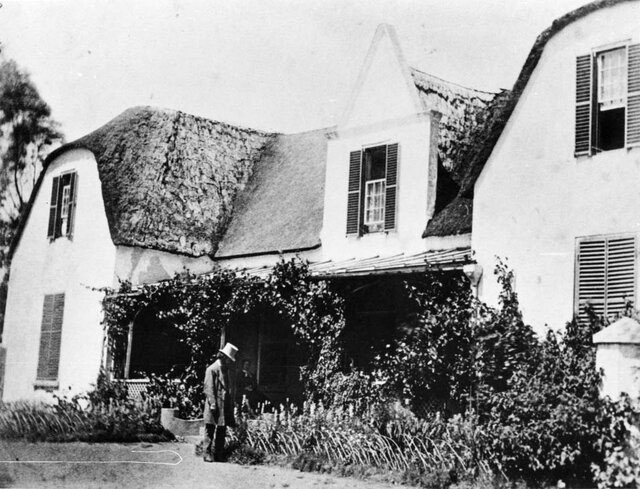
The Hill in Mowbray in the early 1870s when the Bleeks lived there and where many of the ǀXam informants’ interviews occurred.
Informants were interviewed in their home in Mowbray, appropriately called’The Hill’. Some of them lived there for extended periods, also with their families, which helped to stress the Bleek family financially.
According to ǃhanǂkass’o, these words were first uttered by a |Xam man named ǃkuarra kkau after being fatally wounded by a poisoned arrow. He (ǃhanǂkass’o) was moved to remember it when he looked through a window in the Bleek home at Devil’s Peak, part of the Table Mountain range, which was close and clearly visible from Mowbray.
Clearly, as has been noted since, it it reflects a ‘deep emotional and spiritual connection to the landscape, specifically the hills that represent home and belonging to the /Xam people’.
It gained prominence as the title of a 2005 book by the archaeologist Janette Deacon and filmmaker Craig Foster about the history of the /Xam San people in the Northern Cape. This lovely book combines photography of the landscape – often featuring rock art — with narratives about the original inhabitants. Their method was to trace sites mentioned in narrations in the Bleek-Lloyd Collection, most of them located north west of today’s Colesberg.
It must be mentioned that the Breakwater Prison held prisoners from other regions as well. However, this haunting phrase does seem to have a special meaning in respect of Toverview’s hinterland, adding another, deeper layer to the Bailey land ownership story and it’s inhabitants’ attachment to land.
FEATURED IMAGE: Lion and giraffe — a story told by the | Xam informant ǁKabbo (Jantje), as recorded in one of Lucy Lloyd’s notebooks, dated 18 May 1871. (Wikipedia)
Thanks, interesting to see reference to the Pienaar and Barnes Webb families … the Bleek and lloyd collection and some Bushman history today, Human Rights Day … very special!
Very interesting. Thank you
So enjoyed this, Maeder
Fascinating piece. Thanks.
Suggest in future Toverberg isues : Extracts of ‘the landscape’ of the writer’s period. As with info from the past concerning ‘travel/routes/travelling’ , details of the veld, wild game, peoples there, climate – would be illuminating. Thanks ( in hope)! – Marguerite