
By Destine Nde
On 27 April 1994, nearly 20 million South Africans voted in the country’s first inclusive elections, with blacks and whites lining up side by side to put the country on a different path. The election marked the end of centuries of colonial and apartheid rule. For 32 years now, this date has been celebrated as Freedom Day.
It as a historic moment, not only for South Africa but the entire world. At that time we only had black and white TVs in Cameroon, and the only broadcaster was the Cameroon Radio and Television network (CRTV). Its programs started at 7 pm, and only the most popular events were covered.
In 1994, it was the FIFA World Cup in the US and the South African elections. I can still remember the excitement before the elections, and the euphoria thereafter. We saw Nelson Mandela not only as a hero but a god, a freedom, human rights and justice champion. Songs by Brenda Fassie, Miriam Makeba and Hugh Masekela were the radio favourites. Denzel Washington’s Cry Freedom and Whoopi Goldberg’s Serafina were the most watched movies.
South Africa instantly became a star of Africa, a beacon of hope, not unlike the American Dream. Even when, after graduating from university, my father asked me to pick a good institution anywhere in the world to further my studies, I unhesitatingly chose UCT. That was in 2009, and South Africa was set to host the FIFA World Cup in 2010—another milestone for Africa. I just couldn’t wait.
But much has changed since then. In the three decades since the, those rapturous emotions have dwindled, and people no long feel the same way about that special date. As such, it is hardly shocking that a headline in The Star has read as follows: ‘Is Freedom Day still worth celebrating for South Africa’s majority?’
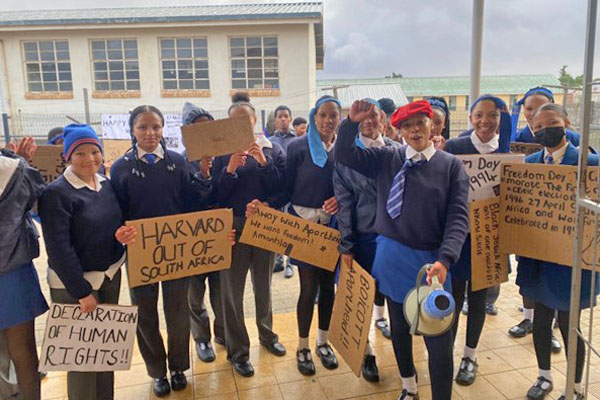
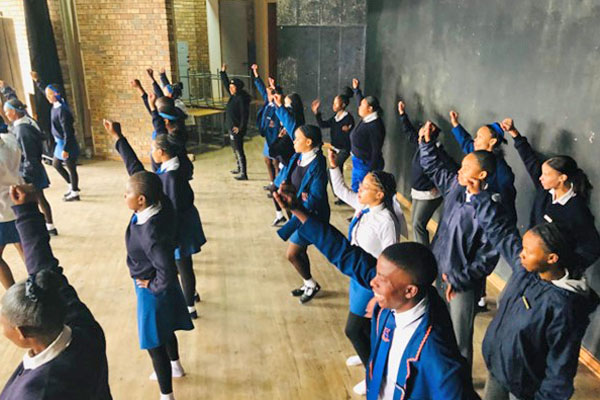
Even at the government’s commemoration of Freedom Day, which took place in in the Dr Rantlai Petrus Molemela Stadium in Bloemfontein, the seats were embarrassingly empty – especially ironic given that the ANC was founded there in 1912. The same was the case everywhere else: underwhelming attendance, no celebrations at all — or, worse still, anti-Freedom Day rallies. In Willowmore only secondary school learners celebrated Freedom Day.
Predictably, in his Freedom Day address in Bloemfontein, President Cyril Ramaphosa said that, while challenges remained, there was a great deal to celebrate, and South Africa had made significant progress towards realising the freedoms enshrined in the constitution.
Focusing his analysis of rights and freedoms on the constitution, Ramaphosa said that, resulting from a long and arduous struggle, the constitution became South Africa’s ‘birth certificate as a nation’, containing a ‘powerful promise about freedom’. He went on to say ‘Our constitution has ensured that freedom is not a slogan but a lived reality.’
The previous day, on Sunday 26 April, the Afrika Mayibuye Movement, led by Floyd Shivambu, hosted a community meeting in Soweto to campaign against the Freedom Day celebrations. The theme of the meeting was ‘No Freedom Day’, on the grounds that no ‘true freedom for the majority’ had yet been achieved.
In the same vein, Herman Mashaba, the leader of Action SA, declared that Freedom Day provided an opportunity to review the country with an ‘open and objective mind’ … ‘As we observe this significant day, it would be remiss not to ask: are majority of South Africans in a position to celebrate this day, the 27th April 2026, under the current living conditions?
‘Freedom, is understood as self-determination, dignity, and opportunity. What then, do we refer to as the democratic dividend of freedom for law-abiding South Africans when they become victims of failing systems? What kind of freedom is it when young people cannot find work, when businesses are suffocated by corruption and inefficiency, and when basic services like electricity and water are unreliable? This is not the freedom South Africans voted for in 1994.
‘The reality is that South Africa is not a free society in any meaningful sense if its people are trapped in poverty, are unsafe in their communities, and unable to access opportunity for upward mobility.
‘True freedom requires more than elections. It requires a capable, ethical government that delivers jobs, protects citizens, and upholds the rule of law. Until then, Freedom Day risks becoming a symbolic ritual rather than a lived reality.’
Despite these conflicting perceptions and contestations, there is no doubt that – as noted by Ramaphosa — the adoption of the new constitution, inclusive of extensive political, economic and social rights, was a major step forward, resulting from a long and arduous struggle for freedom by generations of South Africans.
But many aspects of freedom remain unclear: For instance, what is the essence of freedom? What is its political, economic, social and religious significance? Has the country made real progress towards the vision of South African society embodied in the constitution? Or have these formal rights been a façade behind which the lives of most of its citizns have actually deteriorated?
In short, has the model of freedom adopted in 1994 failed? And when do we actually celebrate with Freedom Day – freedoms achieved, or freedoms as yet unachieved? These issues require deep and rigorous reflection. This, I think, is how Freedom Month should be spent.
In my view, freedom, in essence, is absolute self-responsibility within the ambit of the law. Some see laws as restrictions, impinging on their freedom, and hence wrongfully believe that to be free means being able to do whatever one wants. But freedom in any society can only exist inside the parameters of the laws governing that society. That is why, fittingly, this year’s Freedom Day theme was ‘Freedom and the Rule of Law’.
But what is the scope and significance of True Freedom? Does freedom signify only the release from chains? Does it signify only the right to vote? Does it signify only financial security? Does it signify only the right to worship or socialise with anyone? Or does it signify the sum of all the above, and hence will cease to be freedom if any were lacking?
If freedom comprises all of the above, as many Unfreedom Day activists are saying, the majority of South Africans are clearly not free —- or, as Mashaba put it, ‘South Africa is not a free society in any meaningful sense if its people are trapped in poverty, are unsafe in their communities, and unable to access opportunity for upward mobility’.
Certainly, many South Africans are becoming increasingly frustrated and impatient. According to them, three decades is long enough for these goals to have been achieved. Poor policy-making, poor governance and a lack of accountability are cited as the major reasons.
To take just one example, have BEE and Affirmative Action really taken the country forwaqrd, or from one extreme (white empowerment) to another (Black Empowerment)? Jobs and tenders are no longer secured on the grounds of merit, but on the grounds of race. According to many analysts, this has worked to reduce levels of competence in the public as well as private sectors, undermining service delivery as well as economic growth.
At the same time, as spelled out by Moeletsi Mbeki in his book Architects of Poverty, BEE has created a small black elite living grotesquely ostentatious lifestyles which are resented by many others as the antithesis of what this policy was meant to accomplish.
In his keynote speech, Ramaphosa also mentioned that, last year, the country recorded its highest matric pass rate in history. But was it that high because education has improved or because the standards have been dropped even lower?
As early as 1955, the Freedom Charter, adopted by the Congress of the People at its historic meeting in Kliptown, declared: ‘There shall be houses, security and comfort. All people shall have the right to live where they choose, be decently settled, and to bring up their families in comfort and security. … Rest, leisure and recreation shall be the right of all. Fenced locations and ghettos shall be abolished.’
This was carried forward in section 26 of the 1996 Constitution, which states that: ‘(1)Everyone has the right to have access to adequate housing, (2) the state must take reasonable legislative and other measures, within its available resources, to achieve the progressive realisation of this right.’
Yet statistics show that homelessness has increased massively, surpassing by far the overall increase in the population. This brings us back to the perennial question: when will true freedom be finally achieved for all South Africans?
IMAGES: Freedom Day celebrations at the Willowmore High School. (Supplied by the author.)