
By Destine Nde
The US-Israeli ‘war’ on Iran has wreaked havoc with global fuel markets, and South Africa has not escaped the consequences, which have reached even into the smallest towns in the Karoo.
Over the past three months, from March to May, fuel prices have jumped massively, from R18,60 a litre to R26.63 for petrol, and R20,30 to R31.17 a litre for diesel. (These are inland prices – the coastal prices are a bit less.) Despite the constantly fluctuating international oil prices, as well as the value of the rand, these prices will remain the same for a month, until early June.
This painful increase, which will drive up prices through the entire economy, has once again focused attention on the complex dynamics of the international oil market, and its implications for South Africa. Once again, we are forced to ask: how are international prices determined? What has driven this huge price increase? How are our monthly fuel prices determined? And what does all of this mean for the future?
The fuel price in South Africa is made up as follows:
Base costs (just over 70 percent): the basic fuel cost, transport, wholesale and storage, secondary distribution, and retail margins.
Taxes and levies (just under 30 per cent): the General Fuel Levy, Road Accident Fund, Carbon Tax, and Customs Duty.
Of these, the basic fuel cost – essentially the landed price of petroleum products – is by far the largest component, making up almost 50 per cent of the total price at the pumps.
The price South Africa pays for crude oil on the international market changes constantly, for two main reasons. First, the international oil price fluctuates constantly, depending on supply and demand as well as speculation. It is not set monthly, or annually, but is determined on a daily basis on global trading platforms like the Intercontinental Exchange (ICE). If you check it ten times a day, you would probably find ten different figures. It is a live market that is always active, seven days a week.
Added to this, the international value of the rand also fluctuates daily, depending on the global foreign exchange (forex) market. In order to flatten out these fluctuations, and keep the prices that consumers pay at the pumps constant for at least a month, the Department of Mineral Resources and Energy (DMRE ) — in partnership with the National Treasury — sets the price of fuel on a monthly basis. This is done on the first Wednesday of each month, using a model known as the Self-Adjusting Slate Levy Mechanism, or Fuel Slate Levy.
In terms of this model, the price of fuel is based on the average international oil price the previous month. Of course, no one can tell whether the actual price in the current month will rise or fall. If it rises, the government will pay the extra amount to international suppliers. If it falls, it will retain the excess. Thus, at the end of each month, the Slate Levy will reveal whether the government undercharged or overcharged consumers in that month.
If consumers were overcharged, the excess will be carried over to the next month, and the price of fuel will drop. If, on the other hand, consumers were undercharged, the extra amount the government spent on their behalf will also be carried over, and fuel prices will rise.
The sums of money involved are massive – reportedly, the combined petrol and diesel slate balances at the end of March amounted to a deficit of R14.173 billion, resulting in commensurate increases in the slate levy for April.
Like most other countries, South Africa adds taxes and levies to the basic fuel price. The two main taxes paid on every litre of fuel are the General Fuel Levy and the Road Accident Fund levy. These levies – plus Carbon Tax — were increased in the February national budget, before the oil crisis began.
In March, international oil prices shot up because of the US-Iran War, with Brent Crude jumping from $69/barrel in early March to more than $115. Inevitably, this had a massive impact on the basic fuel cost, with far-reaching implications for consumers and the South African economy. while everyone is affected, members of rural communities – given the distances they need to travel, and the lack of public transport – are particularly hard hit.
The government has tried to soften the blow by temporarily reducing the General Fuel Levy, thereby significantly reducing the fuel increases, but this will end in early June, and the reductions will then have to be recouped. As a result, the AA and others have warned that prices will continue to rise, also due to continued Middle East tensions and a weak rand.
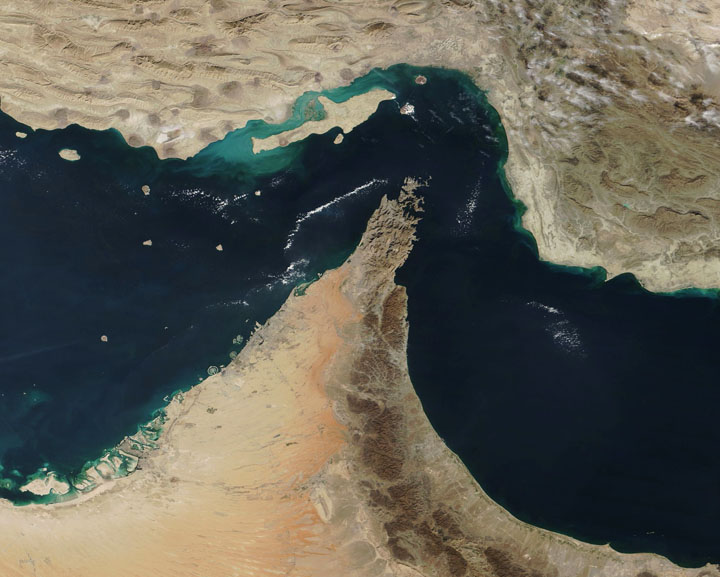
The barren Musandam Peninsula juts into the Strait of Hormuz, the narrow waterway between Iran and Oman and the United Arab Emirates, where the waters from the Gulf of Oman enter the Persian Gulf. A remarkable true-colour image taken by the Moderate Resolution Imaging Spectroradiometer (MODIS) on NASA’s Terra satellite on 6 December 2018. (Wikipedia Commons)
The main cause of the global oil price crisis has been the war between the US-Israel and Iran, leading to the closure of the Strait of Hormuz – a narrow channel between the Persian Gulf and the Gulf of Oman, which carries roughly a quarter of global oil flows. Despite attempted ceasefires, the outcome of the conflict remains unclear, and at the time of writing the Strait effectively remained closed.
The effect on the global economy has been far-reaching, and the outcome is uncertain. The head of the International Energy Agency has warned that the world is losing 14 million barrels of oil a day because of the war, and ramping up production after the conflict would be gradual.
A new variable has emerged in the form of the withdrawal of the United Arab Emirates (UAE) from the Organisation of Petroleum Exporting Countries (OPEC). OPEC was founded in 1960, mainly by Arab oil producing countries, in order to exercise greater control over global oil prices. It does so mainly by controlling the supply of oil.
The UEA was the third largest oil producer in OPEC. It felt OPEC’s production quotas were holding back its ability to expand output, and the move would enable it to decide independently how much oil it produced and sold. Spokespersons were quoted as saying that the UAE had the capacity to increase its output by about 1million barrels per day.
It also has an alternative export route besides that of Hormuz—the port of Fujairah on the country’s east coast. So the UAE’s withdrawal from OPEC could help to stabilise the global oil market, thereby working to stabilise prices. However, some analysts say its withdrawal from OPEC could backfire, increasing geopolitical tensions and raising the risk of an adverse price war instead.
Ultimately, the current crisis underlines the fact that the longer-term global challenge is not to improve the workings of the oil market, but to reduce reliance on fossil fuels, and seek alternative forms of energy. This includes the use of electrically powered vehicles, or EVs.
Here again, differences between developed and developing or underdeveloped economies come into play. According to the European Federation for Transport and Environment, sales of Battery Operated Venicles (BEVs) in Europe are reaching a ‘tipping point’, and are on track to reach the goal of price parity with combustion vehicles by 2030. Large BEVs have already reached price parity, and small and medium size vehicles would reach it by 2030.
This trend is driven by the European Union’s regulations for limiting carbon emissions – but there is no such mechanism in South Africa or most other developing countries, and the conditions are very different.
While sales of EVs are increasing, South Africa lags behind global adoption, with EVs making up only 1,45% of new vehicle sales in 2023 compared to more than 20% globally. One of the biggest obstacles to growth is the country’s fragile electricity grid. Another is affordability, and yet another is sheer distance.
Somehow, it remains difficult to envisage EVs becoming practical options for most members of largely poor rural communities in South Africa’s vast interior. In the meantime, they will remain exposed to the consequences of geopolitical events over which they have no control.
The photo looks like the filling station in central Willowmore?