
By Destine Nde
The severe storms in recent months have wreaked havoc in the Eastern Cape. It started on 5 May, when torrential rains began to fall and continued for almost two weeks. The devastation in the Baviaanskloof was massive. Roads were washed away for kilometres, leaving trenches of two to three metres deep. Whole valleys were flooded, some homes were ripped apart, and trees were uprooted. Some 200 households were trapped: no one could enter or exit part of the kloof. They had no food, no power and no cell network. Eventually, the government declared a national disaster.
All of this happened at a time when Baviaanskloof tourism was doing extremely well. Baviaanskloof — the longest wilderness area in South Africa — is a World Heritage Site, renowned for its biodiversity, vast wildernesses, virgin nature reserves, majestic mountains and lush valleys. These features provide its spectacular scenery, while its canyons, gorges, and meandering passes turn it into one of Africa’s greatest adventure destinations. For instance, people now come from far and wide to participate in the annual Trans-Baviaans Mountain Bicycle Race.
The Interpretive and Visitor Information Centre
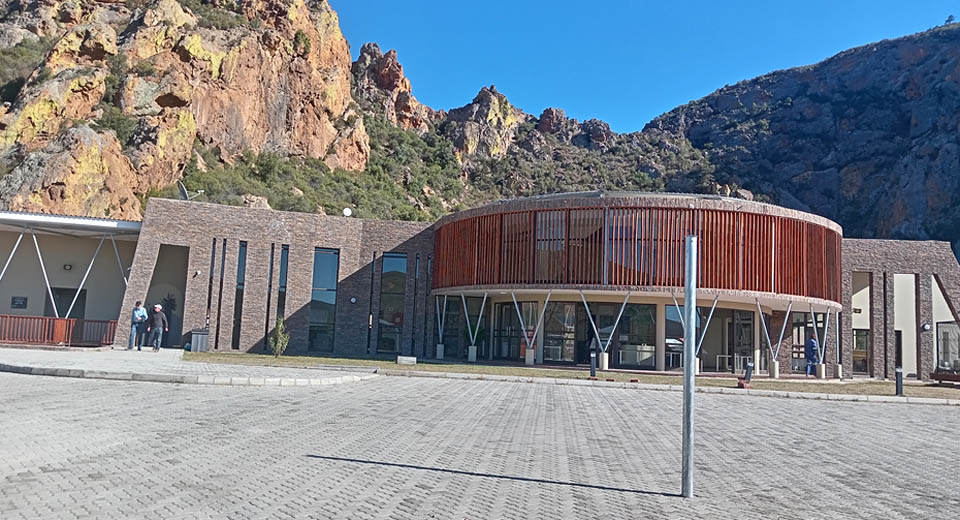
In 2022, the Eastern Cape Parks & Tourism Agency (EPTA) opened a magnificent new structure – The Baviaans Interpretive and Visitor Information Centre — at the Nuwerus entrance to the Baviaanskloof. Funded by the European Union to the tune of R57-million, it comprised a modern information centre, a conference room, an array of interpretive and immersive virtual tour platforms, an admininstrative office, a kitchen and cafeteria, ablution facilities, a parking area, and a covered terrace. Some hikers’ huts were also upgraded. The Deputy Minister of Tourism, Fish Mahlalela, officially handed the facility to the provincial department on 3 March 2022.
But the EPTA could not sustain the facility, so in 2025 the Centre was leased to private owners – two brothers with active tourism enterprises in the area. The name of the partnership is GO! Baviaans. Before this deal they already owned the Canyon Trail, and offered accommodation at their privately owned facility of Ceder Falls, while also promoting other Baviaanskloof trails.
Since taking over in 2025, GO! Baviaans has revamped Baviaanskloof tourism into a multi-million rand per month business. They have erected five new camps in far-flung corners of the kloof: Cedar Camp (Camp 1), Kudu Camp (Camp 2), Savannah Camp (Camp 3), Canyon Camp (Camp 4), and Base Camp (Camp 5). The latter is situated behind the Centre, which still serves as a reception facility. They have also added a new Leopard Trail to the Canyon Trail.
Their operation functions as follows. A group of tourists (maximum of 16) arrives at the Reception Centre to book in and receive instructions — for example, how to identify a leopard’s footprints, determine its trail, and what to do if it attacks. Over the next five days, they hike from one camp to the other, overnighting in a new camp every day, and finishing up again at Base Camp on Day Five. Support teams transport their luggage and other necessities from camp to camp, so they are not burdened by heavy backpacks.
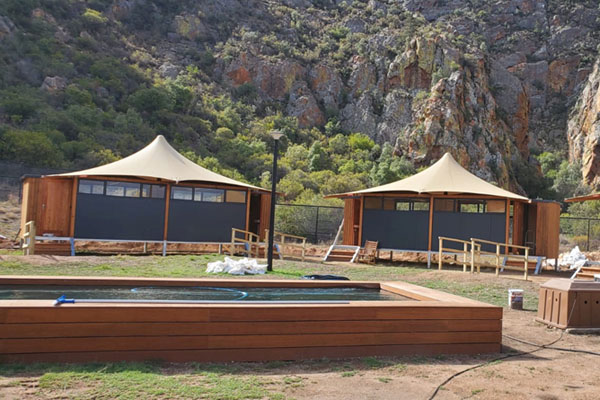
Two sleeping huts and a swimming pool in one of five camps on the Baviaans Canyon Trail.
The camps are beautiful. Each camp houses three identical sleeping huts, a large, fully equipped kitchen, an outdoor shower, and a swimming pool. The huts are made of wood, steel and glass, and roofed with tents. The furniture, fittings and equipment are all high quality.
My family and I recently spent a night in the camp behind the Centre. Spending a night in the Kloof is like spending a night in the jungle. Instead of voices, music, vehicles and machinery, all one hears are the sounds of insects and animals, the wind, the rain, and rustling leaves. The camps offer fresh air, starry nights, and incredible sunrises and sunsets. The only intruders or robbers to repel are baboons. Actually, Baviaanskloof is Dutch for ‘Baboon Canyon’. One morning, at the Centre, we woke up to a shocking sight – a troop of baboons had sneaked in and wreaked havoc in the kitchen.
Recovery efforts and fundraising campaign
The damaged roads have affected Baviaanskloof tourism very badly. They were bad to begin with, passable with four-wheel-drive vehicles only. Since the floods, they are far worse. In some areas, roads have turned into rivers.
A tourist recently wrote the following on Facebook: ‘We decided to go camping in the Baviaanskloof to see what was left after the devastating floods…. We spent a beautiful first night at Doornkloof, with light rains falling around us — we were the first campers to stay there after the floods. The next day we headed towards the nature reserve gate, but it was impossible to reach. The road had simply disappeared. We then turned back towards Willowmore.’
The local community has started a fundraising campaign to assist with emergency relief and recovery efforts. Some alternative roads have already been created, and residents have received food parcels and medication. Donatioins can be made to Baviaanskloof Flood Relief on the Backabuddy website.
Go! Baviaans is investing heavily in solar energy. Before the floods, all the camps were powered by solar, except the Centre. During the power outage they were spending up to R8000 a day on diesel to run their massive generator. Now they are going completely off-grid.
A reminder
This train of events has highlighted the need to strengthen climate resilience, including disaster preparedness, and work towards a healthier, greener and more sustainable planet.
There is little doubt that climate change is intensifying. Indeed, in June, climate prediction scientists announced that Africa should prepare for a ‘super El Nino’ — a cycle that happens every two to seven years, when the surface of the Pacific Ocean becomes unusually warm. It can alter weather patterns worldwide, often leading to extreme droughts, floods, and heatwaves, causing widespread food shortages.
Warnings were issued before the rain and floods, but communities were still ill-prepared for the consequences. To be honest, I think the reintroduction of donkey carts should be considered.
FEATURED IMAGE: The Centre at the entrance to the Baviaanskloof. Photographs: the author.