
If nothing else, the recent unemployment statistics affirm, at least in the general perception, that the government – even in its current configuration – is way out of its depth when it comes to meaningful and sustainable job creation. With unemployment hovering at more than 30 percent for the past six years, the powers that be seem woefully incapable of stemming the jobs bloodbath, let alone positively reversing them back to more acceptable levels.
When, earlier this week, StatsSA released the latest Quarterly Labour Force Survey (QLFS) data for the second quarter of 2026, it dealt the country a familiar blow. Some 345 000 people had lost their jobs, taking the number of unemployed to a staggering 8.5 million, and bringing the official unemployment rate up to 33.6 per cent. And this is on the narrow definition, namely active jobseekers only. Put differently, it means that one in three adults capable of working are actively seeking work.
When one includes discouraged job-seekers, underemployed workers and potential workers – the broad definition – the number rises even further. ‘When these are included, ‘the composite underutilisation rate reaches 46,3%, meaning that nearly half of South Africa’s extended labour force is not fully employed.’
In the same period, the labour force increased by 329 000 – new entrants whom the market simply could not absorb – and unemployment and time-related underemployment increased to 36.6%.
As has consistently been the pattern for at least the past five years, youths are the most affected, with the jobless between the ages of 15-34 rising by 1.5 percentage points to 47.4 per cent. More than anything, this figure doesn’t point to a ‘cyclical dip’ but to an ‘entrenched structural failure in job creation’. The economic sectors in which much of the jobs bloodbath occurred were community and social services, mining, agriculture and manufacturing.
It could be argued that a government’s single most important challenge — and the single most important benchmark of success — is to ensure that the majority of its citizens have productive work. So the situation certainly does not augur well for those currently in power, who who will soon be asking voters to support them once again in the upcoming local government elections.
In an attempt to ameliorate the situation, the government has created various public employment programmes, including the Expanded Public Works Programme (EPWP), the Community Work Programme (CWP), and the Presidential Youth Employment Intervention. These are billed as an ‘income safety net and a pathway to valuable work experience that supports post-programme employability’ as well as ‘addressing poverty through structured, community-based engagements’ on the state’s communications platforms. But in reality they are little more than stop-gaps, which cannot make up for the lack of proper jobs.
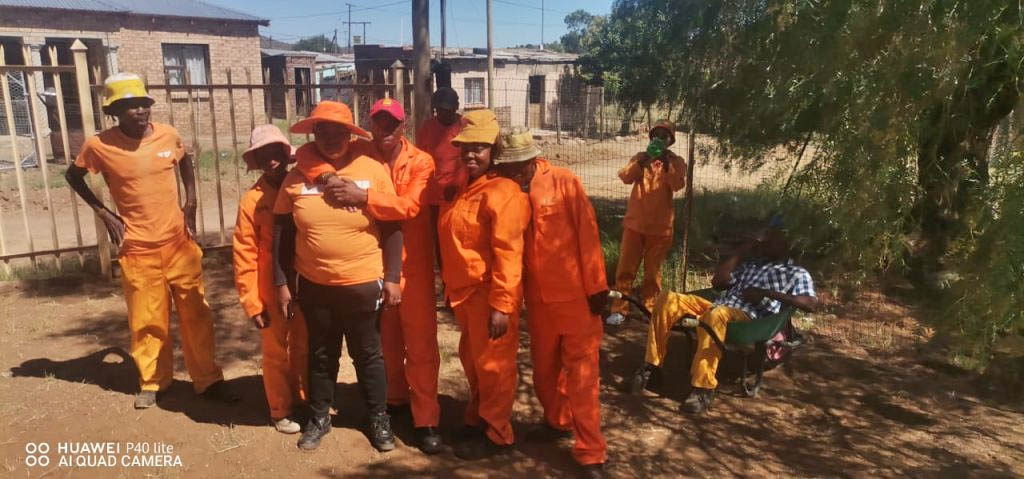
Introduced as far back as 2010, and administered by the Department of Cooperative and Traditional Affairs, the Community Works Programme is described as an ‘innovative offering from the government to provide a job safety net for unemployed people of working age … and a bridging opportunity for unemployed youths and others who are actively looking for employment opportunities’. It currently ‘employs’ some 200 000 people.
But the flowery language does not match the grim experiences on the ground. The wages (around R1200 a month) may be a buffer against poverty and hunger, but beyond buying some groceries and keeping the lights on, they do little else for these workers.
They are certainly not a permanent gateway out of poverty, especially for workers with families to support, and they certainly don’t absolve the government from its responsibility to ensure that its citizens are permanently and productively employed.
The same is true of the swathes of graduate internship programmes — they are more for the optics, namely to create the illusion of employment, and to keep those who are fresh out of varsity hopeful and optimistic. A quick Google search should show you that some of these programmes are yet another trough for feeding the politically connected.
According to the government, they are meant to provide interns with practical work experience, thereby preparing them for the job market. But in practice, interns remain jobless when the contracts expire, only to see the same internships carried out with new recruits. Put differently, they really are preparing ‘interns’ for jobs that don’t exist.
With the local government elections due in a few months’ time, job creation – or perceptions of who will be capable of creating them or not — may be where much of the battle for power and electoral support will be won or lost.
With the latest figures showing that the Western Cape has the lowest rates of unemployment in the country, the DA will no doubt be drawing on this for future electioneering mileage. The argument goes that good governance attracts capital and investment which in turn leads to infrastructural development and job creation. Thus the massive disparity between the Western Cape’s relatively low unemployment levels and the Eastern Cape’s staggering numbers.
The rallying cry in the days preceding democracy, right up until now, has been to ensure ‘dignified’ work for ‘our people’. This slogan was a firm favourite among politicians and trade unionists alike. Yet in the midst of glaring government failures, widespread corruption, unmitigated incompetence and a fractured, toothless labour movement, that entire schtik rings hollow.
If anything, the unemployment statistics serve to illustrate the gap between rhetoric and reality. For now, it seems that the guys who are able to put together persuasive campaigns around growth and jobs may be serious contenders come 4 November.
Featured image: Community Work Programme workers in Colesberg. Source: eParkeni.
Simple answer to the problem – reduce red tape, multitudinous regulation, do away with current form of BBBEE, open up mining licence acquisition and exploration, restore the rail network (follow China example of high speed access to ALL regions of the country – passenger and freight), privatise to a greater degree all state owned enterprises and insist that regional and local government only employ suitably qualified people for essential services, extinguish the power of SADTU over the education system, provide schools with libraries and fill them with actual books, get rid of unnecessary crony filled ‘management’ levels. A bit of a chaos may initially be the result but investment, growth and employment will surely follow.