
By Destine Nde
It is said the road to perdition is marked by good intentions, alluring milestones and exciting prospects. At first, this seemed to be the case with Artificial Intelligence (AI), especially when OpenAI launched ChatGTP on 30 November 2022. It was hailed as the saviour of humankind, a resource that would solve most, if not all, of our daunting problems. Its inventors and promoters promised that its efficiency, serviceability and convenience would enable us to realise a sort of utopia on earth.
But we have passed that stage, of introduction and excitement. We are now living in an era in which if something is not done entirely by AI, it plays some kind of a role. Nobody can deny that AI is making the most arduous of activities easier and more convenient to undertake than ever before.
AI is imposing itself on everything and, more alarmingly, is threatening to seize the driving seat from humans. It is reshaping the fundamental processes of thought and action: a digital renaissance. In such a time, it is not only necessary but prudent to look back at the promises, and then at what is happening presently, to see whether AI is actually leading us to utopia or not.
When I did so, I was shocked by the many threats which AI poses to the survial of the earth as well as humankind. It is attracting growing scrutiny not only for its voracious energy demands but also for its ethical, socio-economic and political shortcomings. In fact, researchers have raised so many red flags that this has got me thinking: Is AI really our friend or foe?
Energy crises
The world has been tackling energy crises for decades. Crude oil is still the leading global energy source, but fossil deposits are depleting rapidly. Stakeholders have long since been searching for alternative sources, renewable and cleaner energies than those derived from crude oil. Electricity seems to be the next best option. However, AI bases are already proving to be its largest consumers, with an insatiable thirst for water.
The UN has estimated that by 2030, AI could consume some 3 per cent of the worlds’s energy, and consume more water for cooling than the water drunk by the global global population. And if AI becomes more efficient and affordable, its users, instead of falling, would increase tremendously, skyrocketing its electricity and water consumption.
ChatGPT, for example, reached more than 1.5 billion visits just four months after launching; and in two years’ time it has amassed more than 300 million weekly users who send roughly one billion messages to the chatbot daily.
Climate change
Given the above, it is projected that offsetting AI’s carbon footprint would req require 6.7 billion trees to be grown over ten years. AI is a notorious energy consumer, which is bad for the environment: indeed, one query to ChatGPT uses about as much electricity as one light bulb for 20 minutes.
Kate Saenko, a computer scientist at Boston University, started an article titled ‘The carbon footprint of ChatGPT and its cousins’ ads follows: ‘Generative Ai is the hot new technology…. But how hot is it making the planet? He goes on to explain that ‘the more powerful the AI, the more energy it takes. So what does the emergence of increasingly more powerful generative AI models mean for society’s future carbon footprint?’
It is estimated that creating the GPT-3, for instance, consumed 1 287 megawatts hours of electricity and generated 552 tons of carbon dioxide equivalent, the equivalent of 123 gasoline-powered passenger vehicles driven for one year. And that is just getting the model ready to launch, before any consumer starts using it. And it must be updated regularly. OpenAI has already launched GPT-4.
Automation
With AI, humankind risks losing artistic originality and creativity. The passion, the imagination, the persistence and sacrifice which have consistently uplifted us over the ages may become obsolete.
AI threatens to destroy the very rudiments of human ingenuity, the seed of fecundity and the driver of innovation. There are many forms of physical enjoyment, including playing, feasting, resting, sleeping, and so on. But Art (music, paintings, literature and drama) is the only source from which mental and spiritual satisfaction can be derived.
Thus relinquishing Art to AI is tantamount to losing specifically that which makes humans superior to animals. Thought, speech and creativity together constitute the crown that allows us to rule the world. In effect, AI is capable of sacrificing its creators on the altar of materialism, like Dr Faust and Mephistopheles.
The crime novelist Jerry Falade recently lost a book deal worth more than $2 million. Reportedly, his own literary agents said they could ‘no longer faithfully determine how his manuscript had come together’. Hence the EU is now demanding that all AI-generated content is labelled or watermarked.
Reliability
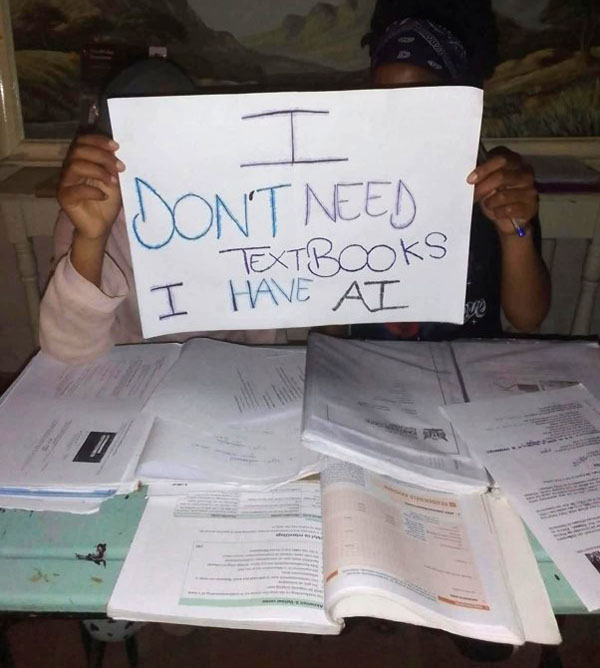
The various models of AI are now the go-to place for facts. Yes, it is quicker and far more convenient than traditional methods: search engines, textbooks and teachers. But is it reliable? My experience says the answer is no. I seldom ask AI questions about subjects I know nothing about. Then I can easily tell whether the results are correct or incorrect. Otherwise I would have been misled many times.

A screenshot of AI’s incorrect result.
Even the latest AI detection software is far from perfect, and can worsen existing biases. A 2023 Stanford University study found that seven popular AI detectors falsely identified an average of 61 per cent of essays written by non-native English speakers as AI-generated, with one flagging 97 per cent of them’.
Researchers at the University of British Columbia have argued that AI is highly biased with regard to environmental challenges. ‘AIs are programmed to obscuring reality by ignoring marginalised communities and watering down the dangers of climate change and making them seem less urgent’, they wrote. Therefore, AI users receiving these responses uncritically risk drawing misleading conclusions.
The biases are indeed systematic. In the US, the leading HR software company Workaday is facing a lawsuit over its use of job screening tools powered by AI which allegedly discriminates against applicants based on factors such as age, disability and race — one of many examples of AI systems alleged to have caused discriminatory harm by replicating and amplifying inequalities.
in an article titled ‘AI bias isn’t just an error in the algorithm. It’s a chain of human decisions’, the researchers Muneera Bano and Didar Zowghi note: ‘AI systems quietly narrow who gets seen as competent, employable or fit to lead … which widens global inequality’. This is appalling because AI is increasingly gaining influence over private and public operations.
Unemployment, especially in Third World countries, is making life unbearable, yet AI machines are increasingly replacing humans in labour markets. Script writers in Hollywood, for example, were outraged when ChatGPT made most of them jobless, so they took to the streets in protest.
Legal claims
The Founders of MetaAI, for example, are being prosecuted by a bipartisan coalition of state attorneys general in the US for multiple charges against Facebook and Instagram. According to the technology and law scholar Carolina Rossini, claimants have argued that ‘Meta deliberately designed Facebook and Instagram to hook children into using its apps, misled the public about the harm, and improperly collected data from children under 13’.
Meta has already agreed to pay US$17billion over 10 years to settle the claims, which obliges it to make fundamental changes to the platforms – or else, ‘penalties could reach hundreds of billions of dollars’, because other states are suing, and thousands of individual claims are pending.
Various social media companies are in the same crucible for introducing features which ‘exploit the vulnerabilities associated with adolescent development and maximises engagement’. Indeed, the lawyer representing California carved out his whole argument against Meta with four cutting words: they hook’ users, ‘hold’ them, ‘harvest’ their data and ‘hide’ the harm.
I could continue, but I think the foregoing is enough to make my point, namely that the costs of AI threaten to drown its practical advantages.
However, this does not mean that AI should be abandoned. Rather, awareness about its threats should be raised pervasively, so that policy-makers and users can make well-advised decisions. In a digital world, digital awareness — and literacy — is non-negotiable. As Amanda Turnbull of the University of Waikato has put it, two main forces shape AI’s operational footprint, namely: ‘How much we use it, and how we use it’.