
By Destine Nde
On 4 November, 12 candidates will present themselves for election in 12 wards in the Beyers Naudé Local Municipality, and 12 more will added from party lists. The question voters should ask all candidates – and all candidates should ask themselves – is to what extent they are willing and able to implement the values and principles of the person whom the municipality is named after, namely the Reverend Beyers (Oom Bey) Naudé.
But let’s start at the beginning. In 2015 the South African Municipal Demarcation Board decided to merge the Eastern Cape local municipalities of Camdeboo, Ikwezi and Baviaans into the Dr Beyers Naude Local Municipality. Both the municipality and the name are national treasures.
The municipality
The new municipality began to function on 3 August 2016. It is now the third biggest local municipality in the country, stretching over some 28 653 square kilometres, and the largest of seven making up the Sarah Baartman District Municipality. Going by the 2022 National Census, it has a population of just over 100 000 people, and is growing at about 2.4 per cent a year.
It encompasses historic towns like Graaff-Reinet, World Heritage Sites like the Baviaanskloof, and important towns like Willowmore.
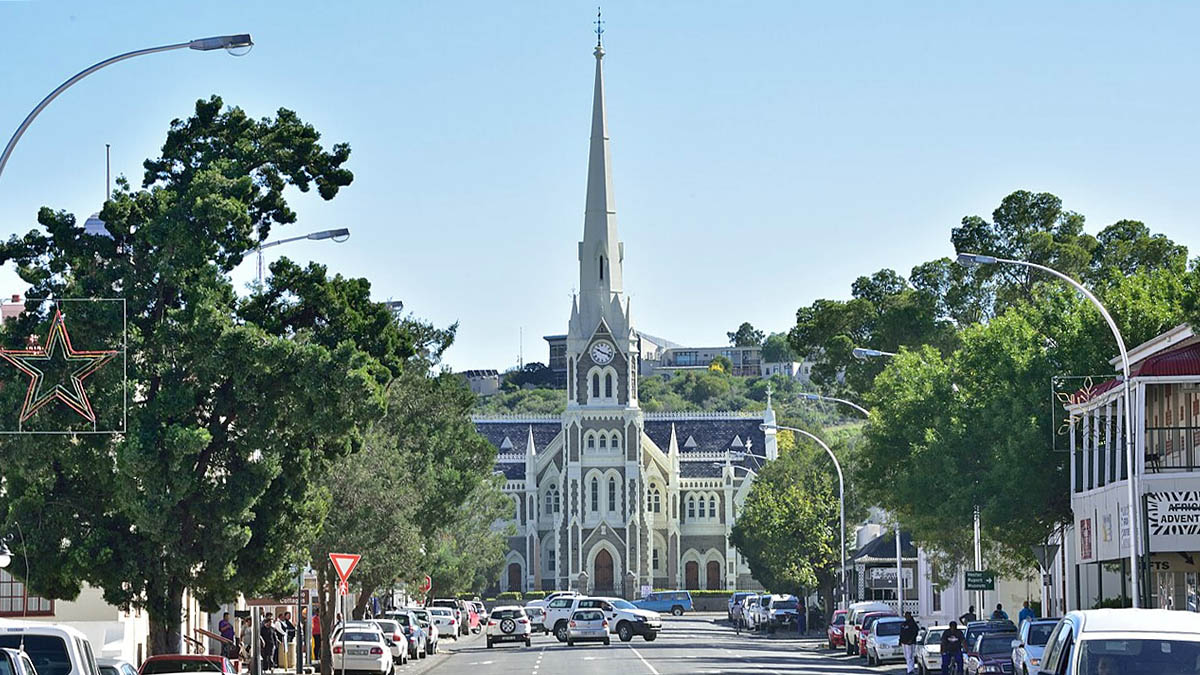
Graaff-Reinet is the largest town in the municipality, and serves as its administrative headquarters. It is the fourth oldest town in South Africa, often referred to as the “Gem of the Karoo”, and the municipality’s most densely populated area.
Besides its many tourist attractions, the Baviaanskloof is the country’s longest wilderness area, and a World Heritage Site. In fact, the ‘Baviaanskloofberge’ are still remembered today as the Boere rebel heartland—a place of refuge for guerrilla commandos where the British forces couldn’t find them.
Willowmore, the Beyers Naudé Municipality’s second biggest town, is a doorway to the Baviaanskloof and has always been South Africa’s biggest mohair producer. It is the home of the world’s number one meat goat, the Boerbok, whose world-wide demand has been growing continuously for decades. The Boerbok Rally is celebrated annually in Willowmore.
Indeed, the Beyers Naudé Municipality is a most strategic one: it is the main portal to the mystical Karoo—a region renowned for its unique natural and rich cultural heritage, with sublime landscapes, pristine natural environments, and diverse peoples and cultures, with various indigenous fauna and flora.
The person behind the name
Christiaan Frederick Beyers Naudé was born in Roodepoort, Transvaal, on 10 May 1915. He was a prominent pastor in the Dutch Reformed Church (DRC). His father, Jozua Naudé, was the founder of the Broederbond , the ultra-conservative Afrikaner secret society that directed apartheid from behind the scenes.
In 1921, Jozua became the minister of the Dutch Reformed congregation in Graaff-Reinet, and remained in this post until his death 27 years later. He also founded an Afrikaans-language high school, where Beyers matriculated in 1931.
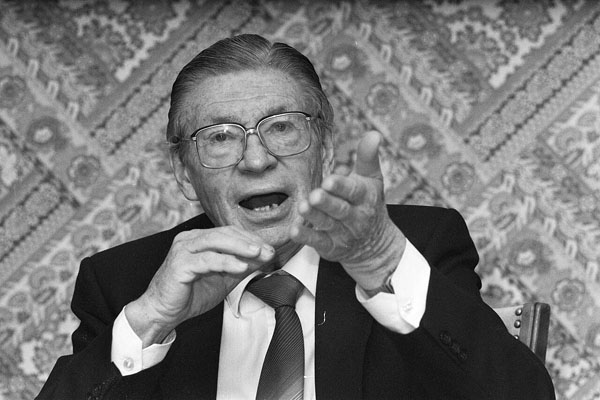
Beyers Naudé addresses a media conference in Amsterdam, 1985. (Wikimedia Commons)
After graduating from the Stellenbosch University in 1939, Beyers became a minister in the Dutch Reformed Church, and the youngest member of the Broederbond. Over the next 20 years he served in several congregations across the country, preaching that apartheid rested on sound religious or theological foundations. Then, after the Sharpeville massacre in 1960 —w hen the South African Police opened fire at a crowd of black protestors, killing 69 and injuring many others — he rejected the DRC’s teachings and left the Broederbond.
After his resignation, he declared: “I made an intensive study of the Bible to prove that those justifications were invalid … In some cases, there was a deliberate distortion to prove the unprovable.’
He then became an enthusiastic activist for equality and racial reconciliation, maintaining that every person was made in the image of God, and that denying the dignity of one denied the dignity of all – which contradicted everything the Broederbond, the National Party and the DRC stood for. In the process, in the eyes of the establishment, he transformed from a hero into a villain. In the eyes of others, he transformed from a villain into a hero.
After the Sharpeville shootings, Naude helped to establish the Cottesloe Consultation (CC) tp mediate between the World Council of Churches (WCC) and some 80 South African Church delegates in Cottesloe, Johannesburg. The CC pressed for the rights of all persons to vote and own land, and for the WCC to provide financial support for liberation movements in southern Africa. Then Prime Minister H.F. Verwoerd repudiated the CC, and asked the DRC to exit the WCC.
Undaunted, in 1963, Naudé founded the Christian Institute (CI) of South Africa — an ecumenical organisation aimed at fostering racial reconciliation, noting that “if blood runs in the streets of South Africa, it will be because the churches have done nothing”.
Soon, black activists like Steve Biko started joining the CI, and the Security Police began to harass Naudé. In 1972 the government started investigating anti-apartheid Christian organisations, and Naudé was imprisoned. In 1973 his passport was withdrawn, in 1977 the CI was silenced, and Naudé was “banned” – a form of house arrest involving various restrictions, including that he could not be in one room with more than one other person. He still managed to help anti-apartheid activists in various ways
After his unbanning in 1985, he succeeded Archbishop Desmond Tutu as secretary general of the South African Council of Churches, and called for the release of Nelson Mandela and others, and for the government to negotiate with the ANC and other liberation movements.
He was the only Afrikaner in the ANC delegation that participated in the historic Groote Schuur talks in 1990. He later signed the Declaration of Commitment by White South Africans— a public document acknowledging that apartheid had inflicted massive social, economic, cultural, and psychological damage on black South Africans.
Naudé died on 7 September 2004 at 89, and was given a state funeral. Nelson Mandela praised him as a “a true humanitarian and a true son of Africa”. He never held any office in the post-apartheid era. Love for humanity and human dignity was his sole motivation. Indeed despite his persecution at the hands of his own, he still said “I’m an Afrikaner”, and never retaliated, or acted in a ny spiteful way.
He received many awards and accolades, including the Reinhold Niebuhr Award for justice and peace in 1974, the Bruno Kreisky Award for services to human rights in 1979, the Franklin Roosevelt Four Freedoms Award in 1984, the African American Institute Award in 1985, the Robert F. Kennedy Human Rights Award in the same year, the Swedish Movement Award in 1988, and in South Africa the Order for Meritorious Service (Gold) in 1997. He also received no less than 14 honorary doctorates from universities in South Africa and abroad.
Today streets, squares, buildings, organisations and a municipality are named after him. There is a Dr Beyers Naudé High School in Soweto, and a Dr Beyers Naudé Gymnasium in the Netherlands.
In the Confessions of a Christian Humanist (2006), fellow Calvinist theologian Prof John de Gruchy wrote that Beyers was ‘South Africa’s Bonhoeffer’; and compared him with John Calvin as a ‘true church reformer’, stating that his defining mark was ‘solidarity with the Other’—thereby choosing the side of victims over his own people.
He had shocked the Broederbond by declaring that apartheid ‘a false gospel, a false ideology’, and embarrassed his brethren by calling on Christians worldwide to ‘reject’ the DRC’s teachings ‘unequivocally’. Beyers was a typical Christian because unlike others, he stood with the oppressed instead of escaping into piety: ‘One cannot truly love God without loving all humankind’.
De Gruchy also edited Resistance and Hope: South African Essays in honour of Beyers Naude (1985).
An ongoing legacy
Given the foregoing, in the the run-up to the elections, the question facing the present mayor, Councillor Willem Safers, other councillors seeking re-election, and all other candidates and parties is as follows: To what extent has this municipality realised the sorts of values that Beyers stood for, and the principles he lived by? What is his local heritage, beyond the mere name? And what will they do to honour his legacy in the future?
To serve on the council as well as the executive in this municipaity means you are – or should be – a custodian of Beyers’s values, not just as empty words but in terms of translating them into real improvements in the lives of residents.
Honouring our heroes demands far beyond renaming or building monuments. They also serve – or should serve – as reminders of the roles they played in shaping the country’s history, and the responsibility of current leaders to reincarnate those lessons every day.
By naming this municipality after Beyers Naudé, the bar has been set high. Now it’s up to candidates to reach that bar – and to residents to ensure that they do.
Featured Image: The main street in Graaff-Reinet, against the backdrop of the Groote Kerk (Great Church). Beyers Naudés father served there as minister for 27 years. (Wikimedia Commons)
Sources: Beyers Naudé Local Municipality website; Wikipedia; John De Gruchy, Christian Humanist, Resistance and Hope; J.D. Omer-Cooper, History of Southern Africa.