
By Jay H. Ell
On 4 November 1995, a right-wing fanatic assassinated the prime minister of Israel, Yitzhak Rabin. In retrospect, this was an example of a historical contingency comparable to the assassination on 28 June 1914 of Archduke Ferdinand, on 12 June 1964 of Justice Quartus de Wet for not sentencing Nelson Mandela to death after being found guilty of sabotage and conspiracy against the apartheid government (not), and the assassination of Robert F. Kennedy on 5 June 1968. While all these catastrophic derailments are examples of how the future was (or might have been) reordered, Jay H. Ell will focus on Rabin and the role played by Israel’s current prime minister, Benjamin (Bibi) Netanyahu.
The Oslo Accords
In the early 1990s, there was an optimistic mood in Israel. They had survived the War of Independence, the Six Day War and the Yom Kippur Wars, and for all practical purposes the First Intifada had been squashed. The surrounding Arab nations no longer presented an existential threat. Although in1979 the Ayatollah had pledged Israel’s destruction, he had not as yet conjured up, trained and armed proxies that would later spearhead this attempt.
The principal danger then was Yasser Arafat, head of the Palestine Liberation Organization (PLO). Mainly via hijacking, he had raised terrorism on the world stage on a scale never witnessed before. However, he had weakened, and was tending to what was left of a six-year-long Intifada (The First).
On 22 July 1992, Israel elected the first Israeli-born prime minister, Yizhak Rabin (in fact for the second time) to negotiate peace for a country that had known none. Momentous peace talks with Arafat followed, and the Oslo Accords were agreed to – this barely more than a year after Rabin had assumed office. The accords were then announced, signed and sealed at two meetings at the White House in September 1993, with President Bill Clinton residing.
In 1994, Arafat, Rabin and the Israeli foreign minister, Shimon Peres, received the Nobel Prize for Peace. In that same year,. further talks took place in Cairo extending what was to be a gradual process of peace between the two peoples.
The Oslo Accords embodied fundamental agreements that were never followed through. These included recognition of Israel as a state, self-rule in Gaza and the West Bank, and the legitimatisation of the PLO. At this stage, Netanyahu entered the scene. Like his father, he was dead set against Palestinians permanently occupying Gaza and the West Bank.
Rabid opposition to Rabin
In 1994, Netanyahu took part in a demonstration against Rabin in which a coffin was paraded with a noose, accompanied by various offensive signs and slogans. On the coffin was a message that screamed: “Rabin is killing Zionism”. Netanyahu’s opposition hardened and became uglier to the point where, as leader of the opposition, he stood on a balcony while crowds below yelled curses at Rabin. Among others, waved posters of him in a Nazi uniform with an Arab kafiya on his head.
Rabin’s widow, Leah Rabin, blamed Netanyahu for creating the environment that led to the death of her husband, and snubbed him publicly at his attempts to show sympathy.
Why Netanyahu and not Peres succeeded Rabin in the 1996 election is agan one of those vagaries of history. However, in the next election in 1999, Ehud Barak won a rare clear-cut victory, which sent Netanyahu to the political wilderness for a decade.
In 2000, Barak followed up with another attempt at a two-state solution. This time Clinton blamed Arafat for rejecting the deal, and for marring his presidency. Arafat argued that Rabin’s assassination had derailed the first attempt, and he also provided soms reasons for the latter.
While Leah Rabin rejected Netanyahu’s denials of culpability, she had every reason to support Arafat’s contention that he was committed to the peace plan. Within days of the assasination, the PLO leader visited her in secret in her apartment in the North District of Tel Aviv. He had wanted to attend the funeral, but security concerns overrode that objective, So he flew in from Gaza by helicopter, under tight security, for a 90-minute condolence visit, and told her Rabin was a “hero of peace and a personal friend”. She responded: “My husband regarded you as a partner in peace”.
In an interview with Time a week later, Arafat claimed that he and Rabin had been “more than friends”, had spoken regularly on the phone, and had another special channel of communication. Adding that “the man paid with his life for the peace of the brave”, Arafat hinted at coordination between the fanatics “on both sides”.
Arafat also said he was worried about the peace process. It was noted that neither Netanyahu nor Hamas had signed the agreement. He believed Peres would deliver, but Netanyahu – the leader of the opposition — had intervened.
In 2000 the PLO leader rejected Barak’s effort. There were two other major initiatives. First, in 2004-5, Prime Minister Ariel Sharon attempted a unilateral withdrawal from Gaza and the West Bank, but Hamas won the next election. The second was in 2008, when Ehud Olmert developed a comprehensive two-state proposal, which Palestinian Authority President Mahmoud Abbas declined.
Netanyahu and the NAZA documentary
Benjamin Netanyahu is the only one left of the original dramatis personae, still clinging to power. Sadly, the world has turned against Israel rather than its government. The Jews in the diaspora are being blamed as well. Antisemitism is peaking once again. The current scapegoat narrative is that the Jews generally are the oppressors and the Palestinians are the oppressed.
The emergence of the documentary NAZA, which seeks to provide that the Israeli government government has been intent on ethnic cleansing in Gaza, has added to the drama.
[Editor’s note: NAZA is a 2026 British documentary film written and directed by the Israeli-born filmmakers Yuval Abraham and Rachel Szor. Produced by The Guardian and JW Films, it investigates the use of artificial intelligence and automated surveillance by the Israel Defence Force (IDF) to identifiy targets during the Gaza war. Its title is derived from ‘Nezek Agavi’, the Hebrew military term for collateral damage. Essentially, it claims the system was used to tolerate and even maximise civilian deaths in the course of strikes on military targets, such as Hamas.)
The film has become an international cause celebre, and has won a special prize at a film festival in Venice. When it ended, there was a standing ovation for 25 minutes.
There were several reasons why its claims have been accepted at face value – including the enormous destruction of Gaza, Israel’s ongoing presence nearly three years into the war, and the reporting of the Gaza Ministry of Health of more than 70 000 deaths, most of them non-combatants.
Adding fuel to the fire, Netanyahu declared that the two Israeli-born directors had ‘fuelled global antisemitic sentiment’, and proposed the doubling of fines for those defaming the military, and stripping individuals of their citizenship”. Now everyone wants to see it.
At the same time, a counter-narrative from one of the founders of the NAZA system has been ignored. On 17 September, The Times of Israel ran a page one lead featuring former IDC Lieutenant Colonel Sarit Zahavi titled “The filmmakers mistook the IDF’S system for limiting civilian casualties as something far darker. They should have asked me; I helped build it.”
She continued: “A little less than 20 years ago, [when Olmert was prime minister], I was one of the founders of the unit within the IDF that deals with warning populations on the other side of enemy lines and preserving civilian lives …
‘The chart shown at the beginning of the film’s promotional material is not a ‘killing chart’, but rather a planning chart for a target identified as being used by Hamas. … Its purpose is whether to strike at all, who in the command echelon is authorized to approve the strike …
‘In stark contrast (to what the film purported to represent), NAZA 500 – collateral damage’ means that action must be taken to reduce collateral damage …
‘Both Hamas and Hezbollah deliberately place their rockets and headquarters in the heart of civilian areas … it is precisely the IDF’S efforts to preserve lives…. namely evacuation warnings and tracking evacuation status that have been interpreted as ‘ethnic cleansing’ … ignoring the scope of terror infrastructure exposed inside and beneath villages in both Lebanon and Gaza in almost every house …”
There is little doubt that the conduct of the war must be investigated, but this explanation exposes the gross negligence of all involved in the NAZA documentary. At the same time, the story in The Times of Israel raises the issue of why Netanyahu did not tell the world that the production had got it all wrong.
At least he could have repeated the point made by Zahavi that no-one in the IDF had been asked for comment. Rather, Bibi chose to use this opportunity for political grandstanding, and left it to the IDF to contest the premises of the documentary. Perhaps he was reluctant to focus on the fact that the system had been initiated by Olmert, and to avoid any investigation of the conduct of the war. Rather, he was off to New York to attack Mamdani.
Bibi goes to New York
On 24 September, Netanyahu went off to New York to address the UN General Assembly, and used this platform to engage in a running battle with New York mayor Yohran Mamdani, who had previously said he would have Netanyahu arrested when he arrived in the Big Apple.
Instead of ignoring the mayor, who is not a major political player, Bibi decided to try to boost his chances in the looming Israeli election by attacking Mamdani. Among others, he said Israel wasn’t committing genocide just because Mamdani had said so.
UN delegates walked out in droves before he started. Bibi has a way about him that endears him to no one. He lives by his wits, with unbelievable political and survival skills. So he sneered that those leaving had ‘no moral courage’, and invited those who had the courage to remain to leave as well.
Meanwhile, anti-Netanyahu demonstrations outside the UN and elsewhere did not amount to much. One group ‘demanded’ that the UN “do something” about antisemitism. (Be careful what you wish for. … ) It consisted of about 1 000 representatives of every conceivable Jewish organisation. About 1 000 attended an anti-Netanyahu rally, and only 24 attended a pro Bibi support group. The largest march was led by the Palestinian Youth Movement, said to be attended by ‘thousands’.
All in all, Bibi did not go out in New York with much of a bang. The figure who use to create a stir wherever he went was no longer calling the shots. As Bill Clinton once said: Who the hell does the guy think he is? Who is the world power around here?”
It was a far cry from the last visit where he took over the Situation Room and persuaded Donald Trump that they could change the Iranian regime more rapidly than Putin thought he could overrun Ukraine. His foil now was the mayor of New York. From the global vantage of the UN podium, he screamed that the Jews of New York feared Mamdani. Jay H. Ell believes they fear Netanyahu far more.
At the end of the day
There was a moment – in 1995 — when the stars were aligned to end the perennial strife in that tiny, holy piece of real estate in the Middle East. For a brief period, the climate in Israel was favourable enough to carry the peace attempts through. Bibi played a key role in preventing them from finally lining up, and has taken Israedl in the opposite direction.
He has to exit now, allowing a new, painful, peace process to emerge. Among others, the world community needs to realise that two states are needed to create a two-state solution.
What would Netanyahu have done without Mamdani, and Mamdani without Netanyahu? The fact that many of the countries that are currently attacking Israel have not done much to counter antisemitism through the ages does not exculpate the Netanyahu cabal for its anti-humanitarian behaviour.
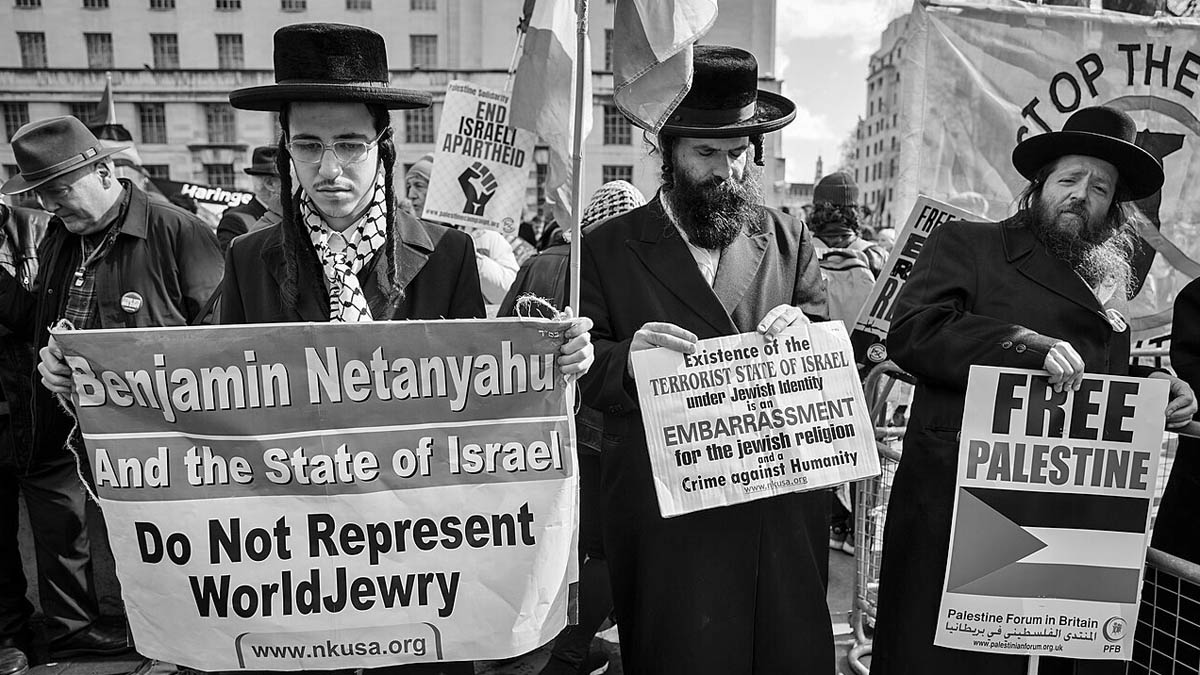
FEATURED IMAGE: Protest against Israeli Prime Minister Benjamin Netanyahu, London, 24 March 2023. Wikimedia Commons.