
By Phakamisa Mayaba and Riaan de Villiers
Barely a month before the local government elections, the ‘illegal’ immigration issue has once again flared into violence, threatening to shade into a full-blown political crisis.
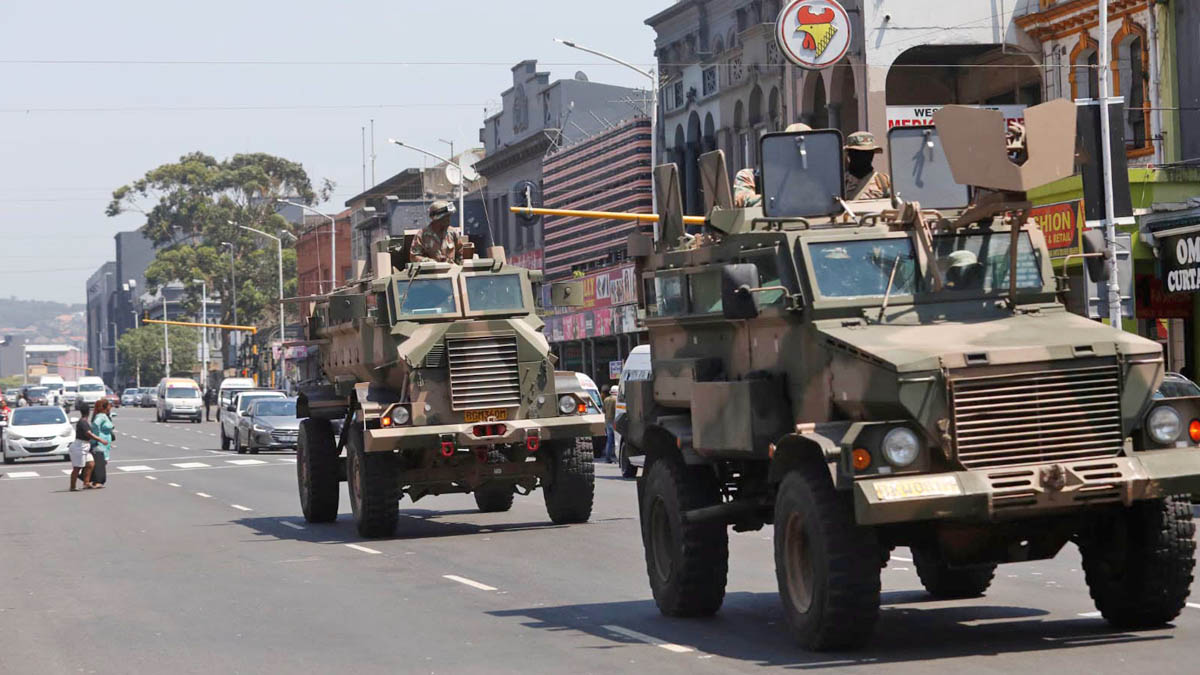
While police and soldiers have quelled the unrest – at least for now — political analysts are starting to say that the anti-immigration movement, led among others by March and March leader Jacinta Ngobese-Zuma, is presenting a growing challenge to the SA constitutional order.
Among others, News24 has published a strongly worded editorial stating that ‘Ngobese-Zuma is a threat to democracy’, and ‘must be stopped’.
And a migration scholar, Prof Loren Landau, has noted that, rather than a legitimate debate about immigration, the marches reflect a ‘deeper crisis of governance’ in which ‘politicians who lack genuine solutions to economic inequality, poverty, and unemployment are using immigration to advance their political careers’.
The background
The current crisis has a long and complex history. According to government spokespersons, the latest round of violent protests has been triggered by false information about a Concourt ruling, and subsequent government procedures for considering applications from refugees and asylum-seekers.
At issue are provisions in the Refugees Act as well as regulations which set out the procedures for considering applications for asylum. Specifically, asylum-seekers need to enter the country through authorised points of entry, or report to a Refugee Reception Office within five days of entry. If they don’t, they need to provide officials with valid reasons why they entered the country illegally or missed the five-day window. If they fail to do so, they may not apply for asylum, and may be detained or deported.
Last year, the Scalabrini Centre in Cape Town – an NGO which seeks to assist cross-border migrants, refugees, asylum-seekers and other vulnerable migrants – asked the Western Cape High Court to declare these provisions unconstitutional and invalid, on the grounds that they infringed in various ways on the rights of refugees.
The Department of Home Affairs opposed the application on the grounds that eliminating these preliminary procedures would lead to refugee centres being overwhelmed. Despite this, the Western Cape High Court granted the application, and the Constitutional Court upheld it in a ruling in July.
Op 28 September – a bit less than two weeks ago – the Department of Home Affairs issued a directive which instructed Refugee Reception Offices (RROs) to reopen and to accept asylum applications regardless of how the applicants had entered South Africa.
The latest round of violent protests – in Durban, Johannesburg, and elsewhere – have been triggered by renewed queues at refugee centres, accompanied by growing agitation on social media.
Last week, amid brewing tensions, various government spokesmen tried to explain that the Concourt ruling had been widely misrepresented and did not mean that applications for asylum or refugee status would automatically be granted.
But this failed to quell the smouldering fire. On Thursday evening, violence broke out in Soweto, with residents torching vehicles torched and at least one building, and engaging in looting. In no time, reports of violence flowed from Durban as well. There, the Moore Road Refugee Reception Office became a scene of violence, with cars being torched and the CBD being brought to a standstill.
On Friday morning, the government announced that the directive had been withdrawn. In a statement, the department of home affairs said the directive had been a ‘purely operational’ attempt to implement the Concourt ruling.
However, this had led to ‘serious consequences’ that the court could not have foreseen – notably, that ‘RRO operations were overwhelmed within a matter of days since the directive was issued, Home Affairs officials were placed at risk, and serious threats to public safety and order had emerged’.
Given this, the department would ‘embark on a fresh process to determine the most appropriate operational approach to ensure compliance with the Constitutional Court’s order’.
In a television interview, Home Affairs Minister Leon Schreiber reiterated that, despite its opposition to the ConCourt ruling, the department was obliged to implement it and had tried to do so in good faith. However, given subsequent events on the ground, withdrawing the directive was the ‘responsible thing to do’.
Violence continued on Friday, and spread to other parts of the country, but at the time of writing (Saturday 10 September) it seemed to have died down.
Apex court under fire
In retrospect, the ConCourt ruling was bound to be met by disdain, conspiracy theory and all manner of impassioned responses. The #Abahambe lot, specifically Jacinta Ngobese-Zuma, came out with guns blazing.
Precisely because the anti-immigration fringe was itself premised on fear-mongering, the misrepresentation of facts, a general ignorance of the law, and elements of tribalism, the apex court’s ruling was never going to be regarded as a bona fide move to maintain and interpret the nation’s laws, but as some sort of affront to citizens’ rights.
It is the tinderbox the Abahambe fringe needed to drive home once more that the South African government and laws favour migrants over locals.
Some of Ngobese-Zuma’s more extreme pronouncements have drawn fire from members of the chattering classes – but perhaps the ivory tower darkies were never really her target audience to begin with. Nor, for that matter, was the prospect of a political career.
One thing she has done quite effectively is to show just how pressing an issue the foreign question has become. The Economic Freedom Fighters (EFF) gained prominence by advocating a radical approach to ‘illegal’ immigration. Herman Mashaba’s ActionSA gained traction as the party that would not only deal decisively with illegal immigrants, but with rampant cdrime as well. The Patriotic Alliance’s #Abahambe rallying call has been a reliable crowd-pleaser.
But none of those parties have done what Ngobese-Zuma has done, rising to the top of the national dialogue on – for the most part – a singular issue. Her messaging, although optimistic and simplified to reach snake oil conclusions, has garnered her something of a cult following.
She has simply told her followers that once they’ve gotten rid of illegal foreign nationals, everything else would be fixable and attainable – and the masses followed her like the Pied Piper. By early Friday morning, supporters from other towns were making it clear that they would embark on their own protest action.
All of this has worked to put people on a path of mayhem and violence. But no amount of sweetsound and charisma should ever make criminals of desperate men and women – especially in a functioning multiparty democracy. Another election is just around the corner, and that’s where the frustration and anger should really find expression — right there on the ballot paper.
The bigger picture
In the meantime, the conflict has assumed a broader dimension, touching on SA’s constitutional democracy. Some significant moments are reflected below.
According to a report by Carol Paton on News24, the protests ‘led to an attack on the seat of the Constitutional Court in Braamfontein by an armed mob, both a symbolic and a real attack on democracy. Vitriol and hate speech against the court have flooded social media.’
Last Thursday, about 300 protesters wielding sticks, canes, whips and pangas descended on the Constitutional Court and tried to force their way into the building.
MPL Bandile Masuku, chair of the Gauteng Portfolio Committee on Community Safety, later described the attack on the court as “an act of terror”, and an ‘attack on the South African state’ which needed to be ‘[taken seriously and dealt with’.
‘The will of the people …’
Shortly afterwards, Ngobese-Zuma issued the following statement on her Facebook page:
‘The Directive from Home Affairs is withdrawn, the Constitutional Court Judgement IS NOT …
‘If we say we are a Democracy now is the perfect time to see it at play … The Constitutional Court and Parliament cannot be above the will of the people.
‘The Constitution must work for the Citizens if it doesn’t, then something must be fundamentally wrong with this “Democracy”.
‘This is the time we call for parliament to call a referendum on the Constitution of SA and for South Africa to withdraw from the 1951 United Nations refugee convention because it simply does not serve the will of the people of this country. …’
‘Threat to our democracy’
In an editorial News24 has written: ‘The advent of March and March … has tested the strength and resilience of our democracy like never before. This week, March and March expanded its targets from undocumented foreigners to politicians, judges and journalists.’
After outlining a seris of events, including death threats received by one of its journalists investigating March and March, it continued: ‘Here is the big question that President Cyril Ramaphosa and his Cabinet must face: are Jacinta Ngobese-Zuma and March and March above the law?
‘Are they all too petrified to act against her because they are afraid they may jeopardise potential votes before the 4 November polls?
Will Ramaphosa and his Cabinet rather sacrifice the Constitution, the judiciary, and the freedom of the media than act against someone who poses a clear threat to our fragile democracy?’
‘Crisis of governance’
Reflecting the views of many, Professor Loren Landau, a migration scholar at the University of Oxford and the University of the Witwatersrand, has commented that the marches reflect a deeper crisis of governance, not a legitimate debate on immigration. ‘Politicians who lack genuine solutions to economic inequality, poverty, and unemployment are using immigration to advance their political careers.
‘My greatest takeaway from the marches and the lead-up to them is that they are less about immigration and more about the nature of South African politics, and the degree to which it has become captured by people willing to use the language of hate, threats of violence, and actual violence to shape the country’s political future.’
- We will continue to track this story and its implications in the comings weeks.
FEATURED IMAGE: An SANDF contingent arrives in Durban to help quell the unrest. Source: IOL News on Facebook.
//////////////////////////////////////////////////////////