
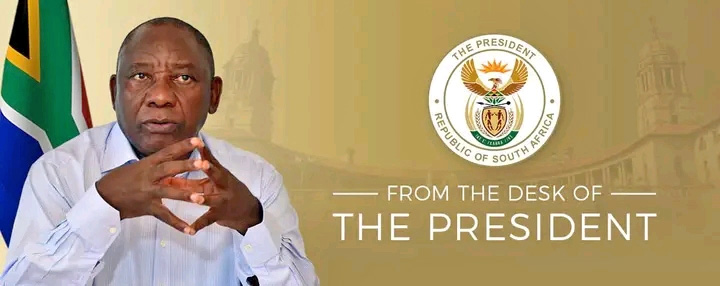
Wounded, The Buffalo no longer has the stomach for the hot seat. Recent election results have knocked the wind out of his sails, and all he wants to do is retire to Constantia – or Phala Phala – and watch the world pass by from a couch stuffed with dollar bills.
Those were the post-election murmurings that cast Cyril Ramaphosa as a man whose responsibility had always been – to paraphrase political analyst Prince Mashele – officiating over the ANC’s disinterment. What this effectively meant is that he had either dismally failed the 2017 Thuma Mina choristers or had fulfilled his white monopoly capital directive to ensure another unchaotic transition from ANC rule to a new political order.
So imagine our collective surprise when — on an ABC News interview with Jonathan Karl last week — we saw Cupcake sounding every bit like the effortless diplomat. Decorum everywhere. A master class on how to be a likeable African statesman, as well as marketing your country to global capitalists. Looking at him, one would never have guessed that barely a fortnight earlier, his party had suffered its most embarrassing election hammering. At 30.75% of the local government vote, they found themselves pushed into the unenviable position of having to engage in coalition talks with people they’d considered unthreatening barely a decade ago.
You’d recall that in 2016, when we thought the ANC were at their lowest, they were still standing at an okay 53.91%. Two years later, Ramaphosa would become president, and he was touted as the one that would bring the turn-around strategy, clean up the internal rot, and restore the country’s credibility with ratings agencies. At 57.5% of the vote in the 2019 general election, they were still comfortably the majority party. Then came 2024 and everything was flipped on its head. At just over 40% of the vote, not only were they knocked out of the majority position, but did so in catastrophic fashion.
Things have worsened shockingly ever since, and this year’s local government election had the ANC men sweating bullets to explain why voters were clearly turning their backs on the liberation outfit. So much so that rumours began to circulate that Ramaphosa was prepared to hang his head in shame and resign. It wasn’t the first time that such rumours surfaced. In 2022, following the Phala Phala saga, speculation was that senior ANC officials had had to plead with him not to resign.
Indeed, in the political turmoil, entrenched avarice and radical economic transformation rhetoric at the tail end of Zuma’s presidential spell, mainstream media had intently packaged Ramaphosa as the market-friendly and cautious candidate who would reel the nation back from junk status.
He had all the specifications that the West encourages – and appreciates – in a palatable African statesman. Whilst his predecessor’s tenure was steeped in graft and talks of an unsettling nuclear partnership with Putin, Ramaphosa was promising economic development, job creation and a smart city – exactly the kind of innocuous language that regales and pacifies Western investors.
Then came Covid, and the world was shut down. Ramaphosa became the distant president who preferred communicating through letters instead of hard interviews. Indeed, the Thuma Mina Bible-thumping went quiet and the man whose ticket to the First Citizenship was clean governance found some of his highest-ranking comrades being implicated in serious graft during the pandemic. But despite it looking like his enemies would smell blood and call for his head, the man had clearly purged enough of them to have more friends around to save his skin.
Now, in the twilight of his stint as ANC president, he has come out in grand fashion with a team of tech experts and gone over to Silicon Valley to try and establish South Africa as a big continental player in AI technology. He is not talking the language of old: nothing about the usual mining or natural resources, but about data centres and AI as the employer of the future. South Africa already houses data centres and it is, according to the president, only fitting that its people should benefit meaningfully from such endeavours.
But on closer inspection, the roadshow in the US has been way more. Ramaphosa has far greater ambitions than to simply promote businesses: he has noted the political shifts following the US mid-term elections, and knows that MAGA and the hostile Trump may be a thing of the past. Because the incumbent president was not one who cared to listen, especially not to Ramaphosa, it seems our man has seized the moment to talk to anyone who will.
He labelled his viral visit to the Oval Office back in 2025 as ‘an ambush,’ and his current audience appears to sympathize with him and is not cornering him with dodgy press clippings or EFF rally videos. instead, they are asking questions and giving him ample opportunity to explain the SA position. They are allowing him space to respond on Trump, white genocide, and even Elon Musk.
Ramaphosa is grabbing the opportunity and wiping the floor with those who have previously sought to discredit the moral compass of ‘Mandela’s children’. Redress policies, painted by Musk, the alt-right and MAGA disinformation peddlers as some form of racist political extortionism, Ramaphosa has explained why his government has always favoured their existence.
Speaking to Stanford University students, he reiterated that the centuries of colonialism and apartheid could not be appropriately confronted in the absence of policies that seek to intently give a leg-up to those who were dispossessed and disempowered by those repressive systems. What better listeners to make such a point to than the very people who gave the world Affirmative Action and DEI?
His special superpower, it would seem, is that, in the first instance, Ramaphosa is a keen businessman rather than a run-off-the-mill political hack. He understands what many often miss when engaging outsiders. Don’t get too bogged down in hardline ideology; rather focus on the rule of law and how investor interests would be safeguarded.
And although he puts the language of money high up on the agenda, he is always careful to ensure that the politics of capital do not trump the politics of sovereign character and integrity. Sure, he is saying to the world, ‘come, invest, enjoy South Africa, but please remember that she has her own history which informs her moral leanings. Respect that and everybody will be happy.’
This is an edited version of an article on Phakamisa Mayaba’s website, eParkeni. Used with permission.