
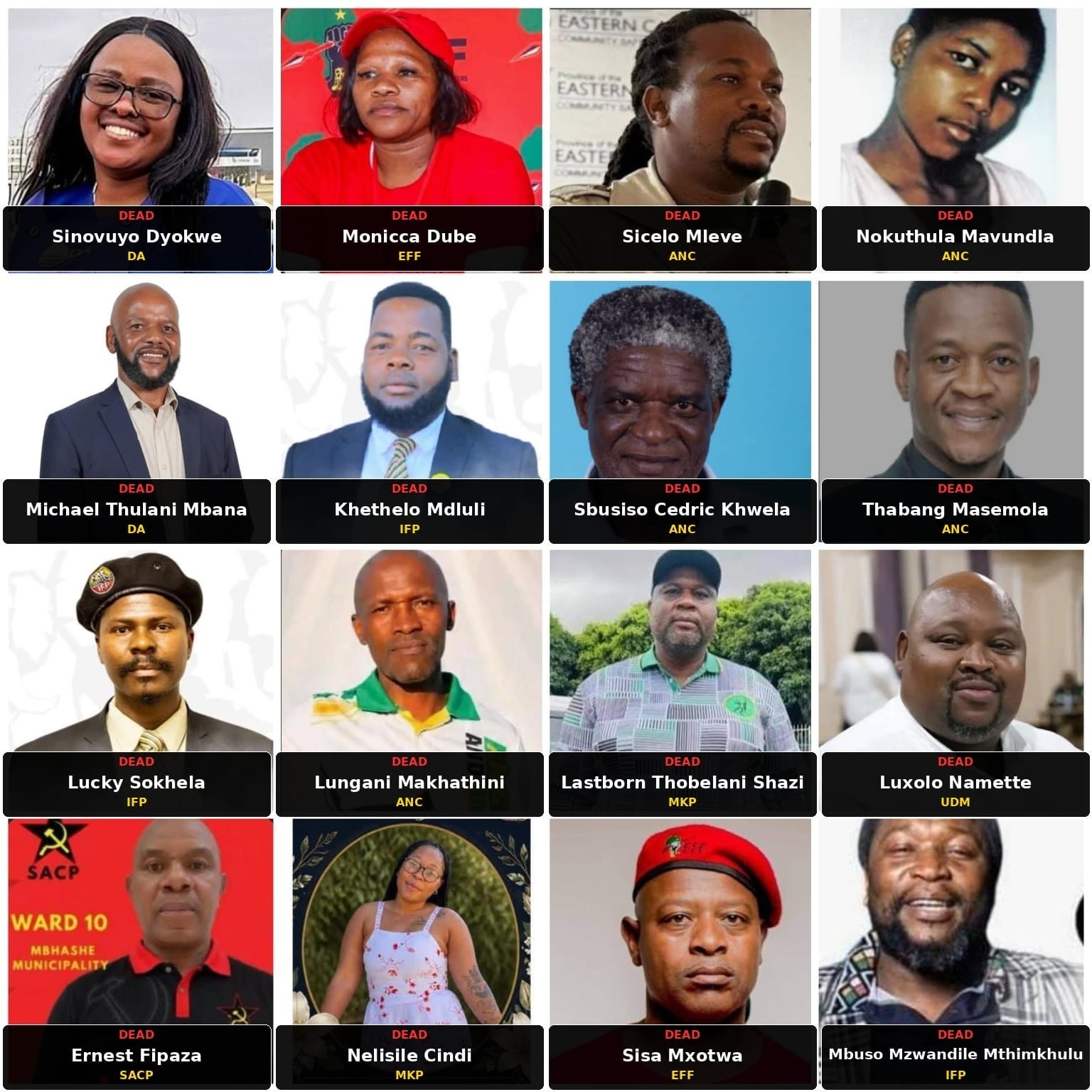
Look a little further than the rank opportunism of what passes as “coalition building” to see the moral decay of South Africa’s political class.
Official figures released by the National Joint Operational and Intelligence Structure (NATJOINTS) put the number of politically motivated murders during the recently concluded election period at 21 – and hardly anyone seems to have batted an eyelid.
On the morning of 5 November, as Deputy National Police Commissioner and NATJOINTS chairperson Lieutenant-General Tebello Mosikili announced this figure, news came that another MK Party member had been gunned down in KwaZulu-Natal.
Police and independent monitors tracking attacks on councillors, candidates, party workers, civic leaders and traditional leaders recorded dozens of additional deaths in the months leading up to the polls.
A Global Initiative Against Transnational Organised Crime report documented at least 43 political killings between January and the end of September, already more than the killings in a full year during previous election cycles.
The contest for power at the municipal level has become a matter of life and death, with death often being the operative word.
The scarcity of good jobs has created such intense competition for salaries and access to state funds that participants are prepared to brave the dangers that now accompany political activism. The violence is concentrated in KwaZulu-Natal and Gauteng, but during this election cycle it spread into provinces previously regarded as lower risk.
Murder to match the calendar
The killings matched the electoral calendar, rising sharply with the first registration period in June.
On Saturday 13 June, Monicca Dube, the 44-year-old EFF Tshwane Region 2 Secretary and Election Coordinator, was shot and killed by armed men at her home in Wallmannsthal. Dube had survived an earlier assassination attempt in March, when she was shot 11 times and spent several weeks in intensive care.
Dube’s daughter, Tshepang Maseko, 24, said the family was devastated. “My family is heartbroken. It feels unreal. We are not coping, but we must be strong. She was a strong woman. She was a fighter who dedicated her life to the community,” she said.
The Gauteng Political Killings Task Team has so far arrested two suspects in connection with her murder. Other EFF members who were killed included Lebogang Mafa, who was fatally shot inside her home in Tshwane, and Aaron Makola, whose murder also drew task-team attention.
During the first voter registration weekend of 20–21 June, the violence intensified across provinces. In Dunoon, Cape Town, Democratic Alliance ward candidate and community activist Sinovuyo Dyokwe, 48, was shot dead on Mnandi Street after spending the day helping residents register to vote. She was walking home from a registration venue when a gunman opened fire.
DA sources said she had earlier reported an extortion threat involving demands for R10 000 once-off or R1 500 monthly. JP Smith, Cape Town’s MMC for Safety and Security, confirmed she had approached him in February, and he had advised her to open a case. The DA has offered a R50 000 reward for information leading to arrests.
In the same township that week, MK Party activist Mzwakhe Dlamini was also killed.
In Gqeberha, ANC ward councillor Sicelo Mleve, 45, was shot at close range by two armed men who stormed a community office in Zwide during a registration and engagement session. Expressing condolences that weekend, ActionSA noted that more than five councillors and candidates had lost their lives across Cape Town, the West Rand and Gqeberha.
“Political violence has no place in a constitutional democracy. Incidents like these not only rob families and communities of their loved ones, but also discourage citizens from participating in political life,” the party said.
The registration-period killings followed earlier attacks. In May, Inkatha Freedom Party PR councillor Mbuso Mzwandile Mthimkhulu, 46, was shot dead during a community meeting in Bekkersdal, and Samkelo Dlamini, an IFP PR councillor and Zululand district chairman, was killed on the main road in Ulundi.
The pattern continued through the year. In July, ANC Ward 10 councillor Thabang Masemola was murdered in Mamelodi East, Tshwane; the Gauteng task team later arrested two suspects, including an alleged hitman. In August, ANC Ward 17 councillor Sbusiso Cedric Khwela was fatally shot at his office in Klaarwater, eThekwini, while assisting community members.
Police spokesperson Captain Tintswalo Sibeko said at the time that unknown suspects, driving a white Nissan Almera, allegedly shot the victim. “The investigation is underway, and no arrests have been made yet,” she said.
The KwaZulu-Natal Political Killings Task Team took over the investigation. In late August and early September, IFP Ward 17 candidate and PR councillor Khethelo Mdluli, 40, was shot in front of his children at his home in oPhindweni and later died in hospital. On 1 September, IFP Ward 8 candidate Lucky Sokhela was shot dead at his home in KwaSwayimani after allegedly being followed.
The IFP formally requested the immediate deployment of the KwaZulu-Natal Political Killings Task Team, insisting the assassinations could not be treated as ordinary criminal cases.
October brought a sharper escalation as the campaign intensified.
In Umgababa on the KwaZulu-Natal south coast, ANC local councillor and ward coordinator Lungani Makhathini and branch activist Nokuthula Mavundla were shot dead by gunmen in a white Isuzu bakkie during a door-to-door campaign. A third female member was injured. Makhathini had survived earlier attempts on his life.
In the Free State, Democratic Alliance caucus leader and Ward 14 candidate Michael Thulani Mbana was shot several times at close range outside his home in Taylor Park, Zamdela, after two men called him outside.
The carnage continues
In the Eastern Cape, SACP-linked candidate Ernest Fipaza was assassinated at his home in Dutywa after two men physically attacked and then shot him. EFF proportional representation (PR) councillor Sisa Mxotwa, 52, was shot inside his tavern in Tsomo, in the Chris Hani District Municipality, by two assailants posing as customers.
In KwaZulu-Natal, MK Party activist Nelisile Cindi was ambushed and shot dead at her rural home in Phepheni, Highflats.
The killings continued into the final stretch in early November. On 1 November, ActionSA activist Ntombi Mkhize, 63, mother of the party’s Ward 11 candidate, was found stabbed and strangled on a pathway near her home in Mnyameni, Maphumulo, in KwaZulu-Natal. ActionSA described her as an active supporter who regularly attended meetings and called for urgent protection of activists and their families.
The next night, 2 November, MK Party regional organiser Lastborn Thobelani Shazi, 45, was shot dead at his homestead in Umzumbe while on a virtual meeting preparing for the elections. The party said his death brought the number of its officials and aspiring candidates killed in recent months to 15.
Shazi’s family was left shattered. His brother Mbongeni said Shazi always spoke about politics and rural development. “As citizens of the country, we have a lot of challenges, which he was good at handling. So we’ve lost a leader,” he said. Neighbours had heard the gunshots that night before silence fell.
On 18 November, just over two weeks after Shazi’s killing, the Political Killings Task Team arrested a 44-year-old man at his homestead near Port Shepstone. Police said the suspect was one of the coordinators of the assassination. Investigators also linked him to the subsequent murder of the alleged hitman, who was shot dead after a disagreement over payment for the job.
National Police Commissioner General Fannie Masemola praised the breakthrough. The suspect appeared in the Port Shepstone and Umzumbe magistrates’ courts on 19 November on charges of conspiracy to commit murder, two counts of murder, and possession of an unlicensed firearm and ammunition.
Former ANC mayor of Richmond Samora Ndlovu survived an assassination attempt when his car was shot at on the R56 near Richmond on his way back from a meeting.
“He was usually accompanied by bodyguards when he went around, but on the day of the shooting he was alone. After being shot, he still managed to call his bodyguards on his cellphone, who drove him to hospital,” said a source.
On election day itself, ANC Ehlanzeni regional committee member Prince Mamba was shot dead in Bushbuckridge, Mpumalanga.
On 7 November, three days after the vote, United Democratic Movement councillor Luxolo Namette, 45, former deputy mayor of Nelson Mandela Bay and former chair of the metro’s Municipal Public Accounts Committee, was shot twice in the head outside a barbershop in Motherwell. Nothing was stolen. His widow Mandisa Namette said he had received death threats.
About a week before the elections, Namette had called her while driving home after spotting two men, one carrying a firearm, near their boundary wall. He had also received an anonymous SMS about internal party plots and leaked voice notes of colleagues speaking against him.
“If someone has to die, so be it,” the message had reportedly said.
Namette’s father, Thembelani, was broken by the news. “I received the call while I was in church. He was such a sweet person. This is hard. He left his wife and kids,” he said.
At a memorial service on 17 November, UDM national chair Yongama Zigebe told mourners the party believed the killing was an “inside” job and that those responsible would be exposed. The national Political Killings Task Team took over the investigation.
These deaths did not occur in isolation. Family members and bystanders were sometimes caught in the attacks. Communities that lose a councillor or organiser lose more than a political representative. They lose someone who mediated service-delivery disputes, chased municipal contracts, or kept local party structures functioning.
Ramaphosa reacts
President Cyril Ramaphosa condemned the killings in the final days of the campaign in Polokwane, Limpopo, warning that those responsible were seeking to undermine the country’s democratic gains. He described the violence as a “plague”.
ANC secretary-general Fikile Mbalula later called on the police and the National Prosecuting Authority to pursue not only those who carried out the attacks but those who ordered and financed them, and to protect witnesses prepared to speak.
Police maintain that the electoral environment itself remained largely protected. Planned marches and protests mostly failed to materialise. Officers intervened at stations where logistical or service-delivery problems threatened to disrupt proceedings.
NATJOINTS said security operations would continue through and beyond the vote counting and results process.
Arrest rates in the murder cases remain low relative to the number of deaths, though the breakthrough in the Shazi investigation shows that specialised teams can deliver results. Investigations continue, and many dockets remain open.
The fear that faces prospective political players was felt by Mayibuye iAfrika Movement leader Floyd Shivambu when he travelled to Nongoma Local Municipality in northern KwaZulu-Natal in a bid to field councillor candidates.
No one came forward to represent the party. Shivambu said the climate of fear in places like Nongoma showed how violence has become a threat to democracy: “I think Nongoma, in my experience, has the highest number of political killings for one reason or another, whichever political party,” he said.
He said his movement struggled to field candidates there because people were too afraid to put their names forward.
Counting the human cost
As South Africa moves from voting into coalitions and the formation of councils, the security focus has shifted to protecting the post-election process. The deeper challenge is whether anything can be done to change a culture of violence that increasingly appears to be an inevitable byproduct of democracy.
Of the cases detailed in this article:
- The African National Congress buried at least six of its representatives and activists (Sicelo Mleve, Thabang Masemola, Sbusiso Cedric Khwela, Lungani Makhathini, Nokuthula Mavundla and Prince Mamba).
- The Economic Freedom Fighters lost at least four (Monicca Dube, Lebogang Mafa, Aaron Makola and Sisa Mxotwa).
- The MK Party publicly stated that 15 of its officials and aspiring candidates had been killed in recent months, including Mzwakhe Dlamini, Nelisile Cindi and Lastborn Thobelani Shazi.
- The Inkatha Freedom Party lost four (Mbuso Mzwandile Mthimkhulu, Samkelo Dlamini, Khethelo Mdluli and Lucky Sokhela).
- The Democratic Alliance lost two (Sinovuyo Dyokwe and Michael Thulani Mbana).
- ActionSA lost one (Ntombi Mkhize).
- The United Democratic Movement lost one (Luxolo Namette).
- One SACP-linked candidate (Ernest Fipaza) was also killed.
These numbers do not capture every death, nor do they include the many survivors of attempted killings.
They do, however, show how political violence in 2026 cut across party lines and left deep scars on communities already struggling with poor service delivery, unemployment and violent crime. Meanwhile, the political class are jockeying for mayoral chains and council seats, as if the dead had never been counted.
This article has appeared on Phillip van Niekerk’s substack, Africa Unscrambled. Click on the link to subscribe. Used with permission.