
By Destine Nde
After two games in the FIFA World Cup 2026 tournament, Bafana Bafana is still in with a chance. After a disappointing 2-0 loss to Mexico in their opening game, and an encouraging 1-1 draw against Czechia, the stakes are high for their final Group A march against South Korea this coming Thursday.
In football parlance, ‘their fate is still in their hands’. This means that, if they win, they will definitely qualify for the round of 32. This alone would be a historic achievement, as it would be South Africa’s first advance to the knockout stage in three FIFA World Cup appearances.
If they draw, they may still advance as one of eight best third-placed teams, provided Czech Republic loses to Mexico. But this would also depend on results in other groups, making qualification far less certain, and beyond their control. If they lose, their tournament will be over.
After a 2-1 win against Czechia, and a 0-1 defeat against Mexico, South Korea is sitting on four points, which puts it in a significantly stronger position than Bafana Bafana. If they draw or win, they will pass through to the knockouts. If they lose, they may still qualify as one of the eight best third-placed teams.
But they will also be determined to ‘keep their destiny in their own hands’, as opposed to entering the third-placed teams lottery, with the results also depending on other groups, and are likely to play for a win instead of a draw. This sets the scene for a thrilling encounter.
The match will be broadcast live on on SABC 3 and SuperSport. But fans will have to, go to bed early. and set their alarms – kickoff is at three in the morning.
Bafana against Mexico: what went wrong?
Bafana’s opening game against Mexico echoed their opener in the 2010 tournament in South Africa, when Bafana came away with a praiseworthy 1-1 draw. Fans hoped Bafana would do at least as well in Mexico – but this was not to be.
The 2-0 loss to the hosts was embarrassing for South Africans in particular, and Africans in general. Following careless defence, Mexico scored an easy goal within 10 minutes. For the rest of the half, Bafana struggled to string together sets of passes. They kept losing possession, allowing Mexico to build pressure with repeated attacks.
The second half was even worse. Raul Jimenez doubled Mexico’s lead within five minutes, essentially due to continued mistakes on the part of Bafana, both tactically and technically. Then Sphephelo Sithole was red-carded in the 49th minute for bringing down Mexico’s Brian Gutierrez just outside the penalty box, thereby denying the home team a goal-scoring opportunity.
Barely 20 minutes later, Themba Swane, Bafana’s experienced attacking midfielder, was also red-carded for smacking Mexico’s Roberto Alvarado in the face, and was suspended for three matches.
With two men out and two goals down, the match had turned into a nightmare. Despair gripped fans, players and coaching staff in equal measure. The assistant referee kept warning Broos to return to his demarcated area. Even before the two red cards, their performance on the pitch was underwhelming. With nine men against 11 for about a quarter of an hour, the game became a disaster. In fact, the score against Bafana could have been much bigger.
The only real threat posed by Bafana came late in the match, and this by a defender, Khuliso Mudau. He was brought down by Mexican defender Cesar Montes, who was also red-carded for ‘denying a goal-scoring opportunity’. Despite all of this, Broos declared that his team had ‘played a good game’.
Heated debates
This match sparked heated debates among analysts and supporters. Some said it largely reflected a lack of experience, as no Bafana players had ever played in a World Cup.
This included the pressures of playing in front of 85 000 spectators, with millions more watching worldwide. Before the game, the veteran Turkish coach, Vincenzo Montella, remarked: ‘Opening matches are rarely decided by tactics and concepts alone. Mostly it’s decided by who can handle the emotional pressure of the occasion.’
This applies to hosts nation as well. As a result, some analysts thought Mexico might crumble, but it turned out to be Bafana instead.
Others pointed to Broos’s largely defensive 23-man squad, as well as the defensive 3-5-2 formation deployed against Mexico. ‘Broos’ ultra-defensive set-up’, wrote Yanga Sibembe of Daily Maverick, ‘left the only true attackers on the field extremely isolated for large chunks of the match.’
Fans said the match needed technicians like Oswin Appollis, Tshepang Moremi or Relebohile Mofokeng to pressurise Mexican defenders. ‘Keeping their most dangerous creative players on the bench … was self-defeating’, Sibembe added.
Others blamed the poor quality of South Africa’s Premier Soccer League (PSL), arguing that it does not adequately prepare players for the intensity and speed of World Cup football.
For others still, a lack of concentration — resulting in individual mistakes— was to blame. For instance, many analysts pointed fingers at Captain Ronwen Williams for the first goal, saying he should not have started play from the back under Mexico’s strong pressure. But Broos said their only weakness was that they did not make good use of possession. ‘We were not so good with that today,’ he admitted.
Bafana against Czechia: renewed promise
Nevertheless, seemingly responding to the criticism, he adopted a more attacking formation against Czechia, and chose more attacking players. The result was a far better performance, resulting in a draw. Analysts agreed that Bafana was more balanced and cohesive, and that, instead of dropping back and struggling for possession, they controlled ‘large swathes of the ball’.
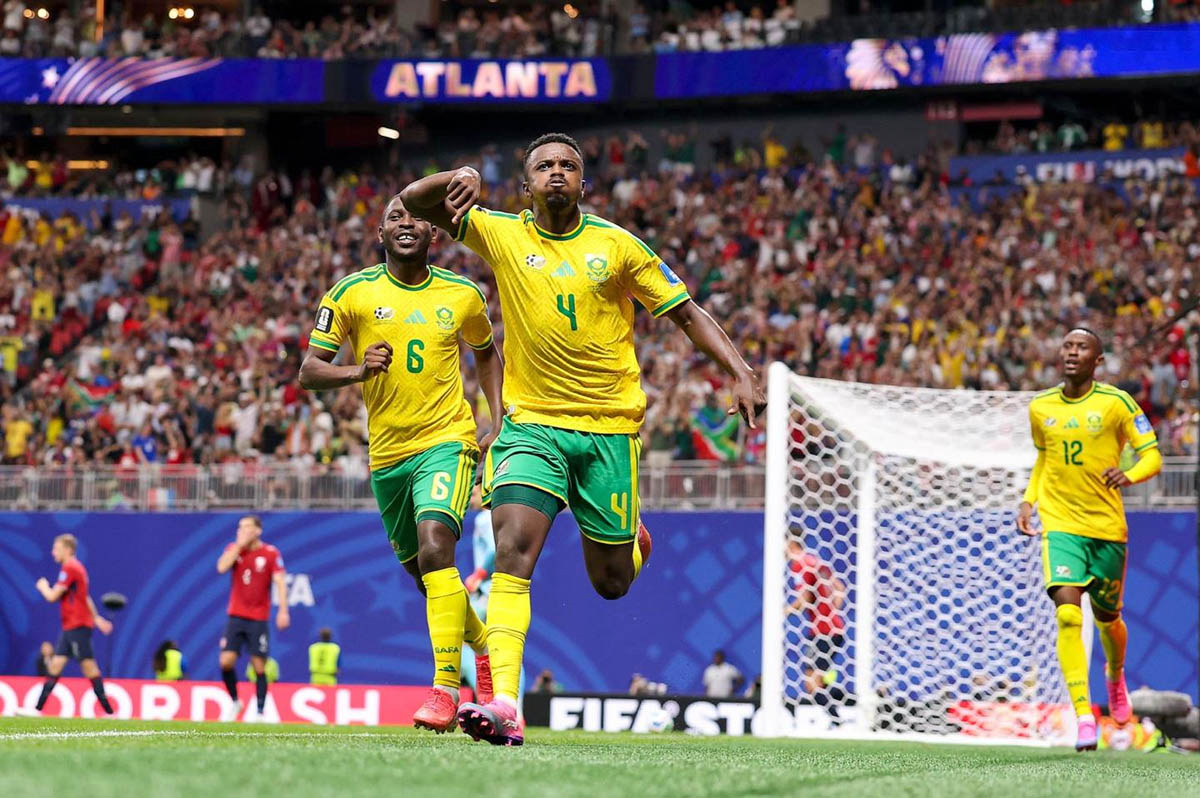
Persistent pressure in the second half resulted in a foul in Czechia’s penalty area, which Teboho Mokoena converted into a goal. Bafana pressed on for a win, but ran out of time.
Writing eloquently for IOL, Smiso Msomi has noted: ‘What the tactical recalibration ultimately did was restore national identity. Against Mexico, Bafana looked reactive and gripped by caution; against the Czechs, there was finally a visible, front-foot plan. The pressing structure improved, the engine room looked connected, and the attacking transitions carried genuine purpose.’
While the game might not have erased the anxieties surrounding Bafana’s World Cup campaign, it suggested that Broos had ‘finally unlocked a tactical blueprint suited to the squad’s natural strengths’.
Now, the ultimate test lay ahead. ‘With a high-stakes showdown against South Korea waiting in their final Group A fixture, South Africa must build on the balance and offensive confidence they discovered in Atlanta. If this tactical progression continues, a place in the last 32 remains within their grasp.’
Following the Czechia game, Broos told reporters that, except for the lapse of concentration in the first half, for which the team had been duly punished, it had been a ‘very, very good game. … During the second half, we were constantly in the Czechs’ half, and the only thing they did was play long balls to their strikers. If we continue like this, I think we have a chance to go to the second round.’
This sets the scene for a memorable game against South Korea this coming Thursday. Here’s hoping the confident, front-footed Bafana will turn up.
FEATURED IMAGE: Teboho Mokoena in triumphant mood after scoring South Africa’s equalising goal against Czechia. (Source: Safa.net)
This punchy, though rather overlong, item on the first two world cup RSA games has helped gear one up in time for the early morning contest this coming week.