

By David Willers
Meitner is the German Marie Curie.’ — Albert Einstein.
‘The amount of energy locked up in the atomic bomb is prodigious, and the problem of controlling its release has not been solved. I have no doubt it will be solved, but a great deal of work will have to be done.’ — Sir John Anderson, president of the council for research on the new atom bomb, 7 August 1945 (a day after the destruction of Hiroshima)
///////////////////
Riaan de Villiers’s powerful report of the 80th anniversary of the Hiroshima atom bomb (Toverview, 12 August) exactly captured the horror of nuclear warfare – as well as the deeply disturbing reality that, eight decades on, more countries than ever subscribe to a doctrine of nuclear deterrence.
The war on Ukraine has changed our security landscape, as the EU’s latest strategic foresight report warns: ‘We are witnessing the erosion of the rules-based international order and fracturing of the global landscape. From the United Nations to the World Trade Organisation, key pillars of the global order are under stress … A return to the previous status quo seems increasingly unlikely.’
A hybrid-style incipient third world war thus seems to have become the new norm — Nato jets scrambling almost routinely; Poland threatened by drones from Russia; actual flashpoints including Ukraine, Taiwan, Sudan, Congo, Mali, Gaza — and our recourse to binding post-WW2 conflict resolution options having seemingly run its course. That’s why the potential horrors of an atomic war are back in the frame, 1950s-style, when schoolchildren were taught to hide under their desks in case of an alert.
In France recently, and again in the UK, my ears were assaulted by a nation-wide security alert emanating from every mobile phone. Earsplitting shriek. A glance at the screen reassured us this was just a test, in case of environmental disaster, floods etc; but everyone knows it’s more than that. Europe is slowly but surely gearing up ‘in case’ of another war. France and the UK, the only western European countries that have the Bomb, last week signed a fresh nuclear armament coordination agreement.
For me, the central question has always been whether the potential of the atom, and the effort to unleash this potential, was driven by a desire to build a bomb, or a desire to harness it for peaceful purposes.
Oppenheimer, the celebrated recent film based on the development of the atom bomb, gave the distinct impression that it was an American invention, costing 500 million dollars, and justified by its military application.
However, this version is not reflected in an original copy of The Daily Telegraph of 7 August 1945 which I recently acquired. This is the carefully planned and detailed edition that announced the Hiroshima bombing of the day before.
The headline read: ‘Allies Invent Atomic Bomb: first dropped on Japan’. The report went on to say: ‘The Allies have made the greatest scientific discovery in history: the way to use atomic energy.’
Statements follow by Winston Churchill and Clement Attlee (the former and new prime ministers of the UK), as well as by US President Harry S. Truman and the US Secretary of War, Henry L. Stimson.
The British statement says that by 1939 it had become recognised that the release of energy by atomic fission was a possibility. The research was carried out in British universities, namely Oxford, Cambridge, London (Imperial College), Liverpool and Birmingham. The British government then threw its weight behind the attempt to realise the potential for a bomb.
Details about ‘the men who made the atom bomb’ also appear on the front page, together with their photographs. They were mostly British, or British naturalised: Sir George Thomson, Sir James Chadwick, Sir Charles Darwin (a relative of the original Darwin),Prof J.D. Cockcroft, Prof N. Feather, Prof M. Oliphant, Mr W. Akers, Prof R. Peierls, Dr Franz Simon and Prof Niels Bohr.
The only non-Brit mentioned in the list was the American Dr Robert Oppenheimer, although it was noted that he had spent two years studying at Cambridge before completing his doctorate at Göttingen University in Germany.
However, the name of the actual scientist – a lone woman – who had in fact discovered the core principle of nuclear fission that made the bomb possible (and coined the word fission) was not included. It was left to Simson, the US war chief, to correct the narrative, and give full recognition where recognition was due, in a sidebar story in the same newspaper.
His statement, under the sub-headline ‘Jewess Found Clue’, relates that British scientists were able to detach electrons from uranium by bombarding the latter with neutron rays.
It then notes: ‘Lise Meitner, a German Jew, calculated shortly after the war began (1939) that something which had been puzzling scientists for about 10 years must be the explosion of atoms in one particular kind of uranium. She published her calculations and immediately scientists in England, the United States and Germany set to work and verified her conclusions. They found that the rare form of uranium 235, when bombarded by neutron rays, responded by splitting its atoms almost squarely in two. This released an incredibly greater amount of energy than was released when only a few electrons were split off.’
So now we have the actual story of the person responsible for the discovery of the physics behind the bomb – an Austrian-born woman – who had left Nazi Germany for Sweden where she continued her work, and where she was instrumental in discovering nuclear fission, the process that made an atomic explosion possible.
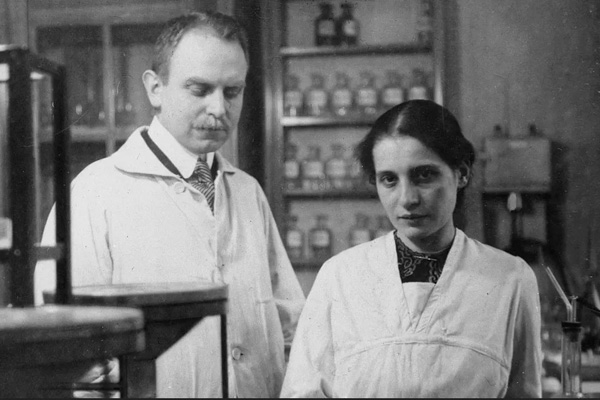
Lise Meitner and Otto Hahn in 1912.
In fact, Lise Meitner’s story is extraordinary in itself. Born in 1878, she was the first woman to become a full professor of physics in Germany. She worked with Dr Otto Hahn at the Kaiser Wihelm Institute, but fled to Sweden in 1938 when she lost her job because of the anti-Jewish Nremburg laws of Nazi Germany. She then relocated to Britain after the war.
Otto Hahn continued to teach in Germany, and the two continued to collaborate. However, it was Meitner who discovered the physics behind the neutron bombardment of uranium, and in her 1939 paper in Nature Magazine she gave the process a name for the first time – ‘fission’.
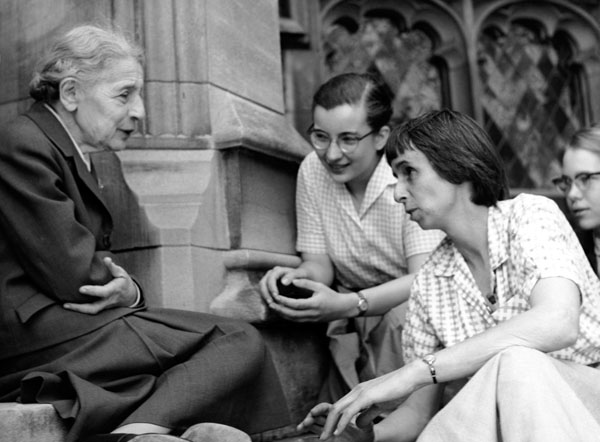
Lise Meitner with students on the steps of the chemistry building at Bryn Mawr College, April 1959.
Alas, it being very much a man’s world, Otto Hahn was later incorrectly and unfairly credited with the discovery of the ‘principle’, and awarded a Nobel Prize. Subsequently, Lise Meitner was nominated 49 times, but the politics of the Nobel Committee always allowed someone else in.
However, the Americans knew exactly who to thank, and the first acknowledgement on 7 August 1945 by the US war chief that her discovery of the ‘principle’ was pivotal, plus the mountains of honours she subsequently received, especially in Germany and Austria, have ensured that the discoverer of atomic fission will be properly recognised by future generations. It was she who told Otto Hahn that it was possible for the nucleus of uranium to disintegrate. Without her insight, the nuclear world as we know it may not have existed.
She herself was morally and viscerally opposed to the development of the atomic bomb, and refused to join the Manhattan Project, which is no doubt why we don’t see her in the film.
She wanted the fruits of her discovery to improve the lot of humanity. She died in 1968, and had she lived longer she would have been gratified to see the extraordinary advances made in the field of clean nuclear energy.
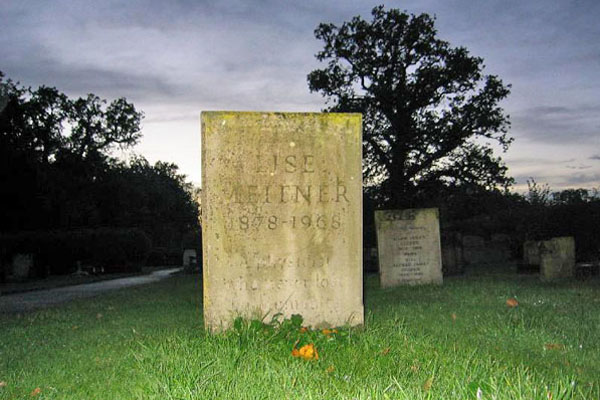
She is buried in Bramley in Hampshire in the UK. A simple headstone reads: Lise Meitner: a physicist who never lost her humanity.
Albert Einstein praised her as the ‘German Marie Curie’, and so highly is she regarded today, eclipsing all those famous scientists who graced the 1945 issue of the Daily Telegraph, that she is the only non-mythological being to have had an isotope named after her. A 2022 satellite also carries her name, as well as libraries and streets by the score. She has received the highest scientific awards from Germany and Austria. She was the first post-war National Press Club Woman of the Year in America, and dined with President Truman.
Her opposition to seeing her discovery result in an immensely destructive bomb also answers my earlier question – whether the potential of the atom, and the effort to unleash this potential, was driven by a desire to build a bomb, or to harness the energy for peaceful purposes. There is no doubt that, for Lise Meitner, the spur was the latter.
Note: A great deal has been written about Lise Meitner in recent years, but in 1945 she was known only to a vanishingly small number of scientific scholars. This mention of her seminal contribution in the Daily Telegraph in 1945 is the first public reference in a newspaper other than her scientific papers that I know of.
FEATURED IMAGE: Lise Meitner at a conference in 1037. With her in the front row are, from left to right, Niels Bohr, Werner Heisenberg, Wolfgang Pauli, Otto_Stern, Rudolf Ladenburg and Jacob Christian Georg Jacobsen. The only other women is (right at the back) is Hilde Levi. All images: Wikipedia.
DAVID WILLERS is a former South African diplomat, and editor of the Natal Witness. He now lives in his mother’s birthplace of Wales.
What a wonderfully refreshing response to the toverview feature on the Hiroshima commemoration. David Willers, we hope to read more from you!
This is fascinating, thank you.