

By Phakamisa Mayaba
Many people in the Northern Cape had little idea that this Tuesday, 9 September, was International Fetal Alcohol Spectrum Disorder (FASD) Day. Estelle Jacobs was not one of them. Neither was Dr Leanna Olivier.
As project manager of the Hantam Community Education Trust (HCET) – the comprehensive education project east of Colesberg which manages, among other things, an Early Childhood Education programme and a secondary school — this issue is close to the heart of Jacobs’s work. Much of her time is take up by conducting awareness camapaigns, poring over how this disorder affects education in general and local communities in particular, and conducting workshops on how best to tackle the inevitable implications.
Shockingly, a study undertaken in 2001 by the Foundation for Alcohol Related Research (FARR) revealed that the sheep-farming town of De Aar in the Northern Cape was the global capital of fetal alcohol syndrome (FAS). Its staggering prevalence rate of 11,2% was unprecedented anywhere in the world.
These findings were corroborated by the World Health Organization, which found that although risky drinking among pregnant women stood at around 2.5% nationally, in the Northern Cape, at 24.9%, it was almost ten times higher.
Six percent of women in the province were also found to have a drinking problem, and ten percent (both percentages double the national average) of them were likely to binge-drink, often leading to incidents of violence and sexual assault.
Enter Dr Olivier, CEO of Farr, and also the sort of person who is always open to talk – even to pesky small-time journos – about her cause.
Unfortunately,’ she says, ‘since 2001, we have reported FAS rates as high as 21, 24 and 28 percent in towns surrounding De Aar.’ Although the early stages of the research were specifically focused on FAS, ‘due to [further] research and more refined diagnostic measures, a spectrum of disorders, caused by prenatal alcohol exposure, was discovered. This spectrum is called Fetal Alcohol Spectrum Disorders (FASD), with FAS as one of the conditions on this spectrum. Therefore, since 2006, we refer to FASD.’
So what is FASD exactly? According to the Center for Disease Control and Prevention (CDC), FASD is a group of conditions that can occur in a person who was exposed to alcohol before birth. Common signs and symptoms listed by the CDC include:
- Behavioural issues which include attention difficulty, hyperactive behaviour and poor judgment and reasoning skills;
- Learning challenges which affect memory, IQ, arithmetic, speech and language; and
- Physical problems, including low body weight; problems with the heart, kidneys or bones; vision or hearing problems; abnormal facial features; and poor coordination. Most dismayingly, the condition is permanent and irreversible.
With at least one study having found that ‘the needs of children with FASD are most noticeable in the schools where the teachers are ill-equipped to adapt their teaching and classroom environment to cater for the learning and behaviour difficulties of children with FASD’, does government education policy pay adequate attention to youths affected by FASD?
For Jacobs, not quite. During her years of working among farming communities in the Northern Cape, she has seen at the negative effects of alcohol abuse in general and FASD in particular at first hand.
According to Jacobs, the HCET has, since 2007, been running awareness campaigns among young parents in the farming community served by the Trust. However, she acknowledges that formally diagnosing a child would be a complex and costly exercise. ‘You’d need a team of at least a doctor, occupational therapist, school psychiatrist, and sometimes a social worker.’
In this vacuum, HCET has taken the pioneering step of introducing two special needs classes for learners with learning difficulties, typically induced by FASD – a junior class for learners aged 8 – 11, and a senior class for learners aged 13 to 17. After completing the latter, learners are typically placed in skills-based learning programmes.
Jacobs also laments the low numbers of special needs schools especially in FASD hotspots like the Northern Cape and the wine farming regions of the Western Cape.
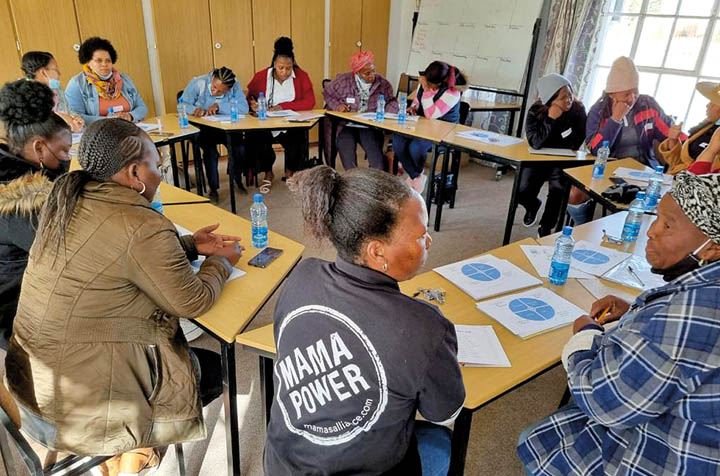
A FASD workshop at the Hantam Community Education Trust. Image: supplied.
In 2021, FARR found that, of 536 Grade 1 pupils in primary schools in nearby De Aar, 64 (119.4 / 1000) had either FAS or partial FAS, which ‘is among the most common causes of learning disability worldwide’. This equates to at least one learner in every ten.
According to Olivier, the organisation’s has been active in De Aar for nearly 25 years – with highly encouraging results. ‘Levels of knowledge and awareness of FASD is so high that we nowadays diagnose very few babies with FASD in our baby clinics.
‘Unfortunately, though, a very small number of babies are still born with FASD. This will always be the case, as there are women who are addicted to alcohol and who are not able to abstain from alcohol use during pregnancies.’
Olivier is quick to dispel the notion that the ‘dopstelsel’ (tot system), the notorious rural practice in terms of which which farm labourers were given daily tots of alcohol before and after work as part of their pay, was a major factor in this area. ‘It was not practiced on a big scale in this region, and became illegal in the 1990s.
‘If this was its simple cause, prohibiting it should have resulted in a sharp decline in the FASD rate, here and elsewhere, which did not really happen.’
Funding from the renewable energy project Solar Capital (which I will write about in a separate article) has enabled FARR to implement a whole-of-society approach, ‘meaning that we involve as many community members as possible in our various programmes’.
These include the 18 month-long Happy Mother Happy Baby Programme under which pregnant mothers receive support in terms of assessments their alcohol use risk, individual and group therapy, home visits during pregnancy and after birth, and examinations by the FARR medical specialist when baby are nine months old. If needed, babies can also receive neurodevelopmental assessments.
FARR also offers youth support groups, an Early Childhood Development Programme, training courses, workshops and an annual seminar, and is involved in the department of health’s efforts to develop a curriculum for learners affected by FASD. According to Olivier, the Northern Cape Department of Social Development has funded part of FARR’s work for two consecutive years.
However, because the government doesn’t recognise FASD as a ‘public health problem with far-reaching consequences … there is no funding available for awareness (other than the example[s] mentioned above), prevention and management.’
Owing to inadequate funding, as of 31 March, FARR has had to end its projects in the towns of Hanover, Petrusville and Philipstown. For Olivier, this is sad because FASD levels in those towns are often higher than more recognised illnesses like HIV/AIDS.
September 9 may have flown beneath the radar for many, but for Jacobs and Olivier, it was just another reminder of the battles already fought, and those that still lie ahead.
FEATURED IMAGE: Estelle Jacobs (front row, third from left) among colleagues at the Hantam Community Education Trust. Image: Supplied.
This is an edited version of an article that first appeared on Phakamisa Mayaba’s website, eParkeni. Used with permission.
People like Estelle and her team at the HCET deserve our admiration and respect for their years of painstaking, patient, gruelling and selfless work to combat this dismaying syndrome. They really represent the best of those South Africans working at the grass roots to change our society for the better.