

By R.W. Johnson
We are beginning to hear more and more about the Artemis mission to return man to the moon. In fact, Artemis is a whole programme: Artemis 1 was unmanned and circled the moon in 2022, allowing the test of its Orion lunar lander. Orion (made by SpaceX and entirely solar-powered) didn’t land on the moon but passed its various tests before splashing back down on Earth after a 1.4 million mile journey. Artemis 2 was supposed to lift off in September 2025 but that has been postponed until at least March 2026 due to a fuel leak. It will be a manned mission, but will also circle the moon and not land.
Artemis 3, supposedly in 2027, will land on the moon, including a woman and a black astronaut (Kamala Harris’s sole contribution while Biden gave her authority over NASA was this identity politics cliché). They will land at the moon’s south pole because that is a probable source of ice and thus water for human consumption, and oxygen and hydrogen for rocket fuel. Artemis 4 and 5 will then get on with the hard job of erecting a permanent settlement on the moon.
A great deal of this is a boondoggle. When Elon Musk launched SpaceX, his real target was the closed circle of big aviation companies which had effectively monopolised the American space programme. Their rockets, Musk said, were old-fashioned and ludicrously expensive. Sure enough, just as SpaceX began to produce rockets at a fraction of the price, the old oligopolists, Lockheed and Boeing, formed the United Launch Alliance which aimed at monopoly control of the rocket business. Their baby was the Space Launch System (SLS), including two other key oligopolists, Aerojet Rocketdyne and Northrop Grumman.
The SLS, which uses various bits from the old Shuttle programme, is the big rocket that will carry the Orion capsule up to the moon. It is ludicrously expensive – over $4 billion per launch, while the overall development costs of the SLS have already reached $11.8 billion and are running at 140% over estimate. All of this is on a cost-plus basis, guaranteeing that the rocket companies make a profit.
Not surprisingly, Trump tried to cut off funding for Artemis 4 and 5. But the aviation companies had carefully located their plants all over America so that there was hardly a Congressman or Senator who didn’t have an interest in the SLS going ahead, so they not only voted through the SLS despite Musk saying he could do it all more cheaply, but they also restored some of Trump’s cuts to Artemis 4 and 5. Not surprisingly, though, NASA is giving Musk the lion’s share of work after that.
The key part of Artemis is the Gateway, essentially a space station orbiting the moon (at its closest, only 6,214 miles away, at its furthest 43,496 miles away) which will act as a jumping-off base for astronauts landing on or returning from the moon, using Orion. It is anticipated that the Gateway and the completed lunar settlement will then provide a base from which to proceed to Mars – though Musk was all for skipping this phase and aiming directly at Mars. The Gateway involves major contributions by the Canadian, European, Japanese and UAE space agencies (the UAE already operates two satellites, DubaiSat I and II, and it is designing the Crew and Science Airlock on the Gateway).
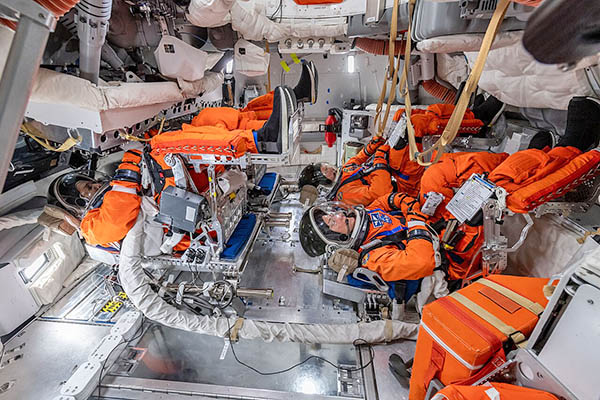
The crew of Artemis II training inside an Orion mock-up in January 2025. (Mark Sowa / NASA / Wikipedia)
In fact, the hazards that settlers will face on the moon are considerable and could help them to prepare for what they’ll face on Mars. The first thing is radiation. Unshielded by Earth’s atmosphere, any person on the moon will be exposed to 200 times the radiation he/she is exposed to on Earth. They’ll wear protective gear and only stay for limited periods but if they want to stay longer they’ll have to live in one of the moon’s recently discovered caves. Otherwise they’ll return to Earth with cancer.
Moreover, sometimes solar flares can bring tremendous spikes in radiation and it will be essential to dodge those. The Gateway itself will have full radiation shielding so all astronauts first arriving will rotate back to the Gateway after each 90 days – though obviously a better solution needs to be worked out for permanent settlers.
Another key problem is lunar dust. Twelve men have walked on the moon, and all of them complained bitterly about dust getting inside their suits and eyes, and causing sore throats. Lunar dust is much finer than Earth dust and also much sharper – and thus dangerous rather than annoying. Also, because of low lunar gravity it’s not compacted as on Earth and any footstep stirs up clouds of dust. The solution mooted at this point is to use extreme heat to melt the dust into solid walkways. This can be done with lasers heating the dust to 3,000 degrees Fahrenheit, liquefying it and then letting it set solid – but NASA is looking for easier ways.
Then there are the dire effects of micro-gravity on the human bone structure. This can only be countered by humans doing strong physical work-outs for at least two hours a day. Currently, its thought that the first group of settlers could number as few as 22 but they will quickly want to devise environments which simulate Earth gravity by rotating living quarters, generating centrifugal force.
Moreover, lunar dust could build up on the settlement’s solar panels. They will want robots to clean them and a small nuclear reactor to back up the power provided by solar and batteries.
The first thing moon settlers will have to deal with are the extreme swings in temperature of several hundred degrees in a day. They will have to live in thermally well-controlled habitation and have extremely good protective suits for outside work. But the moon also has a long 29 day/night cycle, with each lasting 14-15 Earth days. This makes any idea of reliance on solar power a nightmare and means that back-up nuclear power will be essential. There’s also the fact of the moon’s continuous bombardment by micro-meteorites. Even objects as small as grains of sand might puncture space suits if they come at many miles to the second.
The next thing is water. They may find ice but the question is whether the water will be safe. They’ll probably need to purify it. Lunar water is likely to contain a lot of calcium, carbon monoxide, mercury and magnesium. And, of course, there’s the problem of breathing. Ironically, the moon’s atmosphere, though very thin, is 42% oxygen but it’s all too spread out and low on the ground to be breathable.
So for the human mix of oxygen and nitrogen just breaking down the water into hydrogen and oxygen won’t do. Somehow they will need to get hold of nitrogen – and lots of it. Luckily, the settlers will have access to enormous amounts of solar power – and some of the peaks near the south pole are high enough to get 24 hour sunshine – but they will need a great deal of battery storage. And nuclear back-up.
Nitrogen is key in any case. Botanists on Earth have managed to grow plants in lunar dust brought back from the moon – but only after adding nitrogen and water. The key philosophy behind all lunar or extra-planetary settlement is ISRU: In Situ Resource Utilisation – ie. self-sufficiency, because depending on things being shipped up from Earth is too expensive and impractical (though in the early days SpaceX’s big rockets can carry up payloads of many tons, which will help the settlers to get started). But the plan is for settlers to grow their own food.
The first key activity for settlers will be to survey for what resources the moon can provide. But before even that they will have to build somewhere to live, probably using lunar caves (most of their life on the moon will have be to be underground). A number of mining survey companies have been recruited which will analyse the lunar soil for mineral deposits and once that’s done the key activities will be mining and then transforming the minerals found into usable form.
We know that there’s bauxite, silicon, iron and titanium there but one of the most fascinating possibilities is an isotope, Helium-3, very rare on Earth but a crucial fuel for nuclear fusion once we can perfect that process, providing almost unlimited amounts of cheap energy. And we know that over many millions of years the solar wind has deposited Helium-3 on the lunar surface.
Mining on the moon will be very expensive, but it’s thought that it could still be quite lucrative since the moon may well have sizeable deposits of minerals rare on Earth. If this is so, there will have to be a considerable profession of lunar truck drivers – space cowboys like Hans Solo – carrying the stuff back to Earth.
Already there is much excitement about the possibility of asteroid mining. Between Mars and Jupiter lies an asteroid belt with millions of asteroids – a storehouse of enormous wealth. (In science fiction spaceships have to dodge and weave their way through this crowded asteroid belt but the reality is that they’re widely separated and easy to navigate through.)
Mining would be tricky since most asteroids have little or no gravity. So a miner pushing in a shovel would generate enough reactive force to send him floating off into space. The first thing, then, is to anchor miner, ship and tools firmly to the asteroid surface. But extracting minerals should be easy because of the small size of many asteroids and the lack of gravity which would mean that the minerals weigh little.
The asteroid belt itself will probably have to wait until we have a settlement on Mars but there are also many thousands of NEAs – Near Earth Asteroids. There are three kinds:
-
- Carbonaceous – with large amounts of water, carbon, nitrogen and ammonia – all key for agriculture.
- Silicaceous – stony, with silicate minerals like olivine and pyroxene, iron and nickel. They could provide building materials for housing, machinery and tools while the silicates can provide glass and ceramics.
- Metallic – containing, iron, nickel, cobalt and potentially huge amounts of platinum group metals.
Clearly a huge job of (robot) surveying and prospecting lies ahead. And the ores extracted would need to be processed, either on the asteroid or in Earth orbit. There is even talk of solar-powered tugs which could simply pull smaller asteroids into Earth orbit.
As may be seen, there could soon be a booming space economy with more and more of the Earth’s GDP actually being off-Earth. But while some of the results of asteroid mining might then be sent down to Earth it’s clear that the main purpose of all this activity will be to provide the wherewithal for the future colonisation and settlement of the solar system.
It’s pretty clear that the moon is not really suitable for large-scale colonisation. More likely it will be a research outpost and a low-gravity base for launches further into the solar system, with Mars the obvious next target.
For ultimately that’s what going back to the moon means. It was a miracle to get there in 1969, but now, with another 60 years of technological development under our belts, we are getting ready to expand our species into an interplanetary one. It will be by far the greatest adventure that Mankind has ever undertaken.
FEATURED IMAGE: Artemis II in preparation. (NASA / Wikipedia)
Very good piece.
One more recent development to add to the mix:
Musk has spoken of the potential for space-based data centers.
With his low cost/reusable space transport (Starship), proven communication technology (Starlink) and the benefits of space based solar electricity generation (24×7, higher watts due to no atmosphere), spaced based AI data centers (obviating the need for batteries and cooling) have a competitive advantage if they do all their thinking and power consumption up there.