

By David Willers
It is generally accepted today that the Sharpeville massacre in March 1960, when South African police killed 69 civilians during a protest march against the pass laws, and wounded 180 more, was a watershed event that earned the country a global reputation for using excessive state force to repress political dissent.
How ironic then, to discover that only 15 years and some months before Sharpeville, in late 1944, South African troops had averted an even bigger massacre in Italy by German forces.
The event is commemorated to this day by Italian authorities, as well as the local villages and towns, by naming a main road in gratitude after the 6th South African Division, then fighting against crack German paratroopers in the Apennine mountains.
Why Italy?
A few months ago, after spending a few days in the walled city of Lucca, where Puccini wrote exquisite operas capturing the bathos of humans in love and war, I set off by car on a voyage of discovery towards Bologna.
Some Toverview readers will be familiar with this part of Italy. It is mountainous from start to finish, with the Apennine range stretching from one peak after another. It was here, in 1944, that a South African armoured division, the 6th Division, stumbled upon German soldiers in the act of massacring hundreds of Italian women and children, drove them off, and prevented the murder of hundreds more.
Around Monte Sole, the heroism and courage of the South Africans, who fought like tigers to clear the area of German falschirmjager, is not only remembered, but commemorated with a street name, honouring the brave troepies.
Italy was the end game for many South African units – both army and airforce – who had first battled against Mussolini’s Italian army in Abyssinia (today’s Ethiopia), and then in North Africa against Rommel’s Afrika Korps.
The South Africans – who wore red flashes to show they were volunteers – fought alongside commonwealth units such as the Australians, British and others – all under the command of Rommel’s nemesis, Field Marshal Bernard (Monty) Montgomery.
When America entered the war, Winston Churchill persuaded them to first help the allies clear north Africa, and then to focus on how to beat Germany itself. Once the Germans and their fascist allies, the Italians, had been successfully dislodged, the allies agreed that the main invasion of German occupied Europe should take place through France.
In order to siphon off German forces from that part of the continent, the Allies also decided to occupy Sicily and then the Italian mainland itself, which had been under German occupation since 1943.
The definitive book to read about all this, among many others, is Italy’s Sorrow, a Year of War 1944-45, by James Holland (Harper Collins).
Comprehensive, and profoundly moving, it covers the Italian campaign in detail between 1944 and 1945 — the most destructive fought in Europe, with some battles, such as the struggle for Monte Casino exacting a higher casualty rate than Stalingrad,
Once the allies had gained a foothold in the south of Italy, a bitter conflict of attrition ensued, with the Germans fighting the allies on the one hand, while Italy descended into the most dreadful civil war between the largely communist partisans and the fascists on the other. The war was further fuelled by the Italian government having changed sides to join the allies, while Mussolini established a new base near the Alps in the north.
The film to see about this period, and what the South African forces encountered, is the sad and beautiful Night of the shooting stars of San Lorenzo by the Taviani brothers. It tells the story of the escape from San Martino by a handful of civilians and their confrontation with Mussolini’s fascists at the end of WW2.
The Germans retreated systematically, seeking to inflict the maximum possible casualties on the Allies in the process. Some of their concrete machine gun bunkers in the Apennines still remain — always sited at the highest point, and with deep bunkers on the reverse of the slope, just below the crest, in order to evade Allied artillery.
They created major ‘lines’ of defence, and it was on the so-called Gothic Line that the American Fifth Army allowed the SA 6th Division to take the lead in advancing towards Monte Salvaro and Monte Sole.
Monte Sole, and the villages surrounding it, had become a refuge for partisans, who were giving the 16 Waffen SS Division facing the South Africans absolute hell from behind.
The massacre on the Monte Sole massif
For some time, a local partisan group, known as Stella Rossa, (Red Star), had become a growting thorn in the flesh of the German forces. Operating with impunity from mountain villages around and on the Monte Sole massif, they repeatedly ambushed German supply columns, both trains and motorised. With the arrival of 16 Waffen SS, reinforced with German infantry who had fought on the eastern front in Russia, a decision was taken to clear the entire massif, a large area, of all partisans and civilian support.
Various German units stealthily surrounded the entire massif, and in the early hours of Friday 29 September, 1944, they began to advance, killing everybody, including women and children.
The massacre was methodical. In one instance described by Holland, inhabitants of the village of Cerpiano rushed to take refuge in the church. Finally there was a banging on the door and about 200 women and children and a few old men were ordered to the local cemetery. One old lady carrying an umbrella was helped through the gate by a German soldier. They were lined up while a machine gun was set up.
According to Cornelia, a survivor, one of the women began to panic, shouting: ‘I want my daughter!’ She was shot dead immediately. The next moment the machine gun started firing, and bodies around her began to fall. She fainted, and when she came to, she found she was lying under a pile of bodies. The soldiers walked around for a few hours, finishing people off methodically.
All over the massif, similar events were taking place. But the South African 6th division was steadily advancing towards Monte Sole, capturing one village after another, and forcing the Germans back. On their right, elements of the British 8th army was also advancing, as was the American 5th army. The Germans did not have the time to complete their operation, but left plenty of gruesome evidence behind.
Kendall Brooke of the Natal Carabineers describes a scene on a farm that has stayed with him ever since. ‘Lined up on the grass outside the house were the bodies of twelve women who had obviously been lined up and shot. One had a child in her arms. She was lying face up. The house had been ransacked, and there wasn’t a man in sight.’
Later that day Kendall himself was shot when ambushed by a German patrol. The bullet went right through one cheek and out the other. He was frogmarched into captivity, and sent to a prisoner of war camp in Germany where he spent the rest of the war.
According to the military historian Peter Dickens, Allies tried two Nazi Germans for the massacre. Max Simon was sentenced to death, but this was later commuted to a life sentence. He was released in 1954 and died in 1961. Walter Reder was handed over to the Italians, sented to life in prison, and released in 1985. He died in 1991.
Another version
Another version of this episode appeared in the May 2008 issue of The Roman Forum, and has been reproduced on the website of the South African Legion – United Kingdom & Europe. It has also been reposted on The Observation Post, a website about South African military history, by the military historian Peter Dickens.
Every year, it says, deep in the heart of the Apennine mountains between Bologna and the Po valley, local people gather to celebrate their emancipation from Nazi forces in the autumn of 1944 by the South African 6th Armoured Division. This area was the site of the biggest, yet least-known, massacre of civilians in Italy during WWII, namely the Marzabotto Massacre.
On 3 October 1944, German and Austrian SS troops were ordered to purge the entire area of Monte Sole and Monte Ruminci because the townspeople of Marzabotto, Grizzana Morandi, and Monzuno were suspected of assisting Italian partisans along the Gothic Line, which Hitler himself had ordered to be kept at all costs to sever south Italy and Allied forces from the industrialised and developed north.
Here, Allied and German SS forces saw out the last winter of WWII, tired, cold, depleted, neither able to advance or retreat. But this was also where the Allies eventually broke through the following spring, spelling the end of the war in Italy. Before that, Nazi troops marched into every town and exterminated every living thing. Women, children, babies and the elderly alike were killed by gunfire and with grenades.
By sunset 3 on October, Marzabotto’s and Monzuno’s unique population of mountain people, numbering nearly 2000, had been exterminated.
The SS then started moving into Grizzana Morandi and Monte Stanco, herding the townspeople into two groups. The first group (half the population) were slaughtered that night, and the remaining group was to be executed the next morning.
On 4 October 1944, the executions had already started when a group of Allied soldiers who had been sent to scout the area appeared out of nowhere and engaged the SS in combat.
After a long battle they managed to drive the Nazis off, saving the few remaining people of Monte Sole. They were the 6th Armoured Division of South Africa.
The South Africans had been the first Allied troops to arrive in the area; British, American, New Zealand, Rhodesian, Australian, and Indian troops arrived some three days later from the nearby American base in Livergnago (dubbed ‘Liver & Onions’ by soldiers) with food and supplies for the towns’ afflicted victims, and set up Allied camps along what is today one of Italy’s most famous war commemoration sites – the Gothic Line.
This is why the people of Monte Sole – and particularly the few survivors — celebrate South Africa every year. A new road connecting Castiglionei dei Pepoli and surrounding area with the Bologna-Modena highway was unveiled in November 2007, was named in honour of the South African 6th Armoured Division.
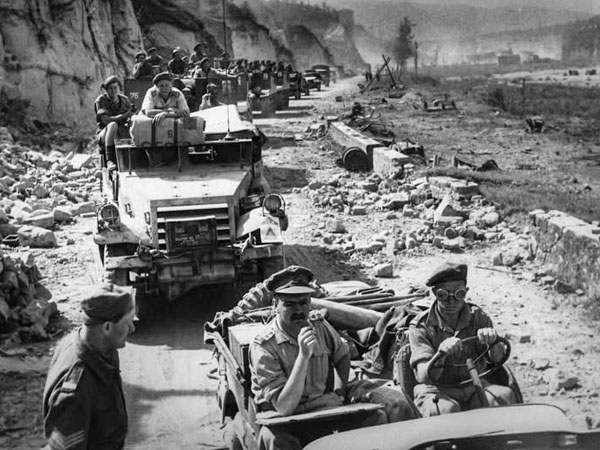
6th South African Armoured Division on badly damaged roads choked with advancing troops during its breakthrough to Bologna, April 1945 (The War Rooms on Facebook)
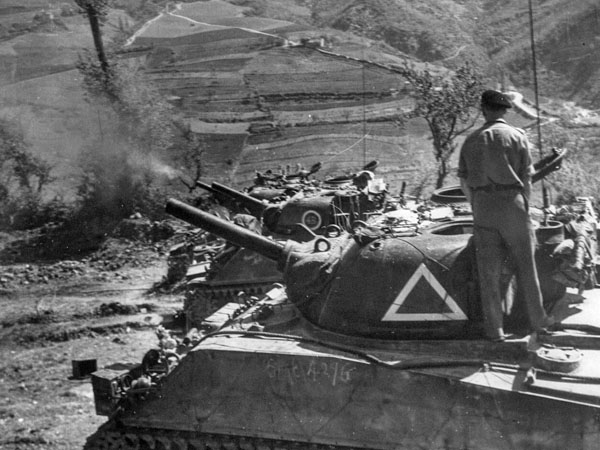
Tanks firing at Monte Sole and Montebello at the start of the attack which ended in the breakthrough to Bologna, April 1945. (The War Rooms on Facebook)
In those far-off days, the South Africans were fighting against fascism, Nazism, and Hitler’s dictatorship. Only four years after the events described above, the National Party won the 1948 election and in no time at all, South Africa was deemed to have crossed over to the dark side, politically speaking, losing a hard-earned reputation for defending democracy against dictatorships and tyranny.
Today, however, the new SANDF — loyal to the democratic constitution, subject to civilian oversight, and working with other commonwealth countries as well as the UN and the African Union — seems little changed from the ‘old’ defence force that the Italians would have known. The conventions, the protocols and ranks are the same. The only difference is that there seems to be a greater degree of flexibility when it comes to embarking on joint military manoeuvres with other countries. In fact, South Africa’s allied partners of 1944 might be surprised by some of the SANDF’s new bedfellows!
FRANK PHILIPS@GOODTHINGSGUY
FEATURED: Road sign in the Monte Sole commemorating the South African 6 Division. With thanks to FRANK PHILIPS. @GOODTHINGSGUY
Fascinating. Thanks, David.
Thank you David, for your research and article . Our father was in the 6th SA Armoured Division in Italy – and like many others, could/did not speak about their experiences in this War. We, his children, grew up ignorant of the Horror of WW11 and of his personal involvement history, and have only in our later years been able to research and investigate this. Despite modern perspectives and ‘treatment’ of such combatants, I am proud of my father, his róle, as well as his decision – for HIS reasons – to ‘simply’ continue forward in his own life and work commitments. I regret deeply, that, due to my ignorance, I was unable to discuss such experiences at a personal and world historical level – and offer him my pride and thanks. Marguerite Osler van der Merwe
Thank you Marguerite. I am very touched by your comment. The Italian campaign was one of the toughest of all the campaigns. Terrible weather and terrible ground conditions in the mountains. My father was an air combatant based at Foggia. From Foggia in the south of Italy the allies provided air support to the soldiers on the ground. And like your father he never really opened up about his war.
Greetings from a local museum dedicated to the history of the South African Division in Italy.
We found this story very interesting, but we are struggling to reconcile it with the historical record. The Marzabotto massacre took place well behind the front line during a German anti-partisan operation aimed at clearing the rear areas. Because of this, it is difficult to understand how a South African patrol could have directly stopped the massacre.
Could you please share the historical source or references for this part of the story? We would be genuinely interested in learning more. Thank you.