
By Maeder Osler
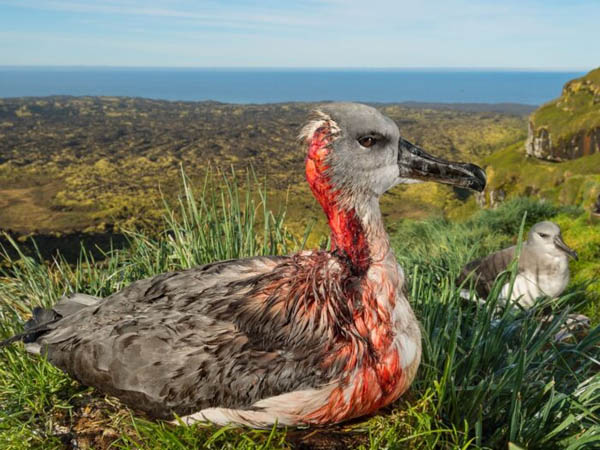
The horrifying images below show invasive House Mice, accidentally introduced onto Marion Island in the Southern Ocean in the early 1800s, eating Wandering Albatross chicks alive. In response, a massive global initiative has been launched to eradicate the House Mice and restore the ecological balance on this unique island.
Also see a video titled Wandering Albatross mouse attack. This is gruesome, and viewer discretion is advised. The invasive mice are nibbling away at the brain of a Wandering Albatross chick, and it will die an agonising death over a protracted period. The birds evolved to breed on islands with no mammalian predators, and have no defence mechanisms against them.
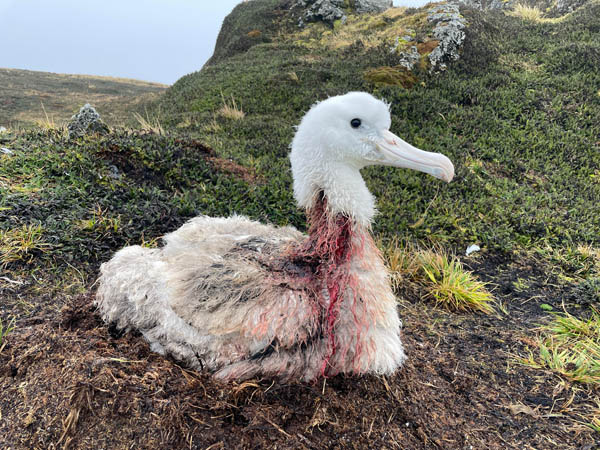
The pictures form part of a global appeal by ‘Saving Marion Island’s Seabirds – The Mouse-Free Marion Project’. This initiative is a joint partnership between the Department of Forestry, Fisheries and the Environment and BirdLife South Africa, and is being implemented through the Mouse-Free Marion Non-Profit Company (MFM).
If the mice are not eradicated, they may cause the local extinction of 19 of the 29 species of birds that breed on Marion Island,’ says Dr Guy Preston, vice-chair of the MFM Board. ‘Eradicate the mice, and we can restore the ecological integrity of this vital breeding sanctuary for seabirds’.
Significant progress
The Mouse-free Marion Project has made significant material and organisational progress. It is currently continuing to invite interested sponsors and supporters to meet with the Mouse-free Marion (MFM) team, care of Dr Guy Preston (+27 83 325 8799, guy.preston@mousefreemarion.org), or Tarryn Havemann (tarryn.havemann@mousefreemarion.org). Donations can also be made online.
All donations are eligible for section 18a certificates, thereby rendering them tax-deductible. This can be arranged by requesting the certificate from Tarryn Havemann (tarryn.havemann@mousefreemarion.org).
‘To date,’ Dr Preston reports, ‘the major donors have collectively invested more than US$16.1 million in the MFM Project, expressing confidence in the project’s scientific foundations, the strength of its governance framework, and the thoroughness of the planning and risk management that underpin its implementation. This includes a recent US$10 million pledge received from a Swiss-based foundation, following an extensive due-diligence process.’
The South African government has committed US$4 million, and other cumulative donations make up just over a further US$1.4 million (thus totalling US$21.5 million). The MFM Project management team may have to raise an additional US$13 million by the end of the third quarter of 2027, in order to prepare for the eradication operation in 2029.
Dr Preston adds: ‘We sincerely hope that you will consider joining hands with us to enable this unique, decisive and lasting environmental legacy, thus restoring Marion Island to its former glory as a critical Southern Ocean sanctuary.’
A threatened ecological integrity
It is widely acknowledged that South Africa’s top-level research and global scientific leadership have long characterised the work in the Southern Ocean’s critical environment. In its appeal, the MfM notes:
‘The Southern Ocean is home to one of the planet’s most extraordinary marine ecosystems, where whales, seals, and seabirds travel vast distances across the icy waters that connect the remote sub-Antarctic islands. Among these, Marion Island stands out as a vital sanctuary – a rare refuge where seals and seabirds can breed safely and sustain their populations.
‘Historically, seabirds on Marion Island had no natural mammalian predators and the lives of chicks were not at significant risk. However, this balance was unintentionally disrupted in the early 19th century when humans accidentally introduced a highly invasive species – the House Mouse. The mice are opportunistic omnivores, severely impacting the island’s birds, invertebrates and vegetation, and threatening the ecological integrity of this vital Southern Ocean sanctuary.
‘As the 20th century gave way to the 21st, a disturbing shift occurred and the mice began preying on the chicks, and even adults, of the surface-nesting seabirds for which Marion Island is renowned: its four species of albatrosses. If left unchecked, the crisis caused by mice on Marion Island could drive 19 of the 29 bird species to local extinction and trigger the collapse of the island’s ecosystem, disrupting the ecological integrity of the surrounding Southern Ocean.
‘In this harsh and expansive ocean, land is precious, and the survival of many species depends on these few islands. Their ecological importance is recognised globally, with many granted World Heritage status. Marion Island and its sister, Prince Edward Island, were declared a Special Nature Reserve in 1995 – South Africa’s highest level of conservation protection – underscoring their irreplaceable role in safeguarding Southern Ocean biodiversity.
‘Home to millions of seabirds, Marion Island is located 2,300 kilometres south of the African continent. The island is volcanic in origin, spanning 30,000 hectares, with its highest peak reaching 1,200 m above sea level. The terrain is rugged, with steep cliffs and numerous volcanic cones. It is wet, cold and windy; the average annual temperature is 4.4ᵒC.
‘Marion Island is also home to more than 30% of the world’s Wandering Albatross population, an iconic seabird that can lock its wings to glide effortlessly, covering up to 200,000 km per year. The Wandering Albatrosses return to Marion Island to breed and form lifelong pair bonds. These majestic birds lay just one egg every two years and dedicate an entire year to nurturing their chick until it is ready to take flight.’
The race to raise the remaining 40% of the budget by September 2027 is intense. A failure to do so would mean the needless deaths of hundreds of thousands of seabirds. But doing so could safeguard the island into perpetuity.
A complex project – but it can be done
Dr Preston has offered the following additional comments: ‘Rodents (mice and/or rats) have been eradicated from over 700 islands across the world. None has been as big as Marion Island, and that it a factor in the complexity of our project. Our technical team has learned from the experience and expertise in these projects, which greatly enhances the prospect of success.
‘Something that people often ask us is what collateral damage there will be. The answer is, very little. The vast majority of the 29 species of birds that breed on Marion Island feed at sea. They are not adapted to feed on land, and therefore do not eat the live or dead mice. (And the mice, when feeling sick, retreat into their burrows.)
‘There are four species of birds that will scavenge – the Black-faced Sheathbill, the Southern and the Northern Giant Petrels, and the Brown Skua. There are such scavengers on virtually every one of the 700 islands where similar work has been done. In not one instance has there been the extirpation (local extinction) of any indigenous bird species on these islands. While a few may die, the population will survive. And when the mice are eradicated, the population will explode, and build back towards what it was before the mice. But if the mice are not eradicated, this will be a real death sentence for the birds.’
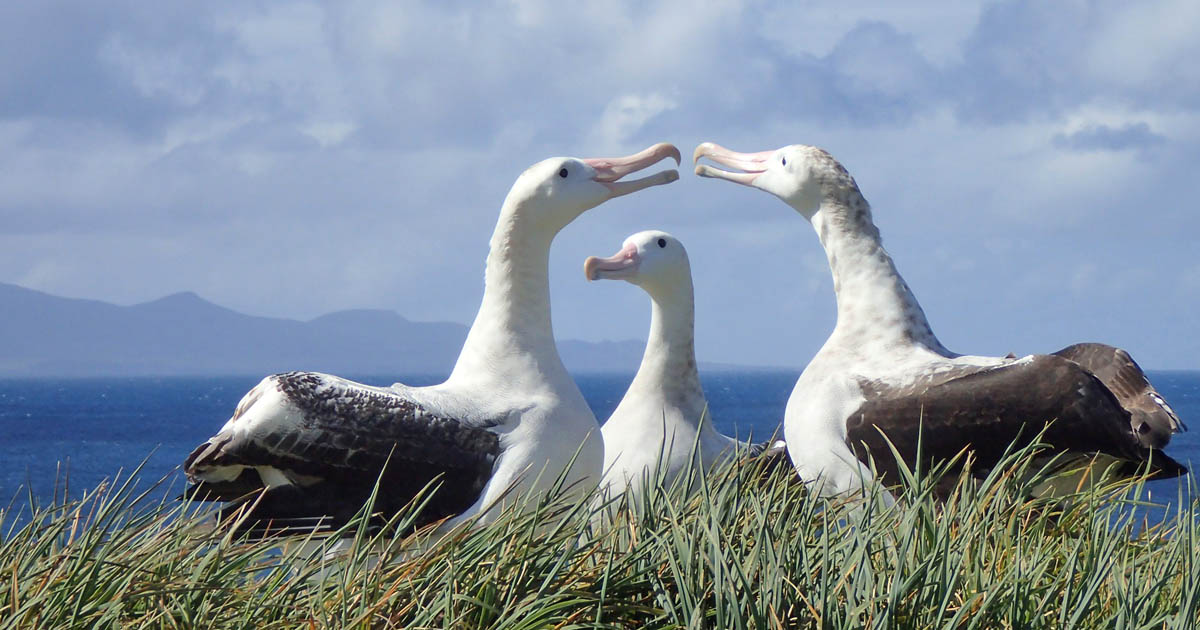
FEATURED IMAGE: Wandering Albatrosses on Marion Island, with Prince Edward Island in the background. Photograph by Michelle Risi. This is one of a number of posters that can be downloaded from the Saving Marion Island’s Seabirds website.
IMPORTANT LINKS:
Saving Marion Island’s Seabirds
Agreement on the conservation of albatrosses and petrels