
By R.W. Johnson
The demand for reparations for the Atlantic slave trade has been gathering momentum. It began with agitation about the issue in the Caribbean, and then the issue was taken up by countries along the West African coast which had actually been the principal victims of the trade. They in turn, led by Ghana, took the issue to the UN General Assembly where they had little difficulty in obtaining a large majority to vote that the Atlantic slave trade had been a crime against humanity, and that huge reparations must now be paid. It seems unlikely that they will even bother to try their luck with the Security Council, so that is currently where matters rest.
Nobody wishes to defend the Atlantic slave trade which was, indeed, a crime against humanity. But there are many problems with giving it such pride of place. Slavery is as old as mankind. It was common throughout the ancient world – the Jews were enslaved by the Egyptians, any number of conquered races were enslaved by the Persians, Greeks and Romans and later the Russians, and many East Europeans were enslaved by the Mongols (hence the word “Slavs”). Nobody is asking for reparations for any of that.
Even within Africa, the picture is complicated. Slavery was common in pre-colonial Africa, and long before the white man arrived, West African chiefs were enslaving their defeated enemies and trading slaves across the Sahara. Very often it was Muslim chiefs – among the Hausa, Fulani and Toucouleurs – who enslaved the non-Muslims, and indeed the traces of slavery continue in Mauretania to this day. Down on the West African coast other slaver chiefs, usually non-Muslims, welcomed the arrival of the white slavers, since it meant more customers for them.
Moreover, the Europeans, led by the British, were early in suppressing the slave trade, with the Royal Navy particularly prominent in capturing slave ships and freeing the slaves. This went very much against the grain for many African countries which continued to maintain slavery. Slavery abolition happened only in 1902 in Cameroun, in 1903 in Mali, in 1919 in Tanganyika, in 1922 in Morocco, in 1924 in Sudan, in 1928 in Sierra Leone, in 1935 in Ethiopia, and 1981 in Mauretania.
What is even stranger is that the Atlantic slave trade lasted about 300 years, but the Muslim trade in African slaves lasted for 1 300 years – and yet it goes wholly unmentioned by the AU.
The Muslim trade was extremely cruel, for the Muslim nations who bought the slaves did not want any permanent black population. So throughout the slaving network special castration centres were set up and all male slaves were castrated. Women were, of course, used as sex slaves, but when they had babies these were normally murdered at birth. This is why none of the recipient Muslim countries boast any African populations today comparable to the large black populations in the US, the Caribbean and Latin America. But, of course, this policy meant that the Muslim slavers had to keep raiding Africa for fresh intakes of slaves – and this they did.
In addition, of course, Muslim slavers from the North African Barbary coast raided Europe for slaves, and over time a million or more people were entrapped in this “white slave” trade. In many parts of Europe, local people were reluctant to live near the coast because of its increased vulnerability to these slave raiders.
African denunciations of the West usually bracket the slave trade with colonialism, but this ignores the fact that the suppression of slavery was often a founding rationale for colonialism. That is, Western countries would survey parts of Africa, find they already had a thriving slave trade, something which they viewed as pure pillage, and then they would cite the need to suppress the slave trade as a motive for colonisation which, they argued, ought to lead to proper development of these territories.
The financial demands that advocates for reparations insist upon vary. A Truth and Reconciliation Conference in Ghana in 1999 came up with the figure of $777 trillion. A judge of the International Court of Justice has come up with the figure of $107 trillion, and there is a Caribbean estimate of “only” $33 trillion. The Ghanaians helpfully say that the cancellation of all Third World debt could be part of the deal and, of course, lots of public apologies. Other calculations, allowing for the addition of interest, push the trillions into quadrillions.
Whichever figure you choose, this is probably the largest demand ever made by Third World countries for resources from the developed world. And by focusing only on the Atlantic slave trade, Ghana and its followers conveniently have the Americans and Europeans in their sights. This sits comfortably both with the old anti-colonial struggles against Britain, France and Portugal but also the more contemporary anti-Westernism current in the so-called Global South*. And, of course, the Americans and Europeans are extremely wealthy by Third World standards, a highly relevant fact given that the reparations demand, under its moral rhetoric, is all about money.
[ * A complete misnomer. The Southern hemisphere contains only 10-13% of the world’s population. The vast majority of the world’s poor live in the Northern hemisphere. And many Southern hemisphere countries like Australia, New Zealand, Chile, Brazil and Uruguay are relatively wealthy.]
But that is also why the demand for reparations is just not practical politics. Imagine being Starmer, Trump or Macron. Britain has a national debt of almost 100% of GDP and both the US and France have debts well over 100% of GDP. There is, in all three countries, no end of demands for more welfare spending, pension increases, higher defence spending, lower taxes and so on.
The idea of trying to persuade national electorates that they must forego all these things and forget about paying down their own national debts so that a whole series of gigantic payments to Third World countries can be made, is just not practical politics – and it never will be. Even as it is, aid to Third World countries has already been squeezed down to the lowest level for many years. And it would be all too easy for Western politicians to point at the corruption and denials of human rights in many African or Caribbean countries, and to ask whether anyone would really want to subsidise that.
So what will happen? Probably what happened in the 1970s. From the late 1960s onwards, inflationary pressures began to drive the international economy. Ultimately this was because Lyndon Johnson was determined to fight the Vietnam War and the War on Poverty at home without any tax increases. But at the same time there was a harmonisation of business cycles due to globalisation: instead of different countries having booms and busts at different times, all the major national economies began to boom in unison.
The result was rising prices for one commodity after another, often accompanied by world shortages of this or that commodity. This worked its way through the whole range of commodities, climaxing with gold and then oil. At which point there was a major world recession as all countries, rich and poor, struggled to cope with the sharply higher oil price. Developing countries were particularly hard hit – and they were extremely indignant. They were mainly commodity producers and had greatly enjoyed the era of higher commodity prices, but those prices had now collapsed. Instead, they faced much higher oil bills and mounting indebtedness.
Thus the Group of 77 developing countries was formed, demanding a New International Economic Order (NIEO). In effect, they wanted all commodity prices to be frozen at their old peak levels, which would have involved a permanent shift in the terms of trade and a massive transfer of resources from the developed countries to the Third World. This was, of course, accompanied by a great deal of moral rhetoric.
In May 1974 the Group of 77 (by then actually supported by 95 states) forced a Declaration for the Establishment of a NIEO through the UN General Assembly. Developed countries like the US and UK simply said this was impractical, but made no effort to mount their own moral rhetoric.
Matters stopped there, though the Group of 77 then unwisely began to complain about the often unflattering picture of the Third World given by the Western media. The problem, they said, was that all international news was dominated by a handful of Western press agencies – UPI, Reuters, AFP and so on. What was needed was a New International Information Order (NIIO), essentially a Third World press agency, which would control all news about the Third World.
This was a bad mistake. Many of the countries pushing for a NIIO had long complained that “the imperialist press” publicised things like governmental corruption in the Third World together with stories about political prisoners, abuses of human rights, the harsh treatment of women, political censorship and so on. It seemed clear that once a monopoly Third World press agency was formed, all such stories would disappear.
Writers and journalists throughout the world were horrified by the idea of a NIIO. Many Third World countries were one-party states, dictatorships, or were ruled by entrenched oligarchies. The idea that such countries would have a media monopoly of all news about themselves was dismissed out of hand as authoritarian censorship, and it was rapidly clear that the NIIO proposal was dead. Agitation for a NIEO continued but was damaged by its association with the NIIO, which had reminded international opinion of the darker sides of the Third World.
It was soon clear that while the moral rhetoric might continue, the NIEO was going nowhere. Getting its Declaration through the General Assembly had been the high point, but after that there was nothing that could be achieved unless all the developed countries agreed – which they didn’t. Propaganda for a NIEO continued for a while, but then began to fade. In 2022 a motion reaffirming the need for a NIEO was pushed through the General Assembly by 122-50, but almost no one noticed. The truth was that the NIEO had died long ago.
It seems likely that the demand for slavery reparations will go through the same process. At its heart the attempt at reparations is, like the NIEO, an attempt at a huge grab for Western resources to be redistributed to the Third World. And, as with the NIEO, it will go nowhere unless a large number of developed countries agree voluntarily to go along with this. With the sums to be redistributed mounting into the many trillions or even quadrillions of dollars, it is simply a political impossibility to imagine the developed countries agreeing to anything like that.
For the fact is that in all the excitement of their righteous indignation, the poorer countries have repeated their mistake. With the NIEO they not only demanded the impossible – that commodity prices be frozen at their old peak level – but then over-reached even further by demanding a NIIO. Similarly now, if the African countries had asked for, say $1 trillion, they might have got something near that over time – thanks merely to soft hearts in the West. But going for far higher numbers may be exciting and more in line with all the self-righteous indignation about slavery, but it actually robs the whole exercise of credibility.
As may be seen, there are in any case all manner of difficult questions to be answered about concentrating merely on the Atlantic slave trade. The reparations enthusiasts make no answer to these questions, and this too is not good enough. So while they may engender a good deal of sympathy, they will not succeed. They have already reached their high point – getting their motion through the UN General Assembly – and ahead stretch years in which they will be quietly ignored until their agitation fades away.
The fact is that human history is full of sad and terrible events. They are not going to be “put right” now any more than we can turn back the clock on the Fall of Rome, which brought about the Dark Ages, or, later, the Fall of Constantinople, the St Bartholemew’s Day Massacre, the Holocaust – or, indeed, all the different systems of slavery. All we can do is learn from this terrible history never to repeat such things.
We seem, slowly, to be doing that as we listen to “the better angels of our nature”. It would be more sensible to celebrate, as black Americans do, Watch Night (“Freedom’s Eve”) on December 31, as slaves waited to hear Abraham Lincoln’s 13th amendment to the Constitution, abolishing slavery, signed on January 1, 1863. Or Juneteenth (June 19), commemorating the day when the news of Emancipation finally reached Texas, thus completing the abolition of slavery throughout the USA. Why not special celebrations of the Abolition of the Slave Trade (1807) or the Slavery Abolition Act of 1833-34, for both those events had effect on a much wider scale, throughout the whole British Empire and beyond?
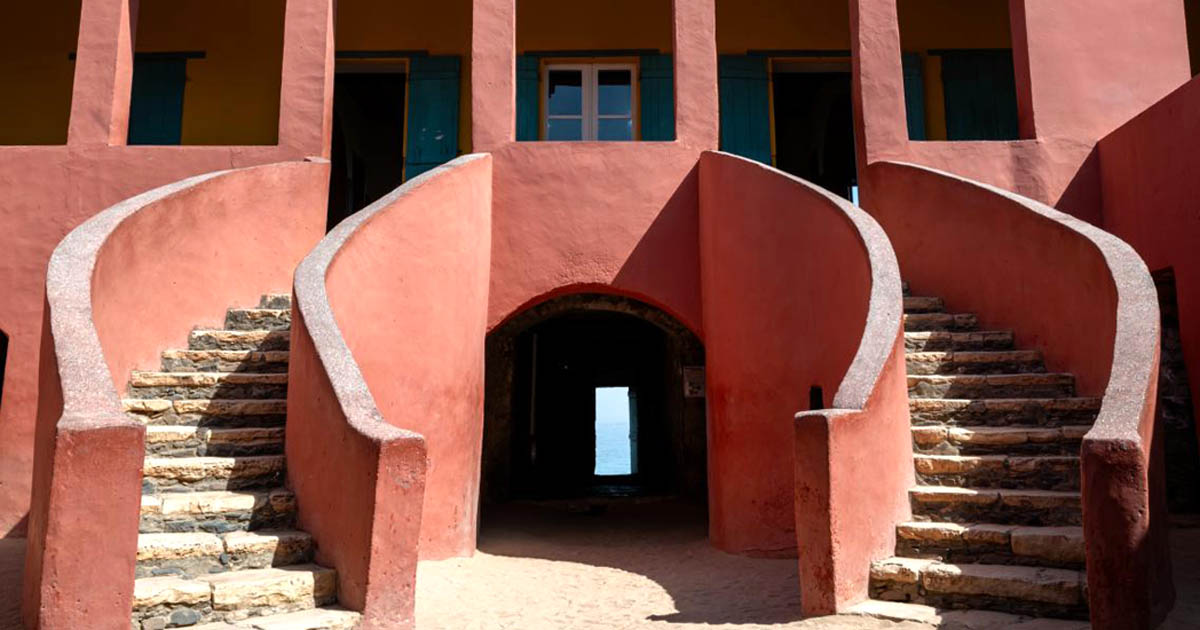
FEATURED IMAGE: The House of Slaves on Gorée Island, off the coast of Senegal, opposite Dakar. From the 15th to the 19th century, it was the largest slave-trading centre on the African coast, ruled in succession by the Portuguese, Dutch, English and French. This picture shows the narrow door —also known as the Door or Point of No Return — through which slaves were loaded onto ships bound for the Americas.