By Phakamisa Mayaba
You may have missed a potentially ground-shifting but underreported story that transpired at OR Tambo International Airport when, on Sunday 5 April, three Nigerian nationals were barred from entering the country.
Not because they did not have the requisite paperwork, or they had committed any criminal act. Apparently, one of them, a man known on X as Yemi Firstson, had written a number of insulting social media posts on social media, on the grounds of which he was adjudged to be an undesirable entrant.
According to reports, the Nigerian in Diaspora Commission (Nidcom) attributed the incident to an over-reliance on the part of these nationals to unregulated visa agents as well as Firstson’s alleged flagging by the South African government for previous offensive social media posts, a claim which Firstson disputes. ‘At no point did any South African immigration official make reference to or ask me anything about my social media,’ Firstson reportedly said.
In a statement, the national immigration branch of tghe department of home affairs said it routinely reviewed applicants’ social media profiles, and warned that derogatory or inflammatory posts about South Africa or its government could lead to heightened scrutiny, entry refusal, or future bans.
‘In your specific case, prior online posts containing insulting remarks about the South African government had already placed you on the authorities’ watchlist. Your inability to adequately explain or substantiate those statements during processing further aggravated the situation,’ the statement read.
This incident reveals that the South African government has taken an important new direction in respect of immigration control. In fact, it comes at a time when, according to the department of home affairs, nearly 110 000 illegal immigrants have been deported since the formation of the Government of National Unity (GNU).
Dr Leon Schreiber, minister of home affairs, has stated: ‘These numbers show that we are now reaping the fruits of reforms focused on greater efficiency and intensified enforcement against immigration violators. Through ongoing campaigns like Operation New Broom, as well the increasing use of biometric verification tools, we have already increased deportations by 46 per cent.’ He added that the department’s impending Electronic Travel Authorisation (ETA) system would record the biometrics of every foreigner entering the country.
Despite having a reputation as a generally welcoming country, the ongoing revamp at home affairs means that South Africa is finally catching up with global trends. In March last year, the SA ambassador to the US, Ebrahim Rasool, was declared persona non grata by the US secretary of state, Marco Rubio, following a webinar in which Rasool had made ‘unacceptable’ remarks about Donald Trump. Rubio had first made the decision known on X before formally informing Rasool.
The State Department also revoked the visa of the SA record executive Nota Baloyi for posts he’d made about the death of Charlie Kirk in October last year. During that time, in a post on X, the department reportedly listed tweets from foreigners in the US who had supported the assassination, saying ‘the United States has no obligation to host foreigners who wish death on Americans’.
Protests in KuGompo
In the meantime, KuGompo (the former East London) has been engulfed in protests that have turned violent against the presence of foreign nationals. Although xenophobic and anti-foreigner tensions have sporadically flared up in some parts of the country, this particular case was triggered by viral social media videos and images showing the supposed coronation of Chief Solomon Ogbonna Eziko as the ‘Igwe Ndigbo of KuGompo’. This triggered a huge mobilisation and backlash on social media, from KwaZulu-Natal to the Eastern Cape.
Some employers have taken to reviewing the social media profiles of applicants, and some countries have done the same in respect of visa applicants. Initially, this seemed innocuous and understandable. However, it has also raised questions around bias, especially in one particular case when a Palestinian student bound for Harvard University was denied entry into the US based solely on his social media contacts. Although he had not posted anything inflammatory himself, his contacts had.
In Australia, according to one report, ‘if an applicant’s social media shows they are working full-time while holding a student visa, it could lead to immediate visa revocation for breaching the visa’s conditions.’ This also means that the authorities may use social media to scrutinise things like spousal visas and the like. With more countries realising the effectiveness of this form of monitoring or assessment, the concept of a ‘digital footprint’ takes on far more concrete and immediate consequences.
The incident at OR Tambo is an indication that South Africa might be moving in the right direction. Given the massive influx of illegal foreign nationals, it needs to stay abreast of these trends. Some might say this veers dangerously towards the line of a fascist state, but, provided it is kept within the prescripts of the law, it may well serve as an indispensable source of information. Unsurprisingly, given his stance on illegal foreigners, ActionSA leader Herman Mashaba is all for it.
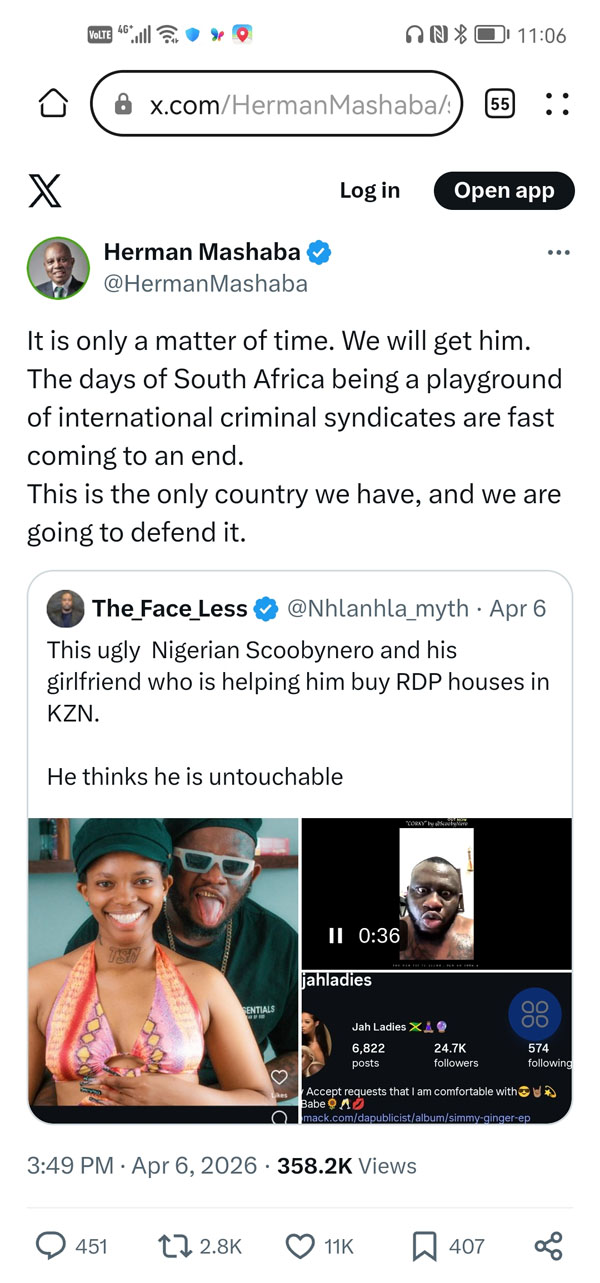
A screen grab of ActionSA leader Herman Mashaba’s post on X.
Recently, the Nigerian rapper Scooby Nero posted a video in which he claimed to own RDP houses in Roodepoort, from which he collected rent. In response, the Gauteng department of human settlements said it was launching an investigation into the allegations.
Mashaba, however, came out with this fiery tweet on X: ‘It is only a matter of time. We will get him. The days of South Africa being a playground of international criminal syndicates are fast coming to an end. This is the only country we have, and we are going to defend it.’
The Nigerian national has since apologised, claiming that he’d meant no harm, and that he was just ‘trolling’. However, this incident has shown again how the seeming openness of social media can lead to self-incrimination and encourage that most common quality of mankind – human stupidity.
In this unscripted, real-life saga, we have seen criminals being rounded up after posting incriminating photos, and tenderpreneurs facing the music thanks to lifestyle posts. The net has exposed everybody from drug dealers to philandering partners. Given that it can also put some people who have no legal right to be here on the deportation bus, social media has become far more than a platform for posting what your dog had for lunch today.
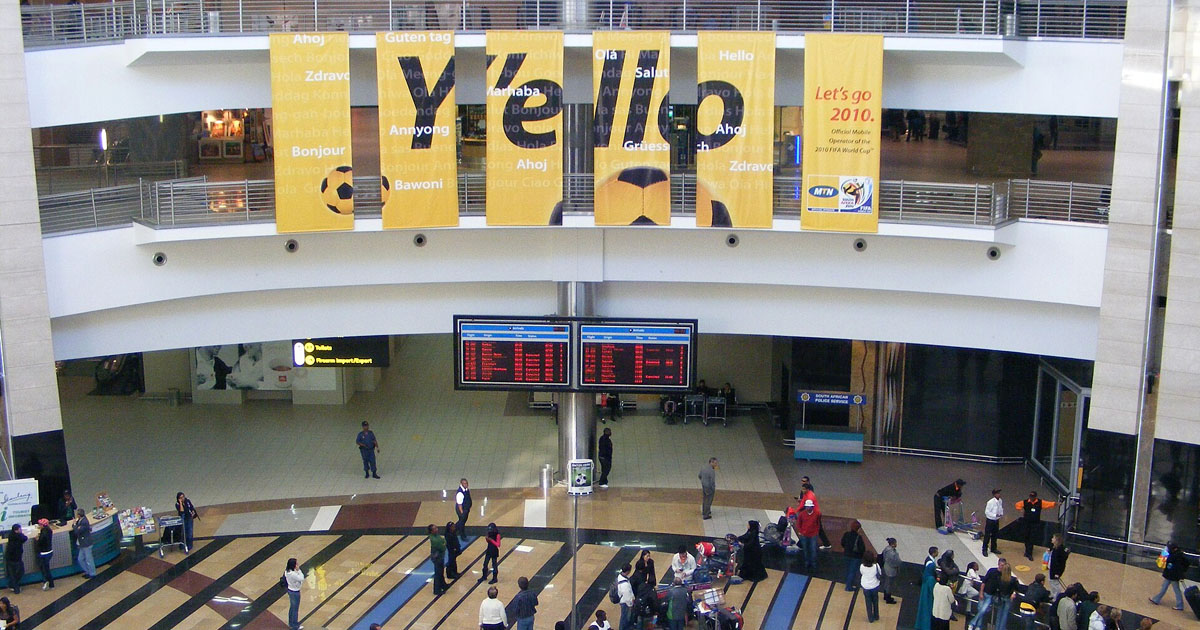
FEATURED IMAGE: International arrivals at OR Tambo Airport. (Wikimedia Commons)
This is an edited version of a report that first appeared on Phakamisa Mayaba’s website, eParkeni. Used with permission.