
By Maeder Osler
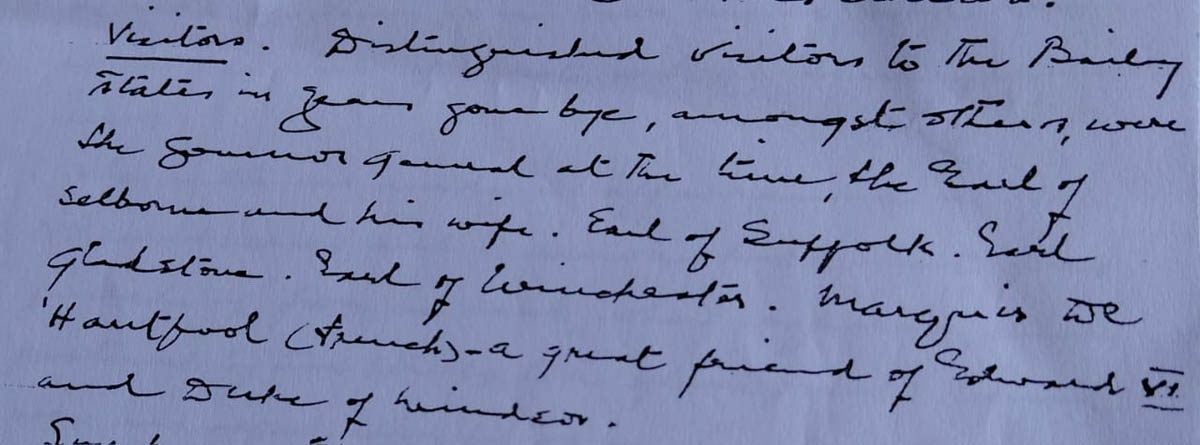
What follows are the last notes in the memoirs of Morton Barnes-Webb, manager of the 45 farms held by the Rhodes Beit Bailey (RBB) syndicate in the Nuwe Hantam district of Colesberg in the early 1900s. As noted previously, they were written after his retirement to Kirkwood in the Eastern Cape. They form part of an extensive collection of documents donated to Toverview by Morton’s grandson, Peter Barnes-Webb, who until recently also farmed in the area. These notes, grouped under a concluding heading of ‘Sundry’, provide fascinating insights into the ‘warp and weft’ of life in the Nuwe Hantam at that time.
AASVOGELS
‘Aasvogels were very prevalent and unless a farmer spotted a sick animal in time he seldom found anything but a heap of bones.’
SPRINGBOK
‘Springbok were plentiful and found on almost every farm and ‘biltong’ was a standard item in every home. They disappeared largely when fencing and intensive sheep farming began.’ Footnote: ‘As far as I can remember the fencing act came into force in 1912.’
ROCK PAINTINGS
‘Bushman rock paintings are prevalent all over the area and some fine specimens occur on the farms Oorlogspoort, De Poort, Vlakfontein, Platberg, Holle Rivier, etc.’
EARLY DAYS TRANSPORT
‘Early days’ transport were very limited and confined to ‘cart and horses’ and the farmers were very isolated in consequence. This resulted in very self-contained households and a grand buildup of character.’
THE SMOUSE
‘A very useful asset to farm communication was the ‘Smouse’, who conveyed town goods round the countryside in a cart and horses and bought or exchanged the farmer’s skins or ostrich feathers for his own wares, and was able to put him up to date with the latest general news.’
THE MOTOR CAR
‘The motor car made its appearance in 1906. No windscreen and a canvas hood that was pulled up from the back, and fastened by two straps to the dash board. Speed was manipulated by two long levers outside the car, and reached an average of about 25 miles per hour, due to the roads at that time having earth humps across them known as ‘Dwars walle’, for drainage purposes – every 100 yards more or less.
‘Petrol was only procurable in 4 gallon tins, packed two in a case, like paraffin, and general repairs had to be carried out by the owners. The car was started by adjusting a crank level in front and was always a severe physical strain to manipulate – especially in winter. If one ran our of oil and the engine heated, a lb, of butter, of you were carrying any, slipped into the engine ‘did the trick’, and one could at least reach home!’
NOTE AT THE END OF THE MEMOIRS
‘Written in good faith and without prejudice to anyone. At 82 this is the best I can do.
‘Best regards. M.W. Barnes Webb, ‘Leehurst’, Kirkwood, 9.7 .’52.
This is so interesting. I am sorry that this is the last. But maybe another old source will appear. Thank you. Antony