
By Destine Nde
Pope Leo XIV has almost completed a historic 11-day tour of Africa, only his second since the inauguration of his pontificate – the start of his reign – in May last year. From 13 April onwards, he has visited Algeria, Cameroon, Angola and Equatorial Guinea, and was due to return to the Vatican on 23 April.
His main objectives have been to advocate peace, promote a solution to problems of migration, and promote religious ecumenism, with a view to establish a universal ecumenical Church (a cherished dream of the Catholic Church since the time of the Caesars).
The visit has underscores the growing importance of Africa to the Catholic Church. According to the Vatican, Africans constitute more than a fifth of the universal Catholic population of more than 288 million people. Its latest surveys have revealed a a ‘remarkable increase’ in the number of Africans being baptised into Catholicism. In fact, Africa is one of the fastest growing regions in the Catholic world.
The Pope’s commitment for peace in Africa, for a mutually beneficial and lasting solution to the migration problem, and for religious ecumenism can clearly be seen in the countries he has chosen to visit.
While largely a non-Catholic state, Algeria was the birthplace of the fourth-century North African theologian St Augustine of Hippo — one of the most influential teachers and ecclesiastics in the history of Catholicism. His teachings and prolific writings helped to define and shape the future of the church.
He was born in the city of Hippo — now called Annaba — in Algeria, and was the Bishop of this part of the Roman Empire. This meant that he was the head and official representative of the Roman Catholic Church in Africa. His doctrines shaped theology and Western thought for more than 1500 years.
Actually, Pope Leo XIV is still a follower of St Augustine and a devoted student of his voluminous writings. He is the first Supreme Pontiff of the Catholic Church to visit Algeria — a predominantly non-Catholic country.
In the capital of Algiers, he condemned the ‘continuous violations of international law and neocolonial tendencies’, which provoked the ire of US president Donald Trump. He also pointed out that ‘Africa knows all too well that people and organisations which dominate others destroy the world.’
He also pushed his ecumenical agenda in a dialogue with Islamic leaders in the Great Mosque of Algiers, and during a visit to the Basilica of our Lady of Africa, a site of prayer and pilgrimage for Christians and Muslims, containing a statue of black Virgin Mary.
Behind the altar, a famous French inscription reads: ‘Notre Dame d’Afrique, priez pour nous et pour les musulmans’ (‘Our Lady of Africa, pray for us and for the Muslims’).
In the Cameroonian capital of Yaounde, the centre of Francophone Cameroon, he was received by President Paul Biya, as well as many other religious and political leaders. He held Mass and delivered a speech in which he exhorted the government and other role players to opt for reconciliation and for achieving peace by non-violent means. He then flew to Bamenda, capital of the English-speaking North West — the main destination of his visit.
In Cameroon, the conflict between the francophone and Anglophone regions has been raging for more than a decade. According to the UN, nearly a million people have been killed, and about half that number forced to abandon their homes.
At Bamenda National Airport, the Pope was welcomed by thousands of people, including political, religious and traditional rulers, and the streets were lined by waving crowds. Among those on the runway to welcome him and usher him into the city were pastors and Imams in their holy attires. Politicians and security guards in black suits were running on both sides on the convoy. Traditional leaders, also in sacred regalia, could be seen everywhere.
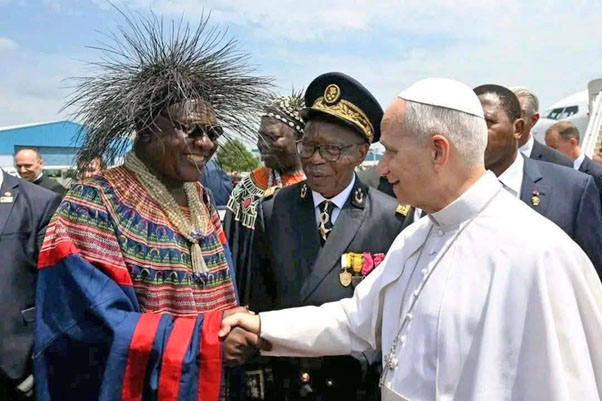
Pope Leo and the Fon Fru of Mankon (the author’s village) at Bamenda airport. Image: the author.
After a brief meeting with local authorities, the Pope moved to the Cathedral of St. Joseph, seat of the Archdiocese of Bamenda. Before entering the Cathedral, he and Archbishop Andrew Nkea stopped in the Chapel of the Blessed Sacrament to pray for peace. There he listened to testimonies of the Paramount Chief of Mankon, the Moderator of the Presbyterian Church, and the Imam of the Central Mosque of Buea – all about the ongoing conflict in Cameroon.
The most crucial part of the gathering came when various victims recounted their experiences of torture, displacement and personal loss. Many people in the audience wept, and the Pope himself clearly struggled to hold back his tears.
He eventually said their ‘lived experience of suffering’ would strengthen their faith in God. He also alluded to himself as a Messenger of Peace by quoting from the Book of Isaiah: ‘How beautiful upon the mountains are the feet of the messenger who announces peace … to this blood-stained yet fertile land that has been mistreated’.
He thanked those present for welcoming him so warmly, and emphasised that he was there to proclaim peace. He then seized the moment to promote ecumenism, pointing out that conflict often brought communities closer together. This included Muslims and Christians in Cameroon. He encouraged them to strengthen this bond, and to use it to facilitate the urgently needed peace and reconciliation.
He went on to warn against those who ‘manipulate religion and the very name of God for their own military, economic and political gain’. Addressing the ‘masters of war he said: ‘It only takes a moment to destroy, yet often a lifetime is not enough to rebuild.’
He lamented how those in power (taken to be a reference to Trump) were turning a blind eye to the billions of dollars spent on killing and devastation, yet ‘the resources needed for healing, education and restoration are nowhere to be found’. He urged everyone to denounce and reject this ‘exploitation of God’s creation’, and to be part of ‘the silent revolution’ in the mission to love one another and to live in peace.
His next destination – Angola – has also been stepped in bloody conflicts, including a protracted bloody civil war from the mid-1970s to 2002. Peace and reconstruction were his main themes
The situation in Equatorial Guinea is similar to that in Cameroon, only less overt and blatant. Social injustice and political hegemony have plagued the country for more than five decades, and human rights abuses abound. Among others, the Pope visited a prison and a psychiatric hospital, pray for the inmates’ rehabilitation and recovery.
There is no doubt that the Pope – and the Catholic Church – are making an honest effort to promote peace and prosperity in Africa – indeed, in some instances, the Church’s efforts to improve people’s daily lives and relieve suffering has surpassed that of numerous governments.
For all of this, the role of religion in Africa remains controversial. In 1843, Karl Marx famously described religion as ‘the opium of the people’, meaning that, by providing solace to the poor and oppressed, and encouraging them to seek liberation in a world to come, it dulled their capacity to identify that they were being oppressed in this world, and to fight for social change. Almost two centuries later, this remains an open question.
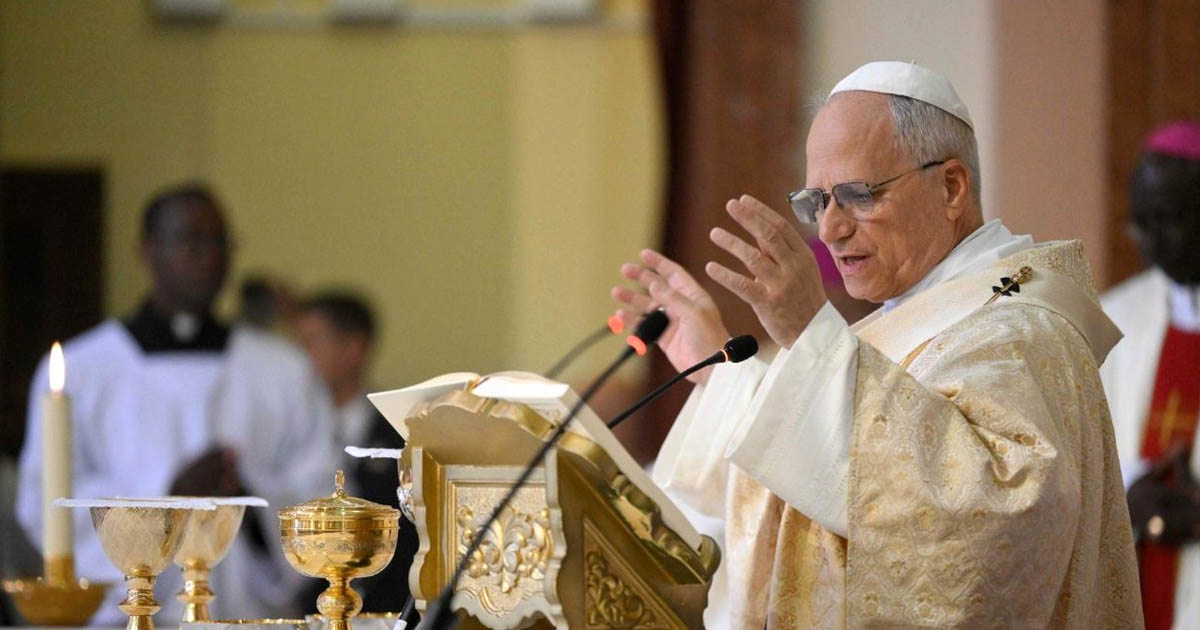
FEATURED IMAGE: Pope Leo XIV presides at Mass in the Basilica of the Immaculate Conception in Mongomo, Equatorial Guinea. (Vatican News on Instagram)
Thahk you for this overview: so informative and interesting for those of us who didn’t follow the Pope’s tour.