
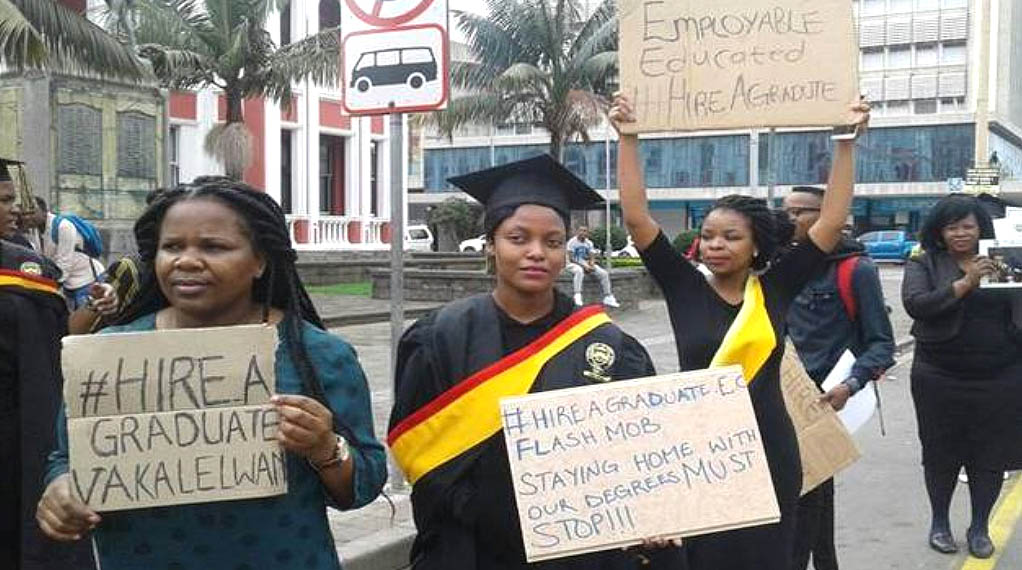
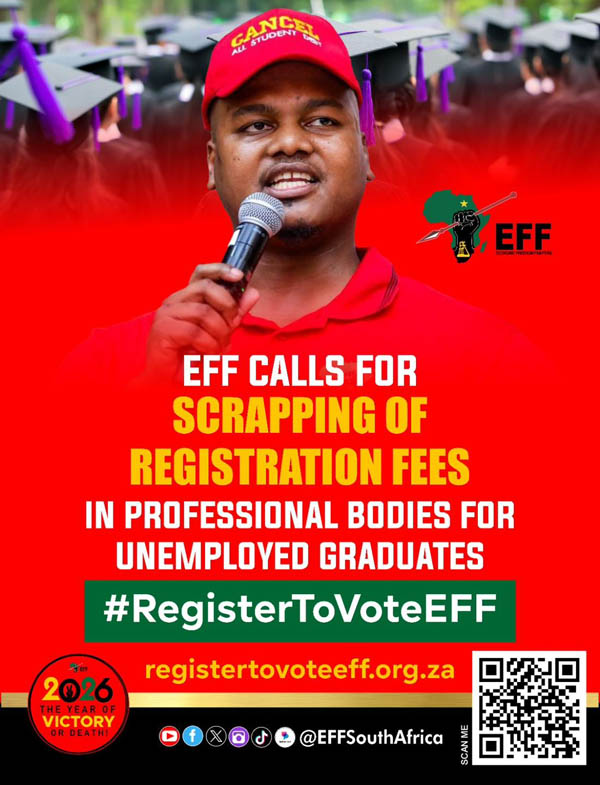
The Economic Freedom Fighters (EFF) have begun to say that unemployed and early career professionals should no longer be required to pay annual registration fees to various statutory professional bodies.
The EFF MP Sihle Lonzi is playing a leading role. In a letter to the Portfolio Committee on Higher Education and Training asking for an ‘urgent intervention’ on this matter, he motivated this by stating that when unemployed professionals failed to pay their annual fees, they were often deregistered, which made it even more difficult for them to be employed.
A little over a year ago, Lonzi also led an attempt to ease the financial burden on university students by proposing that their debts to NSFAS be written off if they pass their final exams.
At the time, the chairperson of the parliamentary higher education and training committee, Walter Letsie, told reporters that it was ‘too soon’ for such a law. Ironically, this rebuff came at a time when university campuses were experiencing renewed protests about fees and admissions; NSFAS was embroiled in allegations of mismanagement and corruption; and university graduates were struggling for find jobs, which made it even more difficult for them to repay NSFAs for their studies.
It also came a decade after the #FeesMustFall movement, the most incendiary student campaign of the post-democratic era. It began in October 2015 as a protest against increases in tuition fee, starting at Wits University and expanding to UCT and other campuses, and widening into a demand for free and decolonised education for all. It came in the wake of the #Rhodesmust fall movement, in which students demanded the dismantling of and redress for colonial and apartheid-era legacies in higher education.
In this turbulent time, university managers found themselves inundated with calls against fee increases, assistance to poor learners, the clearing of previous student debt, as well as the removal of symbols of colonialism and apartheid, and the ‘decolonising’ of curricula.
Various prominent organisations and individuals, including the ANC government, were not impressed. In a letter to The Times, former president F. W. de Klerk wrote that even though Rhodes had been an architect of the Anglo-Boer War, the National Party government had never ‘thought of removing his name from our history’.
Increasingly, the ANC finds itself accused of having distanced itself from society’s immediate problems – including the vital issue of joblessness. The unemployed who haven’t yet given up looking for work tell disheartening stories of how expensive job-seeking has become. Internet cafes, printouts of CVs, copies of qualifications, transport and the like all come present obstacles to those without a source of income. The complaints grow louder when the position applied for is allegedly a deployment gig, the advertisement a mere formality, and responding to it a waste of time.
There is little doubt that the EFF campaign has also been launched with an eye to the forthcoming elections — indeed, a recent EFF post on Facebook ties the campaign directly to a call for votes (see above). That said, if it succeeds, it will be a significant step towards easing the plight of young professionals who say that, despite their professional training, they are struggling to find jobs.
FEATURED IMAGE: Unemployed graduates demonstrating outside the South African Parliament.
Such a no-pay strategy, while it might ameliorate the circumstances of unemployed recent graduates, will become a logistical headache. How will graduates “prove’ that they are unemployed and then when they are employed, how will their status be changed so that they become payers again. Too complex for real time implementation.