
By R.W. Johnson
The rising tempo of anti-immigrant marches and agitation is doubtless calculated to dominate the pre-election period – although municipalities have no control over migration. There are three parties who stand to gain – the MKP, Action South Africa and the Patriotic Alliance, all of which have taken a strongly populist position against illegal migration. They have been joined by social entrepreneurs like the March on March and Dudula movements, and of course the effect on the ground has been to mobilise a general sentiment against all foreigners, legal and illegal.
The unpleasant result is that the numerous foreign workers present in South Africa all live in an atmosphere of fear and distrust. Nobody knows how many illegals are here – estimates range between two and five million – but there are also many who have, by one means and another, acquired official papers, legalising their presence. But everyone knows that it has always been possible to buy such papers from corrupt officials at Home Affairs or from township forgers. The beneficiaries of such deals are said to have “self-naturalised” themselves, but the effect has been to cast a shadow over even those whose presence here is indeed perfectly legitimate.
This in turn leads to a bogus debate about xenophobia. That is to say, other African states and many well-meaning but thoughtless folk excoriate South Africans for having primitive anti-foreign attitudes. The ANC used to appeal against xenophobia both on vaguely pan-Africanist grounds – all Africans are brothers etc – and on the grounds that other African states had supported the anti-apartheid struggle and given sanctuary to ANC missions during the Struggle.
But this was all very foolish. It is pointless to criticise hostility to foreigners as if this was all just about people merely having bad attitudes. And the fact that many (though not all) African states had supported the anti-apartheid struggle or given sanctuary to the ANC was also besides the point. A general African hostility to apartheid was, after all, simply normal and while the ANC ought indeed to pay its debts to foreigners who have supported them, that doesn’t mean that South Africa as a state must also pay those debts. In any case there is no equivalence between a small ANC mission being able to set up shop in Lagos and many thousands of Nigerian immigrants moving into South Africa.
The fact is that any sovereign state has the perfect right to control its own immigration policy. Most Asian states such as China and Japan have historically made immigration very difficult or impossible. In practice only a minority of Western states – and most particularly the Anglophone states, the UK, US, New Zealand, Australia and Canada – have policies of actively embracing immigration. Nowadays most European states also make acceptance of refugees the norm. But such openness is far from the international norm.
Even within Europe there are stark exceptions. A number of East European states, led by Hungary, refuse to accept any Muslim immigrants. Viktor Orban, the then Hungarian prime minister, was recently asked about Muslim immigration. “Well”, he replied, “Muslims have their place. But that place is quite definitely not in Hungary.”
Similarly, when Syria blew up in 2015, creating a huge Syrian refugee problem, the Saudis refused absolutely to take any of these refugees, even though they were Arab Muslims. They explained, simply, that Syrians were very different from Saudis and would never fit in Saudi society. So the Syrians were accepted instead by Germany’s Angela Merkel. The result is seen in today’s polls showing the anti-immigration AFD leading even the governing CDU.
The basic fact is that South Africa has one of the highest unemployment rates in the world, and that simultaneously allowing in millions of migrants is simply suicidal. There is no country in the world in which even a ten percent unemployment rate would not lead to strong resistance to foreigners being allowed in to compete for scarce jobs – and the South African unemployment rate is three or four times higher than that.
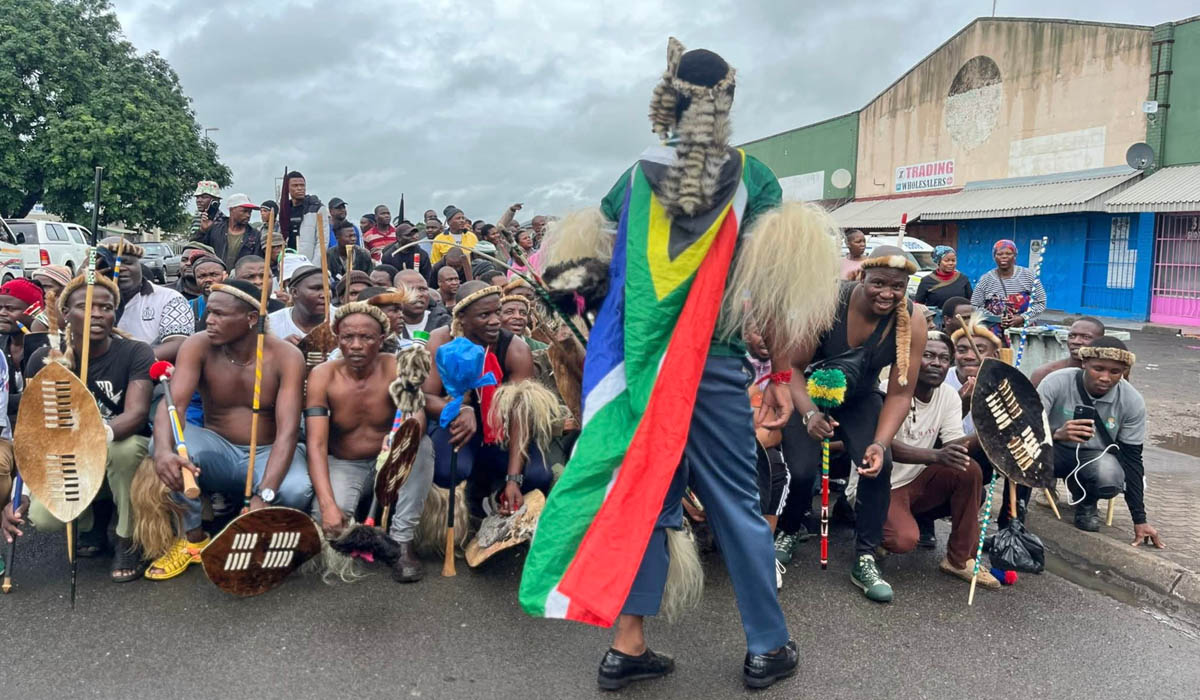
It is absurd to blame South Africans for xenophobic attitudes when resistance to immigration is simply a sociological law even at far lower levels of unemployment than South Africa suffers from. That said, there are some South African quirks to the situation. Xenophobic anger seems to be particularly pronounced among Zulu-speakers and, indeed, to have some sort of connection to Zulu nationalism. This is reflected not only in the size of the anti-foreigner marches in Durban but in the fact that even in cities outside KwaZulu-Natal the leaders of such marches are often dressed in traditional Zulu attire with shields, sticks and “traditional weapons”. Moreover, the Dudula vigilantes use an ability to speak Zulu as the acid test of whether someone is a South African or a foreigner, which is leading to some rough treatment for members of South African minority tribal groups.
All of which leads some to suspect that Zuma and the MKP are the main force behind the anti-foreigner agitation. Certainly, the issue is tailor-made for populist agitation: there is no doubt that anti-foreigner sentiment is very widely spread and that, quite rightly, people blame the government for the situation. Moreover, Zuma has been very quiet for a long time – apart from pursuing a hopeless case against the IEC for allegedly rigging the 2024 election and thus robbing the MKP of victory. This is a fantastical claim: the MKP did exceptionally well for a party only founded a few months before the election but victory was never a plausible goal.
However, Zuma has often been underestimated, and one should be wary. The fact that he was apparently hoping to win the 2024 election is more significant for the ambition it displays. Before the ANC’s Polokwane conference in 2007, few took Zuma’s chances seriously, but he won easily with 60% of the vote. He then utterly dominated politics for a decade, and all attempts to resist or unseat him failed. Having achieved that, Zuma’s ambitions deserve to be treated with respect. There is no doubt that he still hopes to fold the declining ANC into a coalition that he leads. And he is an immensely shrewd and opportunist player of the game.
Certainly, something is cooking in Zulu politics. Currently Zuma is trying to draw the National Freedom Party to his side, and if he succeeds, the MKP will take over KwaZulu-Natal. The fact that the Zulu King has recently suggested omitting “Natal” from the province’s name is a bare-faced piece of Zulu nationalism – which Zuma may have suggested, and with which he certainly seems comfortable. And Zuma recently held talks with Solidarity’s Kallie Kriel, triggering rumours that they may have a common interest in ethnic self-determination – Solidarity in an Afrikaner volkstaat, Zuma in an autonomous KwaZulu. On top of that the adoption of a strong anti-foreigner stance could well see the MKP deal the tottering ANC a lethal blow. Moreover, the fact that the EFF is in favour of open borders gives the MKP a wonderful chance to smack down its populist rival.
The current situation is the result of ANC fecklessness. On the one hand it has insisted on enforcing economic policies which emphasise anything but growth and which has seen unemployment increase by leaps and bounds. On the other hand it has effectively adopted an open borders approach for the last 32 years. For long the government used to castigate xenophobia as a great evil but it has grown progressively more silent, faced with the huge unpopularity of illegal immigration. Now at last there is an energetic Home Affairs minister who is deporting foreign illegals but there is still no general recognition of how alarming the situation is.
South Africa’s image as a relatively rich, developed country is firmly fixed in African minds, guaranteeing a continuing large flow of would be immigrants. In reality, South Africa is a water-scarce country only able to support a maximum population of 70 million, which it has already reached. And that 70 million figure was predicted way back in the apartheid period when water infrastructure was maintained far better than it is now. Already water shortages have become a fact of life in most of the country.
Then there is the African demographic explosion. This is often celebrated as a sign of Africa’s vitality and its plenitude of eager young workers. But in fact the numbers are frightening. As of now the continent has 1.58 billion people (with a median age of 19.5 years) and is predicted to grow to 2.5 billion by 2050 and 3.8 billion by 2100. There is no earthly way in which weak, rickety and corrupt African governments are going to be able to feed, educate, house and employ such numbers so it would be sensible to anticipate growing social unrest, wars, famines and other disasters. Indeed, such disasters are already happening. By the same token this will generate enormous migratory pressure by Africans wanting to leave for Europe or South Africa. Europe is already making such migration more difficult.
Nigeria currently has 237 million people. This total is expected to grow to 400 million by 2050. Ethiopia’s current population of 139 million is expected to grow to 210-225 million by the same date. The DRC, which had only 15.3 million people in 1960, now has 116 million, and this is projected to grow to 215-218 million by 2050. All three of these countries already produce sizeable migratory flows to South Africa but, as can be seen, these are likely to at least double in the near future.
Similarly, in 1950 Uganda had a population of only 5.2 million. By 2025 this had increased to 51.4 million and by 2050 the number is expected to reach 103 million. Tanzania had only 7.6 million people in 1950 but now that has grown to 70-72 million and by 2050 the number is projected to grow to 129-141 million. Kenya had 7.7 million people in 1960, has 58.5 million today and is expected to have 100 million by 2050. These are the world’s fastest growth rates, and their populations are at least partially English-speaking. It is likely that they too will look South as demographic pressures grow.
In other words, over the next 25 years South Africa is certain to face a growing tidal wave of would-be immigrants. Some will come legally but the vast majority will just come, hoping in African fashion to overcome any barriers to entry by whatever means are to hand. But South Africa cannot possibly accommodate such a flood. No doubt there will be humanitarian arguments for accepting people fleeing from wars, famines and despotic, cruel governments but the bottom line is that South Africa simply cannot cope with such a huge and uncontrolled demographic wave – no matter what the arguments are. There isn’t enough water or enough jobs. Services will collapse under the weight of such numbers and so will public order.
So in practice South Africa has no choice. Simply for the sake of self-preservation, it has to adopt a highly restrictive immigration policy – and enforce it. There are really no “ifs” or “buts” about this. Of course, the country will still want to import scarce skills essential to economic growth but such migration has never been numerically large.
The government has not yet understood this challenge. For the last 32 years it has theoretically exercised immigration controls but in fact has adopted a completely lackadaisical approach to policing its borders and has tolerated a corrupt and chaotic Home Affairs department which has failed to grasp the problem or even maintain order. And in practice the government is highly sensitive to complaints of xenophobia by other African governments. The result has been a mess. However, popular discontent has risen to the extent that the danger is that policy will be made and executed by mob rule if the government doesn’t step up. Now that Zuma has decided to take the gap thus created, the risks have considerably increased.
The one bright light is that Leon Schreiber, the current minister of Home Affairs, has already done much to reform his department and appears to be, by some margin, the best and most effective of the DA ministers. It would help considerably if the DA could enunciate a major change in immigration policy, taking account of the realities mentioned above. The hopeless mismanagement of this matter by the present government has brought us to the verge of mob rule and allowed irresponsible populists to take the lead. A calm, considered and rational policy enunciated by the DA would see the party exercising intellectual leadership. And, as with its resistance to tax increases, the party would have popular opinion on its side. It’s an open goal.
FEATURED IMAGE: Image advertising march against illegal immigration in Empangeni, KwaZulu-Natal, on Friday 15 May 2026. (Operation Dudula Facebook page)
Having just read the above, the population figures and population growth, RW Johnson has given, is simply mind boggling.
yes, as Dilys says, the population and growth projections are mind boggles; yet, there can be many a population trend slip between the cup and the lip, as some property moguls used to say in the Colesberg farmland areas. Possibly the trends can be buckled, as China and some other countries seemingly have shown. Also, there could be a caution in the analogy Bill Johnson has used of water limitations. The ability of water to get where it will go is legendary, as much very recent floods have shown. It would seem mixed metaphors abound in featuring immigration and xenophobia, not always helpful? It would seem more fundamental to population pressures is likely to be, as Johnson does say but does not much elaborate; employment, and jobs; in the RSA, Africa and elsewhere. Much calls for fixing! If the bean counters and others can rather come with jobs solutions, a great deal of the paranoia might self-correct. A workable worthwhile advertising campaign for jobs might be a more realistic solution? One step could be to encourage the formidable entrepreneuria skills we see all round, and wealth production, notably often from immigrants!