
By Destine Nde
South Africa is witnessing the rise of an important new category of motivational speakers, namely current and former convicts speaking out against crime and its consequences. They are telling their stories in order to explain to young people in particular where they went wrong, and to persuade them not to follow in their footsteps.
They are gaining growing traction on social media. Rodney van der Byl, for example, an ex-offender from Cape Town, has millions of followers on TikTok/Instagram. His ‘Prison didn’t break me, it woke me’ clips are going viral. Others have even published books.
They are empowered by various agencies, notably government departments like Correctional Services and Social Development (DSD), non-government organisations (NGOs) like the National Institute for Crime Prevention and the Reintegration of Offenders (NICRO), and various faith-based organisations.
These agencies are encouraging current and former convicts to tell their life stories, providing them with a range of platforms, including speaking tours and online channels, and even helping them to write and publish books.
Most convicts are tormented by a sense of regret as well as guilt, which tend to drag them even deeply into despair. But various caring and well-trained agents are working to persuade them that all its not lost, and that they can hope for and realise a brighter future.
Besides this, an important task facing these agents is to advocate against the stigmas and stereotypes commonly associated with ex-convicts, which works against them being reassimilated into society, and most importantly, to seek to prevent others, especially young people, from following in their footsteps.
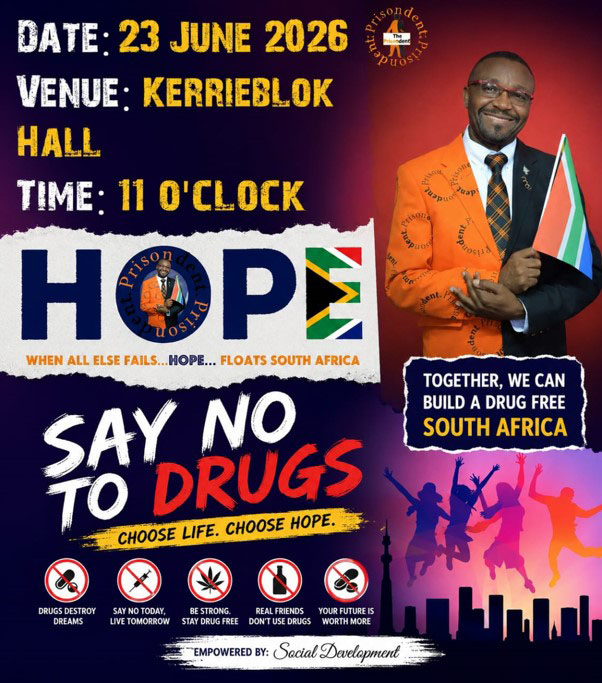
Not all of them are ex-convicts. Indeed, last week, Willowmore received a visit from Brian Davids, popularly called Prisondent, who previously worked as a warder in St Albans prison in Qeberha. In time, he got to know the convicts better, and started to see the humans behind the stereotypes. Importantly, he realised that, given appropriate support, most of them were ‘convertible’ — in other words, they could re-enter society, and live normal and productive lives.
According to Davids, it always starts with one small mistake — one foolish or reckless act. Often due to a lack of support and understanding, that first mistake leads to bigger and deadlier ones. This is how, after a first offence, many people — especially youths — descend into a world of drugs and gangsterism.
Among others, Davids said he began to understand why ‘prisons were fuller after 1994’: ‘Drugs were flooding communities, and gangsterism was on the rise, while the foundational values of the state and family were eroding.’ Eventually, he decided to take action.
First, he started an initiative to help prisoners learn valuable skills when they leave prison, in order to give them a new start and help prevent their return.
Second, his appearances at schools are aimed at early intervention, focusing on the roles played by parents, schools and communities in preventing – or allowing — young people to slip into crime.
Among other things, he draws attention to the gulf between making use of education and entering an active working life on the one hand, and the life of drugs and gangsterism on the other.
‘Don’t dance with the devil,’ he told learners and community members crammed into Willowmore’s Kerrieblok Hall at the sports ground last Wednesday morning.
He also spelled out the links in the chain of events leading from home to prison, letting children and parents know exactly where they fit into it, and how their actions — by commission or omission — form the links. Then his message is: ’Break the chain!’
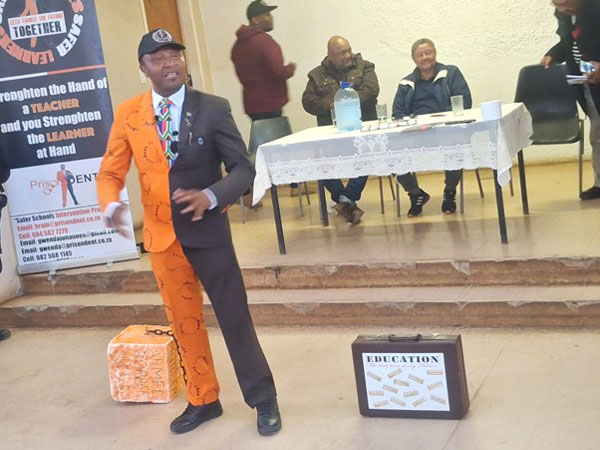
Strikingly, he wore a suit of two colours: the right half orange, and the left half black. The latter half – complete with lapel badges, and a pen in the top pocket — represents the successful life all children aspire to and all parents want: the orange half, made from orange prison overalls, represents the life of crime ending up in prison. Added to this, his right leg was chained to a big orange cube, representing a concrete block, symbolising various forms of crime. In this way, the two worlds he was contrasting stayed constantly before the eyes of his audience.
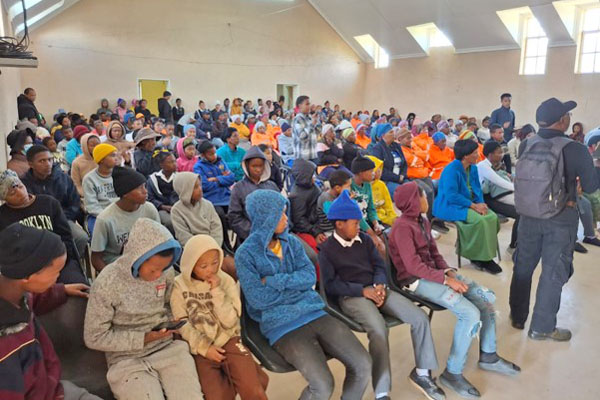
To parents, he emphasised the importance of maintaining a secure home and family life in shaping the lives of their children, and encouraged them to exercise their authority. He cautioned young people against having children they could not support, thereby increasing their chances of winding up in a life of drugs and crime.
‘Crime,’ he said, ‘is cunning and subtle. You never realise how deep you have fallen until you hit the bottom and look back up.’
Addressing the issue of stigma against former convicts, he asked the audience: ‘When you speak to me, which side are you addressing?’ He stressed that, once people were released from prison, they should be treated normally, like all other members of society: ‘Our actions towards them must be totally unprejudiced.’
The event was organised by Shevandre Coetze, an official in the local office of the Department of Social Development, and himself a rehabilitated ex-convict. I have known Shevandre for over eight years now. Speaking in the Kerrieblok, he told me he was a living testimony of the potency of these sorts of initiatives. ‘I’m living a normal life today largely because of them. Otherwise, I would still be an addict or a convict.’
He explained that rehabilitation was not easy, and he greatly admired the tenacity of these agents and the passion they brought to their work. ‘The problem is relapse. Typically, you promise to be good. But once outside you soon find yourself doing the same things, and you land back in jail.
‘This happens over and over, to the point where you either give up or they give up on you. But they usually don’t. They keep coming back, encouraging you and giving you hope, until you finally change for good. It’s really not easy. Even after you’ve changed, they still help to get you reintegrated into society.’
Efforts like these are more relevant today than ever. More than 30 years after the transition to democracy, South Africa remains burdened with high levels of inequality and unemployment as well as crime, which mutually reinforce one another.
Youth Day address
In his Youth Day address in Johannesburg on 16 June, President Cyril Ramaphosa said South Africa had changed fundamentally since June 1976. However, the country had to be honest about remaining challenges, among them very high levels of youth unemployment.
‘We cannot accept this as normal. Young people are among the most affected by violent crime and theft. These are some of the greatest threats to our country’s prosperity and social stability. … That is why our response to these challenges must be comprehensive and urgent.
‘Our progress as a nation must be measured by whether young people are moving from school to skills, from skills to work, and from enterprise support to markets, scale and ownership.
‘Theirs [the students of 1976] was the struggle to enter the classroom. Ours is the struggle to ensure that what begins in the classroom does not end in the unemployment queue.’
While Ramaphosa spelled out various large-scale government initiatives to stimulate youth employment, he emphasised that this had to be seen as a societal problem. ‘All stakeholders must work together to provide sustainable solutions to reduce unemployment among young people.’
The same could be said about combating crime. Patriots like Brian Davids are helping to ensure that grass-roots communities are taking up their part of the challenge.