
By Riaan de Villiers
As most Toverview readers probably know by now, the renowned academic, writer and columnist R.W. (Bill) Johnson died in his home in Cape Town last week, aged 82.
Bill met Maeder and Lesley Osler on Hanglip Farm some years ago, resulting in an enduring friendship. As a result, Bill very generously made his columns available for publication on Toverview, free of charge, an arrangement that continued to the end of his life.
Bill was a brilliant and prolific writer, and his death leaves a vacuum in South Africa’s intellectual life that will not be easily filled. At the same time, as the tributes, obituaries and assessments attest, he leaves a complex, partially controversial legacy that, in some respects, is difficult to assess.
As The Common Sense has written: ‘To admirers, he was the country’s most perceptive political analyst, with a rare command of history and institutions. To critics, he was abrasive, pessimistic, and provocative. Both sides agreed that Johnson could not be ignored.’
Specifically, his life and work were marked by some apparent paradoxes. On the one hand, he professed to be a liberal (and originally returned to South Africa from a long and stellar career at Oxford University to head the Helen Suzman Foundation). In recently years, this was sometimes difficult to reconcile with his unrelenting condemnation of the ANC government and its leaders, which, to some critics, bordered on a sustained Afro-pessimism.
It’s significant to note, however – by both supporters and detractors — that Johnson’s criticism was not casual or arbitrary, but based on a complex and multilayered theory — spelled out, among others, in his 2015 book How Long Will South Africa Survive: The Looming Crisis — that change in South Africa is not primarily determined by internal political contestation but by its relationship to global capital; that this has been the case since the advent of the mining industry in the late 19th century; and that its future will similarly be determined by its articulation with the global capitalist economy.
In this perspective, internal political contestation such as the Anglo-Boer War and the anti-apartheid struggle has been peripheral and even counterproductive, and the problem with the ANC government is that it is incapable of managing a modern, developing market economy. We cannot pursue this issue further here (but may do so in a later article).
In the meantime, David Ansara, CEO the Free Market Foundation, has written a useful article for The Common Sense which commemorates Johnson – and makes him a bit easier to understand – by presenting key aspects of three of his books written over the past two decades. A summary of the article follows.
How Long Will South Africa Survive? The Looming Crisis (2015)
The title of this book, writes Ansara, was adapted from Johnson’s 1977 best-seller with the same title, which correctly predicted the demise of the apartheid system at a time when this seemed like a remote possibility.
In 2015, Johnson discussed whether a similar fate might befall South Africa under the ANC, at the time under the firm grip of Jacob Zuma. He warned that fiscal recklessness and expanding public debt were sending South Africa headlong towards a financial crisis, which would ultimately lead to a bailout by the International Monetary Fund (IMF):
‘Should these trends continue,’ Johnson wrote, ‘it is just a matter of time before the government finds it impossible to fund either or both the fiscal and current account deficits. This would pitch the country into a debt trap from which it probably could not escape without IMF assistance. True, it might soldier on for a while on its own, but this would not be viable for long. The multiple weaknesses of the post-liberation state, together with the general nervousness the ANC inspires in both domestic and foreign investors, more or less guarantee that. Yet for the ANC government to go cap-in-hand to the IMF asking for a bailout would, in effect, signal the final failure of ANC governance – the fate that Thabo Mbeki always feared.’
While, Ansara notes, South Africa didn’t end up submitting to an IMF restructuring programme, Johnson correctly identified the fundamental contradiction at the heart of the ANC’s economic agenda. Simply, its desire for state control over the economy and its insatiable hunger for patronage was undermining its own authority by killing growth and weakening the state:
‘The big question about ANC rule was whether African nationalism, which had elsewhere conquered only poorer agrarian economies and societies, would be able to cope with the challenges of running a modern industrial economy. Twenty years of ANC rule have shown conclusively that the party is hopelessly ill-equipped for this task. Indeed, everything suggests that South Africa under the ANC is fast slipping backward, and that even the survival of South Africa as a unitary state cannot be taken for granted. The fundamental reason why the question of regime change has to be posed is that it is now clear that South Africa can either choose to have an ANC government or it can have a modern industrial economy. It cannot have both.’
Despite his ‘blunt realism’, Ansara writes, Johnson was less pessimistic than many assumed he was. On the next page he explained the reason for his positive outlook as follows:
‘This book arrives at the conclusions it does through what I hope is objective economic, social and historical analysis. I am not, in any case, a Cassandra who enjoys the prediction of disaster. I have always found that however dire a prognosis one may reach, if it makes realistic and rational sense it is always better to face the truth and deal with things as they really are. But it is also why I am more optimistic than many. However much the ANC may resist an IMF bail-out, many countries (including Britain) have had to go through that experience. They all survive it and some, at least, are the better for it.’
Fighting for the Dream (2019)
In 2019, according to Ansara, with Cyril Ramaphosa now in charge of a weakening ANC, Johnson attempted to unpack why South Africa had lost its way and how the dream of a non-racial and prosperous South Africa could be fulfilled:
‘This, then, is the drama that South Africa faces. For any liberal, communist or African nationalist, indeed for any democrat, the awful possibility now exists that majority rule – the goal so long fought for – will go down in history as a sad failure. That would not only give the verdict to the white right, but it would also seem to invalidate, or at least to mock, the popular struggles of a whole century. Such a failure would not only have tragic repercussions for any sense of black pride or self-respect in South Africa; it would also have repercussions for black self-confidence and race relations right around the world. The stakes could hardly be higher. What this book is about is how it came to this. What are the real problems? And what will be necessary to fight for the dream.’
Later in the book, Johnson again reflected on the fundamentally extractive nature of the ANC and its parallels with other African liberation movements:
‘To sum up, then, the real reason why, despite all the ANC’s averrals, African nationalism in South Africa has taken an almost exactly similar course as it did in the rest of the continent is that once in power it is driven by the same politically dominant class, the bureaucratic bourgeoisie. Moreover, the explosive factor that drives them far off course is also the same, the almost irresistible (and apparently bottomless) appetite of that class for primary accumulation. The fundamental problem, of course, is that a bureaucratic bourgeoisie is not productive in the way that a commercial and industrial (or even agricultural) middle class is. Because it does not itself generate wealth, it is inevitably parasitic and can achieve its goals only through patronage and corruption.’
Foreign Native (2020)
In this memoir, writes Ansara, Johnson reflects on a life spent in stubborn pursuit of the truth and in opposition to various forms of racial nationalism (both white and black).
Growing up in apartheid South Africa, his disdain for racial discrimination led to an initial sympathy for Marxism and a closeness to the ANC. However, as a Rhodes scholar back in the United Kingdom, his direct contact with the ANC in exile and his encounters with various other African liberation movements as part of his academic research led Johnson to adopt a more realist and pragmatic politics rooted in the liberal tradition:
‘As a supporter of the Congress of Democrats, I was a Marxist and pro-ANC but I still believed in free speech and individual conscience – while most of the exiles did not. They were in England as a revolutionary minority entirely dependent on British traditions of tolerance and free speech – traditions they were quick to invoke when needed. Yet almost to the last man they belonged to a Stalinist party, the South African Communist Party (SACP). The Party had supported the repression of workers in the East German rising of 1953 and the crushing of the Hungarians in 1956. Even Joseph Stalin’s crimes were not discussed. Elsewhere, right across Europe, Eurocommunism was transforming the communist parties into social democrats but there was no echo of that in the SACP.’
Johnson’s academic work and some close calls with African dictators cemented his appreciation for limited government and individual freedom:
‘In any case, I realised anew that personal liberties really mattered and they were basic. You simply could not build a democratic society without them; they were non-negotiable.
Johnson later recounts, with characteristic nonchalance, an incident that almost ended his life and left him physically disabled:
‘In 2009 I stubbed my toe while swimming in a lagoon on the KwaZulu-Natal South Coast. The water turned out to be badly polluted and I contracted necrotising fasciitis, which kills some 89 per cent of its victims, usually within a week or so. I was lucky enough to survive, though I lost my left leg. This necessitated some changes in my life.’
According to Ansara, most people who experienced such trauma at that age (Johnson was 66) would be forgiven for calling it quits and living out the rest of their days in quiet convalescence. Had he retired then, he would still have had a body of work to be proud of.
The exact opposite happened. Johnson’s brush with death seemed to ignite in him an urgency to produce even more. The following passage sums up his memento mori approach to life after his accident:
‘I continued to roam around Africa for a while, but it was a lot more difficult and laborious than before. Gradually, I accepted that the logic of my new situation was simply to concentrate on my writing, which is what I wanted to do anyway, and what I have done. It has, indeed, been quite a fecund period and this is my fifth book since the accident.’
In the final page of his memoir, Johnson reflected as follows on the ‘maddening contradictions of Africa’ and its irresistible pull:
‘Africa, but especially South Africa, is often so disturbing, so saddening, so gladdening and just plain interesting that once you’ve lived there long enough, it’s hard to live anywhere else. Harold Strachan once went to visit friends in Australia. On his return he told me what a nice place it was, ‘but, finally, rather bland’, he said. ‘It was a relief to get back to abnormality.'”
///////////////////////////////
This feature draws heavily on an article by David Ansara, CEO of the Free Market Foundation, on the website The Common Sense, titled RW Johnson in his own words. Our thanks to David for his agreement.
///////////////////////////////
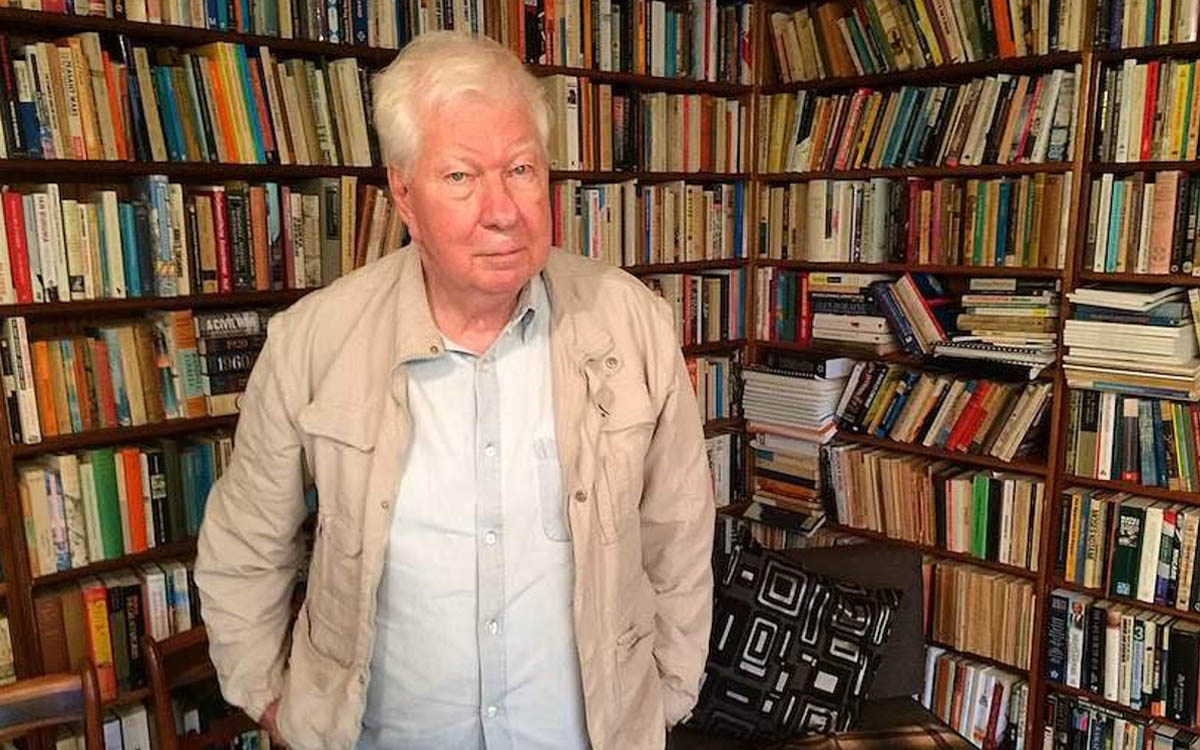
FEATURED IMAGE: R.W. (Bill) Johnson in his well-stocked library in his home in Cape Town, November 2015. Image gratefully borrowed from BizNews. For an insightful intervieew with Bill conducted at that time by Alec Hogg of BizNews, click here.
An excellent piece depicting all the aspects , thoughts and provoking ideas of a great man.
I enjoyed the excerpts from the books he had written.