
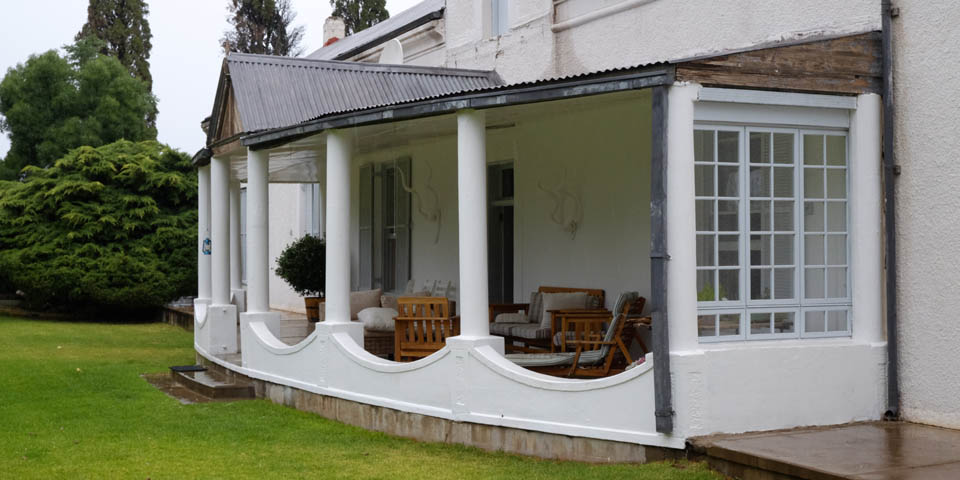
Maeder Osler writes about R.W. (Bill) Johnson, his memorable visits to Hanglip Farm, and twists and turns in perceptions – and memories – of South African liberals and the liberal spirit.
In a land of pervasive ironies, are tributes to people who have passed away a direct expression of affection and sorrow, often wrapped in guilt about unresolved or undischarged obligations, or more like inward, glancing songs or poetry, aimed at those who are left behind?
Bill Johnson’s memorial service is planned for Thursday August 6 at 2 pm at Christ Church, Constantia, on the Cape peninsula. I have gathered this from his courageous and inspiring widow, the widely respected Russian-born historian and academic Irina Filatova.
This tribute is an assemblage of memories by and of liberal old-timers, including myself – us left-behinds, with our introspections and despairs, forever hopeful.
Bill and rural media
When in the very early 2000s I told Bill about the Toverview model for rural digital communication, his curt rhetorical response was: ‘Are there any rural media left at all in South Africa?’
In the event, both then and now, we have we have found and sought to promote surprising signs of life in rural media, including highly original forms of citizen or ‘grass-roots’ journalism. (His response to this would probably have been unprintable.)
Shades of liberalism
While this wasn’t always easy to figure out, Bill claimed to be a thoroughgoing liberal. At the same time, and often in contradictory fashion, to my mind) he questioned – and assailed — various different liberals and various forms of liberalism. Just one recent example is his article, also recorded on Toverview, titled ’Tug of War has shifted to the Liberals’).
For this reason, Bill’s notion of liberalism and liberals do not always correspond to my own. Despite this, among those whom we both admired are Tommy Bedford, the inspirational Springbok captain who studied with Bill at Natal University. They both attended Howard College. Bill often spoke to me of his admiration for Tommy, even though he has written some highly critical accounts of rugby, preferring the working-class game of soccer instead.
Then there was Thami Mhlambiso, a vice-president of the then National Union of SA Students, (NUSAS), who studied at the Wentworth campus. There was special respect, and some contact with, Chief Albert Luthuli at nearby Stanger.
Another prominent compatriot was the late Gavin Stewart, outspoken media advocate and practitioner, a colleague of Bill’s from his days at Northlands High School in Durban, and my flatmate, first in Pietermaritzburg and later in Cape Town, including up to and after his mysterious arrest and detention in solitary confinement.
When, a few years ago, Bill heard about Gavin’s admission to a hospital in Milnerton in a critical condition, he took great trouble to visit him despite his own physical disability, and stayed with him until deep in the night.
While he took a deep dislike to some people, and sometimes flayed them unmercifully in his writings, Bill was unflinchingly caring and loyal to those he liked and admired.
Visits to Hanglip Farm
In recent years, Bill made several courageous (and combative) visits to Hanglip Farm, east of Colesberg in the Grassy Karoo, when Les and I were still living there.
Courageous, because of the ways he needed to endure and manage the progressive amputation of one leg, resulting from a bacterial infection contracted in 2009 after cutting his toe on a rock while swimming in the Mpenjati Lagoon in KwaZulu-Natal. He was given little chance of survival, and the infection pursued him in various ways for the rest of his life.
I vividly recall his detailed, unsentimental preview of each step he needed to take to retain his balance when moving around Hanglip and elsewhere. Also, like Gavin Stewart, as recounted by Irina, Bill kept on writing until the very end.
Bill was competitive, because like most of us, he simply was. Among others, this was evident when he drove – in great discomfort — all the way from Cape Town to Colesberg, together with a friend, to engage with our mutual compatriot and student leader, the late Jonty Driver. Some might describe their encounter as a clash of egos, or a mutual dance of haughty arrogance — though it was much more than that.
What about the poets?
In my understanding, Bill wanted to meet Jonty in order to ascertain why, after establishing himself in the United Kingdom (after detained and effectively being expelled from South Africa) he had stopped writing about his mother country. Bill also asked me this when I appeared as a discussant at the posthumous launch of Jonty’s memoir Dayspring in Cape Town a few years ago.
At that time, I could only suggest that international experience, with all its complications, had widened Jonty’s focus, and that, rather than a conscious wish to marginalise his homeland, this had given him more time to focus on his poetry.
It occurs to me know that I have no idea of what Bill felt about about poetry – probably, not that much? I am reminded of celebrated remark by the Polish poet Zbigniew Herbert that: ‘It is vanity to think that one can influence the course of history by writing poetry. It is not the barometer that changes the weather.’
Nevetheless, the farm visits and the chats hung in the air, much like poetry. I remember vividly much opinionated bristlings, and Irina saying sternly at one stage: ‘Bill, that’s enough…’ (He listened and obeyed.)
Bill and the Hantam Trust
Bill was also (habitually or systemically) skeptical about the Hantam Community Education Trust, the nearby education project founded and managed by Les and two other farmer’s wives, until his friend Peter Mansfield, who had taken the trouble to read about it, urged him to take the trouble to visit the project and ‘see for yourself’. (Peter was one of few other people whom Bill sometimes listened to.)
Bill was so astounded that he and Irina interviewed and cross-questioned Les extensively thereafter, resulting in a lengthy, eloquent article that was published in an international magazine.
Writing to the end
As readers will know, Bill graciously made his columns available to Toverview, free of charge, and imperiously sweeping aside any kibitzing about copyright by his paying media customers. He last communicated with us just a week before his death, when he was still in hospital. Writing on his i-phone, he expressed his concern about whether we had received his most recent columns, and promised to resume writing as soon as possible. Somehow, when we think about Bill in the future, we will think about this most of all.
FEATURED IMAGE: The stoep at Hanglip Farm, scene of many stoep talks, including those between Bill Johnson and Jonty Driver. (Riaan de Vvilliers)
A well informed and honest account by Maeder. RW Johnson was a great man, either totally disliked or admired and sometimes a little of both.
Well done to Maeder who bared his soul writing the above piece. I salute you Sir.!
Thanks for this good piece on RW. I really liked and admired Bill despite many, many disagreements over the years about politics, music and football – some quite fierce on both sides. I am pleased that in his last communiction to me from hospital (Jun 28th), we agreed on something. Here is a quote from that email: “I agree with you about France, Argentina and Brazil though you can never count out the Germans entirely and actually the Spanish are the second favourites for the bookies”.