
By Destine Nde
Last Monday was World Teacher’s Day, aimed at highlighting the role of teachers and the challenges facing them. Most people know teachers play a key social role. In fact, the United Nations Educational, Scientific and Cultural Organisation (UNESCO) estimates the world needs 44 million more teachers by 2030 to achieve universal education.
However, teaching has become a difficult profession, assailed on several fronts by forces seemingly beyond its control, making it less and less attractive to young career-seekers, and exhausting to those already practicing it.
My 23-year-old neighbour, for example, taught Afrikaans at Willowmore Secondary School after graduating with a Bachelor of Education last year. This year she resigned, vowing never to teach again except in Grade R or pre-school. ‘It’s simply too stressful’, she said; ‘before school, I have panic attacks and after school I suffer breakdowns. I just can’t bear it any more—but please don’t mention my name.’
Previously, teaching was easier and more effective because of discipline. People of my generation (millennial) looked up to teachers as irreproachable models, right up to tertiary level. In fact, headmasters, principals and deans were regarded as demi-gods. Today that has changed, and discipline — in the traditional sense – is almost non-existent.
Children must clearly be protected against abuse. But without discipline, teachers can neither enjoy nor do their work effectively. At this point, they are prone to physical threats to their safety, harassment from parents, and the risk of prosecution.
Added to this, teachers are under enormous pressure, among others from curriculum censorship, especially in history, religion, gender and science. For instance they must teach evolution, not religious alternatives; Afro-centric instead of Eurocentric history; and so on. Sex education is mandatory in higher schools, but many teachers are not properly trained to teach this sensitive subject, and face harrassment from parents who say it is too explicit.
Emerging technologies, especially AI, are not making things easier. On the one hand, teachers must integrate tech in their lessons, often with few resources and training; on the other, the same tools help students to undermine teachers and skip classes and lectures, believing they can rely on internet and AI to do assignments and score better grades.
In the past, teaching, policing, pastoring, nursing and doctoring were vocations for passionate people. But due to growing social and economic instability, people tend to grab any available job just to provide for themselves and their families, irrespective of whether or not they are passionate about it, including a field as sacred as teaching.
Such teachers quit the minute something more exciting and less demanding appears. For instance, there are many seemingly alluring career opportunities in today’s digital world. Capable teachers are quitting to teach online courses, to customers the world over. The advantages are manifold: they work from home in their own time in far less stressful conditions, and earn more as well.
Added to this, the pay/status deficit of teaching compared to other professions is growing. In the West, as well as South Africa, teachers earn 20-30 per cent less than similarly educated professionals. Doctors, attorneys and engineers earn far more, and enjoy far greater social status.
All this contributes to the rising rate of teacher resignations — according to UNESCO, from 4.6 per cent in 2015 to over 9 per cent in 2022. This worsens the burdens on remaining teachers, resulting in a vicious cycle.
Many teachers quit due to burnout – administrative loads, marking after hours, pressure from parents, extra attention to slow and/or recalcitrant learners. Indeed, in OECD countries, teachers work 10-plus hours unpaid overtime every week.
Ninety two percent of teachers surveyed by the Suid-Afrikaanse Onderwyserunie (SAOU) say workload and burnout are their biggest challenge, leading to unprecedented levels of teacher absenteeism. According to a research group at Stellenbosch University, 50 per cent plan to leave the profession within ten years.
While Africa is the worst, this is a global trend. In early 2024, 35 per cent of US schools had vacancies, with thousands of unfilled posts advertised in France and Germany. Sub-Saharan Africa has pupil-teacher ratios up to and exceeding 1:60. What’s worse, thousands of young African graduates are emigrating to teach English abroad.
Actually, South Africa is losing teachers faster than it trains them. Some 15 000 teachers graduate yearly, while 18 000 –22000 leave. More than 30 000 are due to resignations, while some 1 200 are due to dismissals. Yet we need about 25 000 more.
Nearly half of our teachers are older than 50, and are expected to retire by 2030. Indeed some 500 schools in South Africa no longer offer pure maths because they cannot find the teachers, with several other academic programmes being shut down for the same reason.
Of the 44 million teachers needed globally, UNESCO says 58 per cent are just to replace those leaving. In the West, more than 90 per cent of shortages are due to people resigning, rather than retiring. Up to 40 per cent of primary schools globally now have overcrowded classrooms, up from 27 per cent in 2018.
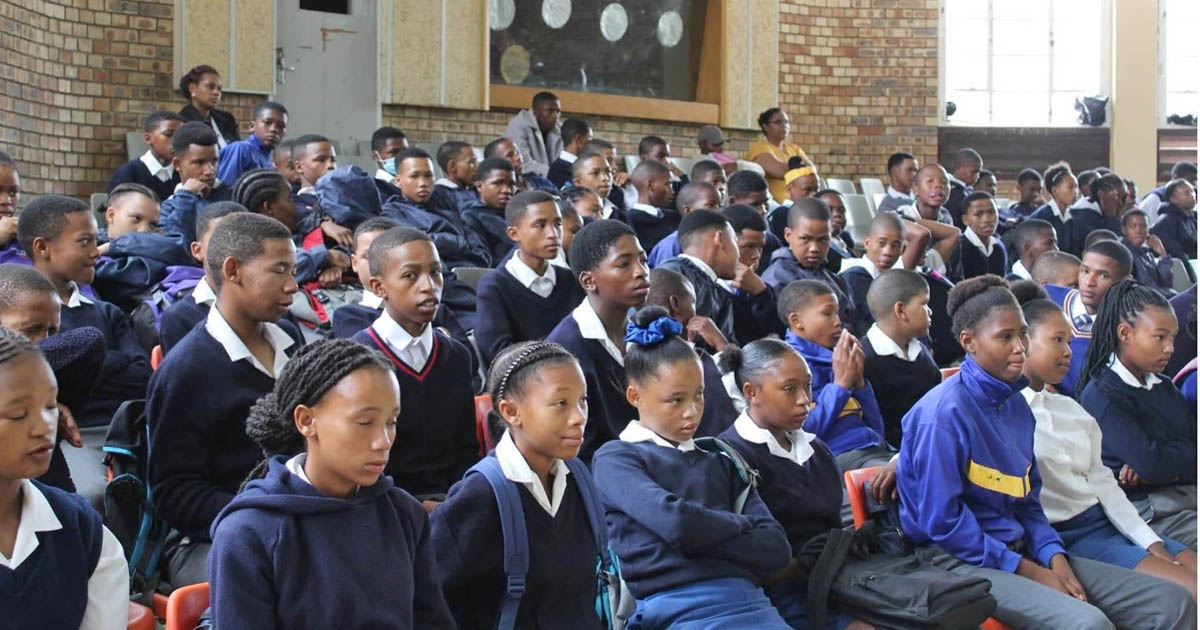
On Thursday 8 October, I attended a parent-teacher meeting at Willowmore Laerskool. The next day I attended a bigger one at the Willowmore Senior Secondary, which coincided with the 2026 Number Day Ceremony. Principals, HODs, teachers, parents, learners, community members and other stakeholders were present.

Principal Raymond Ferreira in his office at Willowmore Primary School.
I spoke to the principal of the primary school, Raymond Ferreira, about challenges, solutions, and the future of teaching. Among others, he explained:
‘We have 317 learners with only 23 staff. Our classrooms are overcrowded, and many Grade 4-6 learners need extra help. We have a new Special Help staff, but only for seven months. The previous one left for a better job.
‘Legally, we can’t fail learners in Grades R-3 — they must be promoted regardless. Presently 80 per cent cannot read. How will they cope in higher grades? Grade 4-6 learners may repeat once only, then they too must be promoted. How won’t they drop out in high school?
‘A child must be absent for nine days before we can take disciplinary action. Now they’re getting cleverer. They will stay away for eight days and return on the ninth, and there’s nothing we can do. Disciplinary action now means writing letters to parents and attending meetings, yet lost hours must be recovered. Punishment is a thing of the past; even parents no longer have rights to punish. It’s seem as psychologically harmful.
‘We’re losing teachers because of gross indiscipline — which begins at home. Learners bring knifes, cigarettes and such to school. They swear and yell at teachers. Police must come and search them. People only wake up when something terrible happens. We need special meetings about discipline; but when we arrange them, parents don’t show up — especially those of deviant learners.
‘But the time for blaming is over. We need passionate teachers and supportive parents. It takes a village to raise a child. There are 108 kids in our hostel without parental supervision. Total engagement is the only solution. We need moral support. I no longer want to sign warnings or get burnt out alone. We’re all responsible and accountable. Things must change!’
His remarks provide a vital window on the reality of teaching in many South African schools. Clearly, the education authorities are in an unenviable position, having to deal with contradictory demands and realities.
How do you educate children from previously disadvantaged communities without compromising standards? And how do you discipline children in poor and stressed communities without reverting to draconian measures, which global standards no longer allow?
Teacher’s Day provides us with an important opportunity to celebrate our teachers, and join them in reflecting on these challenges.
Featured image: Meeting of teachers, other stakholders and senior learners at Willowmore Senior Secondary School. All images: the author.