
US president Donald Trump doesn’t like a long list of people. For some time, one couldn’t quite tell whom he disliked the most.
Then, the name of a South African Indian woman who’d never dealt in narcotics, invaded or annexed another country, or threatened the annihilation of an entire civilization mentioned in the Norwegian capital of Oslo had Trump and his henchmen take to social media to launch a salvo of menacing and bitter comments. (Rather tweets than bombs or a secret service-sponsored kidnapping, I suppose, but I digress.)
The Norwegian Nobel Committee had announced that this year’s Nobel Peace Prize would be awarded to the veteran South African jurist Navanathem Pillay. Now 85, she was the first black judge to be appointed to the South African High Court. She has also served as the UN Commissioner for Human Rights, and as a judge and president of the International Criminal Tribunal for Rwanda.
More recently, she was part of the Independent International Commission of Inquiry on the Occupied Palestinian Territory, created by the UN Human Rights Council in 2021.
She was told about the prize in her office. In an impromptu speech, which was recorded and widely shown online, she told bystanders, with a tinge of Clairwood humour: “If you clap a little bit more I may share this prize with Trump.”
In one disarming clap-back, this child of working class parents swatted away the animosity as though it were a fly on the kitchen sink.
Barely moments after the committee’s announcement, Trump had lashed out against the award in a 600-word post on his social media channel Truth Social. He simply couldn’t wrap his head around how the Nobel Committee could ignore the eight wars he claims to have stopped by awarding the prize to a woman ‘no one ever heard of’.
He continued: ‘The United States of America, represented by me, as your President, should have received the Nobel Peace Prize, but didn’t. This is an indelible stain on Norway, one that will never be forgotten. The Nobel “Peace” Prize has been forever discredited by a handful of Radical Ideologues who are Anti-Democracy, and Enemies of Civilization!’
For Pillay, this was just the beginning of a barrage of attacks from the MAGA frontline, pro-Israel fringe, and even from people in her own back yard.
Her work with the Independent International Commission of Inquiry on the Occupied Palestinian Territory, which concluded in 2025 that Israel was committing genocide in the Gaza Strip, has seen her subjected to allegations of anti-semitism.
Israeli Prime Minister Benjamin Netanyahu called her ‘prejudiced’, and the Israeli Foreign Ministry declared: ‘Now that the Nobel commission has rewarded the biggest lie of the 21st century, Joseph Goebbels is certainly applauding from hell’.
Pillay has suffered comparisons to both Nazism and Jihad, and has been accused of everything from being a Hamas sympathiser to someone who unashamedly hates Israel. In a scathing editorial, the Wall Street Journal wrote:
‘It’s possible that the Nobel Committee will someday bestow its peace prize on a less worthy recipient than Navanethem “Navi” Pillay, but we doubt it. The Oslo worthies this year have honored an 85-year-old South African whose career has been marked above all by hatred for Israel and the Jews that support it.’
Given South Africa’s own divisions about the crisis in the Middle-East, respondes at home have also been mixed.
In the event, the Trump administration’s moved swiftly to impose further sanctions on the International Criminal Court (ICC). Although it had already imposed sanctions on judges and prosecutors at the ICC, the new measures will significantly affect its day-to-day operations.
When asked for her response, and whether she had any advice for Trump, Navi said: ‘Call in your legal advisors to explain to you what international law is and why you must not interfere in the affairs of an independent international court.’
In subsequent interviews she has doubled down, insisting that Netanyahu should indeed be put on trial.
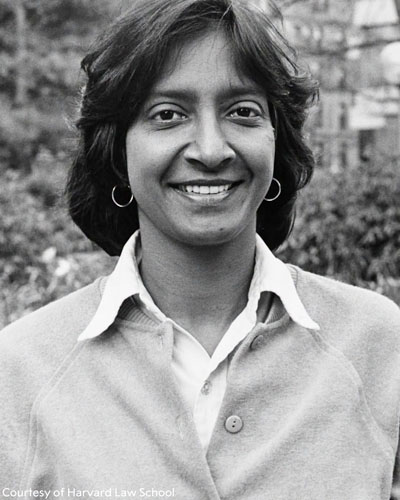
Navi Pillay in earlier years. Image: Nobel Committee Facebook page.
If the Norwegian Nobel Committee were looking for a recipient whose backstory and career speaks to a life of service in the name of peace and human rights, they could not have found a more deserving person.
Her grandparents arrived in Natal as indentured servants shipped from India in the 1890s to toil away on sugar plantations. The daughter of a bus driver father and a homemaker mother, her early life was one of a constant struggle to access opportunities. During her early childhood, she received many accolades for her writing.
With donations from the Indian community, she was able to study law at the University of Natal and graduated with an LLB in 1965 — even though the institution was segregated, and she’d had to file for an exemption with the Minister of Justice.
She then got a scholarship to attend Harvard Law School, earning an LLM as well as a Doctorate in Judicial Science — thew first South African to do so. She was the first woman to open a private law firm in Natal, and the first non-white female judge of the South African High Court. She went on to occupy the esteemed position of UN High Commissioner for Human Right between 2008 and 2014.
Now, she is due to receive arguably the most prestigious award in the world. Some might say she doesn’t deserve it, and others might not be sure. But for those of us who grew up on the wrong side of the South |African colour bar, it’s a moment that reminds us just how much harder it has been for Pillay (and others like her) to prove their worth. Looking at the responses to her win, it sometimes seems as if not much has changed.
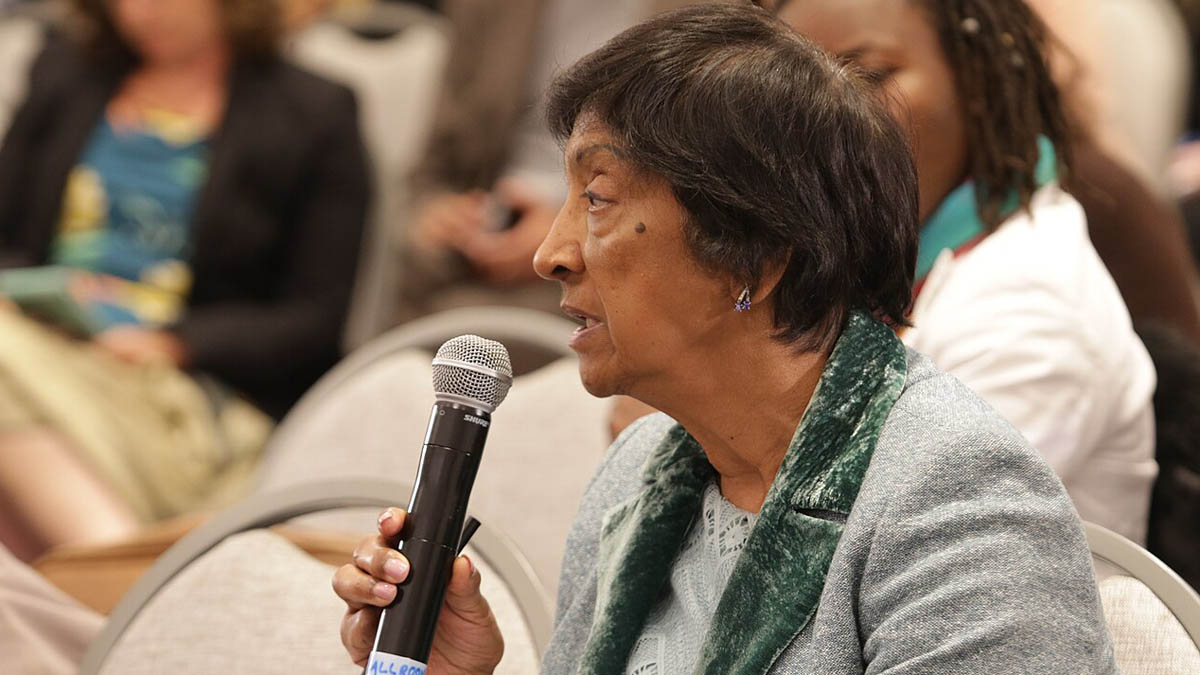
Featured Image: Navi Pillay addressing a meeting in 2018. Wikimedia Commons.