

By Destine Nde
This year’s Africa Cup of Nations (AFCON 2025) final was probably the most controversial in the history of football in general and in Africa in particular. It was marred by unprecedented drama, violence, and numerous questionable decisions made by the officiating team.
The final between the Teranga Lions of Senegal and the Atlas Lions of Morocco kicked off at nine in the evening om 18 January 2025, in the Prince Moulay Abdella Stadium in Arabat, Morocco. Tensions ran very high, especially during the last 30 minutes.
It was a very entertaining game, with no drama or violence until the 90th minute. It was also fiercely contested, with both teams enjoying more or less equal possession of the ball. Thus the score remained at 0-0 up to the end of the 90 minutes of playing time, even though both sides had numerous scoring chances.
The stadium was packed with some 66 000 spectators. Throughout the game, the spectators, technical teams, medical staff and reserve players— and millions of viewers around the world – were sitting on the edge of their seats.
Some were biting their fingernails, and others were imploring the gods of football to side with their country and grant them victory. It had become apparent that the better team might not win, as both teams were very cautious, and played ‘safe’ defensive games, and fortune might therefore play a decisive role.
Everything went peacefully and smoothly until, in the second minute of stoppage time, the central referee, the Congolese Jean-Jacques Ndala, disallowed a goal by Senegal’s by Ismaila Sarr, due to a supposed foul, which – if it was a foul at all – was relatively slight.
The Senegalese players rapidly surrounded him, insisting that he should check the Video Assisted Referee (VAR). But Ndala stood by his decision without watching a replay. This riled the Senegalese supporters and support staff, and the latent tensions began to erupt.
Spectators, security officials and personnel – even the player and coaches — started quarrelling and fighting with one another. Even the mighty Achraf Hakimi, Morocco’s and Africa’s best player of 2025 and a Real Madrid superstar, got involved in a fight with the Senegalese goalkeeper, Mendy, over a towel.
Worse was to come. In the 8th minute of stoppage time, Morocco was awarded a penalty for a supposed foul against its striker Brahim Diaz. It was also very slight, and similar to that which had caused the earlier goal to be disallowed. Yet, this time, the referee immediately checked the VAR screens, and then stood by his decision.
All hell broke loose. Led by their head coach, Pape Thiaw, the Senegalese players walked off the pitch, refusing to finish the game. Senegalese supporters started throwing chairs at riot police, and some of them burst through the barricades and ran onto the pitch.
This decision did seem outrageous: why consult VAR in one case and refuse to do it in the other? Wasn’t this clear proof that the host nation was being favoured? Similar accusations had been made in previous Moroccan encounters against Cameroon in the quarterfinals and Nigeria in the semi-finals. One Facebook post read: ‘Africa and Senegal vs Morocco and the match officials’.
It seemed as if the referee had handed the victory to Morocco on a platter. But the football gods had other plans.
It is at moments like these that the superstars and icons need to stand out, and Senegal’s Sadio Mane did just that. Unlike his Moroccan counerparts Hakimi and Diaz, who behaved badly and set poor examples for young African footballers who look up to them as models, this former Liverpool and Bayern Munich serial scorer calmed down the Senegalese supporters and persuaded his teammates and staff to return to the pitch
He actually ran into the dressing room to bring them back, after he had calmed down the furious crowds, thus saving African football from a huge embarrassment.
The game resumed after about 20 minutes. Morocco’s other Real Madrid superstar, Brahim, took the penalty resulting from the foul – and missed it. It was a terrible shot, a poorly executed ‘panenka’. The ball went straight into the hands of goalkeeper Edouard Mendy, a Champions League winner with Chelsea. Like Mane, Mendy instantly became a hero.
The score was still 0-0, and the match went into extra time. The joy of the Senegalese and the rest of Africa was beyond description. They sang and cheered their players so rapturously that the foundations of that immense stadium shook. Akon, the famous American singer, was present during the celebrations. With their hope and confidence raised by this sudden, unbelievable turn of fortune, the Teranga Lions were now even more determined to win, and defended like tigers and attacked like lions.
In the fourth minute of extra time, Papa Gueye unleashed a vibrating strike from outside the box, scoring the most sensational goal, the only one in the game, and turning him into the third Senegalese hero of the night. His goal gave Senegal the victory which, according to popular opinion, they truly deserved, and made them the proud Champions of TotalEnergies AFCON 2025.
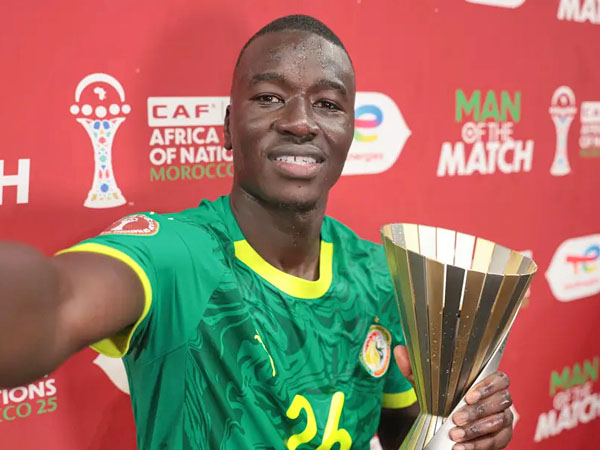
Papa Gueye, who scored the winning goal, was named man of the match. Images: www.cafonline.com.
This is the second time they have won the trophy, the first being in 2021. It was handed over by the CAF president, the South African mining magnate Patrice Motsepe.
The Moroccans were stunned. Some wept openly; others were simply stupefied. They could not believe what had happened. The Teranga Lions had beaten them on home soil. Walid Regragui. Morocco’s coach, said: ‘defeat is painful … but we congratulate Senegal.’ The last time Morocco had lifted the trophy was 50 years ago, in 1976. Senegalese supporters around the world were ecstatic.
The final was indeed a clash of two lions, the Teranga against the Atlas, marked by aggression, ferocity, and the profound desire to overpower and vanquish one’s opponent. The defenders and especially the goalkeepers of both teams were put under enormous pressure. El Aynoui of Morocco, for instance, played to the end with blood streaming down his face.
On their way to the finals, these lions had overpowered football powerhouses like Egypt, Cameroon, Nigeria and Algeria. The whole tournament was tough. All the participating teams had improved, and performed beyond expectation.
Despite the violence and drama, the resilience, determination and heroism of the Teranga Lions, especially that of Sadio Mane, are enough to rate the final as one of the best and most thrilling of all time.
Mane was named player of the tournament, and Pape Gueye as player of the match. Diaz won the Golden Boot as the tournament’s best scorer, with five goals to his name, and Yasin Bounou, also an Alas Lion, was glorified with the Golden Glove as the best goalkeeper, conceding just two goals throughout the tournament.
While congratulating the winners, the FIFA president, Gianni Infantino, also condemned their conduct and praised Morocco. The latter won the ‘fair play’ award for being a hospitable host’ — an important award, seeing that the country is due to host the FIFA 2030 Men’s World Cup.
FEATURED IMAGE: Sadio Mane — who played a key role in persuading the Teranga Lions to return to the pitch — with the trophy in front of his ecstatic teammates. He was later named player of the tournament.