

By Destine Nde
‘I really love living in Willowmore. I wouldn’t want to go anywhere’, said El-Anne Smith, who is deeply passionate about her home town.
Willowmore is a strategically placed town in the Klein Karoo. It’s the western entrance to the Baviaans Kloof—a World Heritage site. It is also a vital link between the Eastern and the Western Cape provinces. Early travellers often chose which route to take based on three important factors: water, food for themselves and pastures for their animals, and the presence or absence of threats.
Willowmore was on one such route, close to the Beervlei region, which satisfied all three conditions. Indeed this route was most preferred because of ‘the pools of Beervlei’ and its abundant reserve of games and rich variety of plants. Here, wagons were rested and food supplies replenished.
As such farms soon began to appear in this region – in fact, the first farm was registered on 20 November 1817. With farms came marketable products, as well as rapid population growth, so the settlement rapidly turned into a small village.
Before long it gained far-reaching recognition as a mohair producer. Indeed, its wool and ostrich feathers were of superior quality and commanded the highest prices in the whole Cape Colony. The Boerbok, one of the world’s most prized meat goats, originated here. According to the Journal, ‘The village [was] frequently recommended as a health resort, especially for those who suffer from pulmonary disorders.’
A town plan was developed in 1862. A district followed in 1874, telegraph connections in 1883, and by 1902 there was a train line from Klipplaat to Oudtshoorn, through Willowmore. And so, for many years, Willowmore thrived as a small but important town in the Cape Colony.
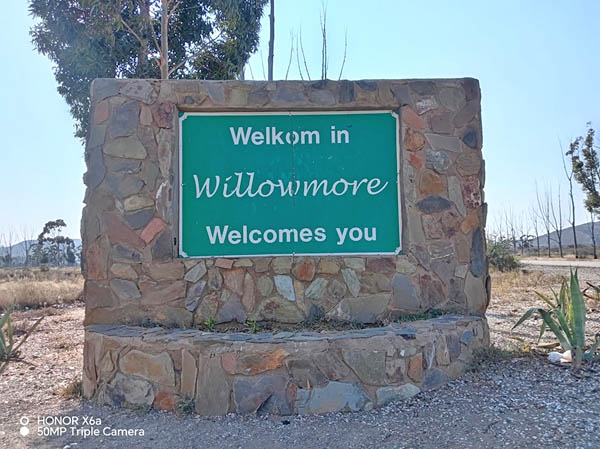
Today, much of this is no longer remembered. Nonetheless, there are a few local patriots who are determined to reverse the situation, and act as the custodians of Willowmore’s heritage and culture. El-Anne is certainly one of them, a genuine home-towner. I was referred to her by Veronica du Plessis, chair of Revive Willlowmore, who said El-Anne was an ardent community booster: ‘Her story is closely tied to the town itself.’
I met her on Tuesday 5 August 2025 in one of the cosy lounges at The Willow Historical Guest House, which was built in 1864. She told me that her parents had settled in Willowmore about five decades ago, and she was born and raised there.
‘I have fond memories of my childhood. It used to be a very close-knit community, with kids of all ages playing together. Our holidays were always amazing — swimming at the municipal pool and climbing mountains. After matric I worked for my father in this guest house and then left to study hospitality management in Cape Town. Afterwards I studied management for three years, and got my National Diploma in Management from Cape Peninsula University of Technology.
‘I then worked in the US for three years, returned home, and in 2004 got married to Derick Smit. His parents own the Albertina Hotel. We worked there for a year, then the kids started coming: Douglas in 2006 and Annabel in 2010. The same year my father asked me to come and help him at the guest house. I did, left in 2016, returned again in 2018, and I’ve been here since then.
‘For these reasons, it’s important to me to protect the town and make it work. There’s always that familiarity, that safe space. I was raised in this house. Our kids grew up just like we did. If you look around, you don’t see any burglar bars. It’s still safe. I can sit here at ten, eleven o’clock at night with the doors still open.
‘Visitors all say the same thing: ‘you guys live in an amazing town, you’re so fortunate’. We know this, but we don’t see it anymore. If you spend time in Willowmore, and don’t just drive through, you’d discover her beauty.’
She adds: ‘You have to step out and do something. You can’t just sit around and wait for someone else to do it; otherwise nothing gets done. In 2023 we were finalists in the Dorp van die Jaar competition. Through this Revive Willowmore was born, involving Veronica, myself and a few others. We’ve undertaken a few projects already, with many still to come.
‘At the moment, we’re trying to beautify the town. Our main objective is to get more people to visit Willowmore. This will provide jobs and improve lives. We don’t want Willowmore to be a one-night top but a destination. Or else people won’t survive, and Willowmore will become one of those sad little towns. We can’t allow that to happen, neither to ourselves nor to future generations.’
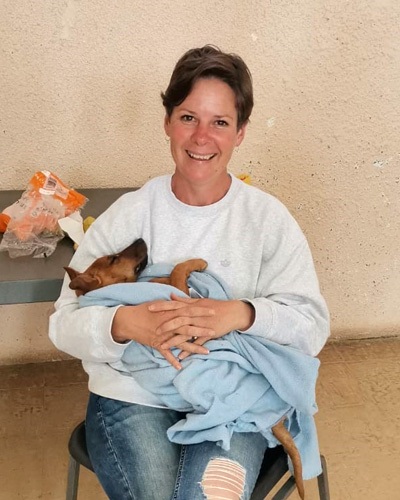
El-Anne with one of her nine rescue dogs.
In 2023, inspired by an older resident, Tannie Riet, El-Anne launched the organisation Animals in Need. With determination and help from the National Sterilization Project, Dancers Love Dogs and Vetsol, the group has sterilized more than 1 200 animals in just two years. ‘It wasn’t easy at first,’ she says, ‘but it’s my other passion. I’ve got nine dogs that I’ve rescued. I do inspections in townships just to make sure the animals are fine. We’ve managed to get up to 80 per cent of the population sterilized.’
Funding remains the biggest hurdle: ‘We need donors and experts; but the progress is visible. You used to see skinny dogs all over town. Now they look ten times better. Anyone returning to Willowmore after 2023 would notice the change.’
According El-Anne, the only thing holding Willowmore back is funding. ‘We have the support of the community and local municipality. Also, Willowmore is in a strategic location; for instance, without Willowmore there’ll be no Trans Baviaans. With more tourism and good partnerships, the town will thrive once again.’
FEATURED IMAGE: El-Anne Smith in a lounge at the in The Willow Historical Guest House. All images: the author