
By Riaan de Villiers
SOPHIE TEMA (later Sophie Tema-Mosimane), a reporter for The World and Weekend World, was one of a small number of black journalists and photographers who witnessed the traumatic events in Soweto on the morning of 16 June. Among others, Hector Pieterson — the 13-year-old schoolboy who was shot by police — was taken to Phefeni Clinic in her small staff car. As such, her subsequent reports and evidence before the Cillie Commission of Inquiry provided an important counterpoint to the official version of events. After working for various newspepers, Sophie Tema left journalism in 1993 and started an NGO called the Learn and Earn Trust, which aimed to rehabilitate prisoners by focusing on life skills, handicraft skills and HIV education, as well as the care of terminally ill inmates. She passed away at age 78 in April 2015. She testified before the Cillie Commission on 21 September 1976. An edited version of her evidence follows.
//////////////////////////
ON 15 JUNE, I received an anonymous call from an adult male who said students would demonstrate the next day in sympathy with those who had gone on strike in protest against the Afrikaans language decree.
At 7 the next morning, I was picked up at my home by our driver, Stanley Mtshali, and we proceeded to pick up our photographer, Dan Tleketle. Thereafter we proceeded to the Naledi High School, but we got there too early. I did not think that there was going to be violence. I thought, as long as the police could keep out of it, there would be no violence.
At about 8:30, when we got to Sizwe Store in Mofolo, we saw a group of students standing outside a school. They were waving placards and they were singing. While at Sizwe Store, another team of reporters from The World, consisting of Sam Nzima, Collin Nxumalo, Thami Mazwai and Willy Bokala, arrived in a second car. But we continued on our own.
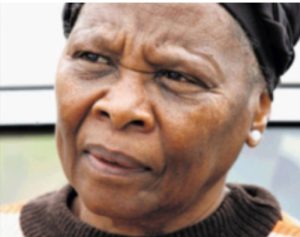
Sophie Tema-Mosimane in her later years. (Phindile Xaba, The Journalist)
The students were joined by another group, seemingly from Morris Isaacson High School, and the crowd was far larger. As they moved through Mofolo towards Dube, they were joined by students from other schools along the way.
At one stage I marched along with them because Dan wanted to take some picture that he thought was worth while. I marched with them up to Phefeni where I again joined Dan and Stanley in our Volkswagen.
The students had placards with them. One read: ‘We are being fed the crumbs of ignorance with Afrikaans as a dangerous spoon.’ Others read: “Away with Afrikaans”; ‘We do not want Afrikaans in Azania’; and ‘Afrikaans is a language of the oppressors’. We drove a short distance ahead of the group, and then stopped, waiting for others who were coming up behind us.
After a while, the group was addressed by a male student, who was known to me [this was probably Tsietsi Mashinini – eds]. I got out of our car and went to listen to what he was saying.
He said something like: ‘Brothers and sisters, I appeal to you to keep calm and cool. We have just received a report that the police are coming. Please do not taunt them, do not do anything to them, just be cool and calm because we do not know what they are after. We are not fighting.’
Next, the students moved down the street towards Orlando West Secondary School. We again drove ahead of them. When they got to the school, they were met by students from other schools who had waited for them outside Orlando West High School. At that stage, they numbered in the thousands.
We drove to a point a bit lower down below Orlando West High School where we saw police, some in cars, and others in vans and trucks. There were more than ten vehicles, and about 30 policemen. They were driving up the main road. They then took a turn in a street above Orlando West High school, turned, and faced the students.
Stanley and I picked Dan up at some corner and drove with him towards the scene. We positioned ourselves behind the police on the right-hand side. By then, the police had gotten out of their vehicles. Some of them were standing next to the vehicles, and others started to move towards the students.
At that time, it did not look like they were going to act against the students. I thought they would first talk to the students to find out what they wanted, rather than to disperse them.
When I saw the police marching towards the students, I got out of the car, and so did Stanley and Dan. Dan climbed on to a brick wall of a house near Orlando West High School to get a better view.
When more police began to march towards the students, I got out of the car and followed them, and so did Stanley and Dan. The students were just standing there, and I expected the police would warn them to disperse.
Some of them were singing the hymn ‘Morena boloka sechaba sa heso’ God save our Nation). They were singing it in Sotho. Some were whistling and screaming to the police, “Go away, we do not want the police here”. Others were waving placards. There was a lot of noise.
I then saw a policeman throwing what looked like a teargas canister into the midst of the students. It gave off a big cloud of smoke. If the police wanted to warn the students, I would have expected them to use a loudspeaker, but I did not see them doing so.
More teargas was thrown. Some of the students became confused, and were running helter skelter. Some of the students in the front row threw stones at the police.
Then, a white policeman on the extreme right pulled out a revolver and pointed it at the students who were more towards the right. He fired a few shots. Stanley, our driver, screamed and said: ‘Look at him, he is shooting at the kids!’
More shots followed. I did not see any policemen being injured. I did see that the windscreens of some of the police vehicles had been shattered. I did not see any policeman hit or injured by stones — because they started running like I started running.
As Stanley and I were trying to get away from the scene, we met four students carrying a fifth, who had a wound in his chest. They were running with him towards the Phefeni Clinic, which was not very far away.
We then took up a position in another street, because by now the students were all over the place. By that time, they had scattered.
While we were in the next street with Stanley, a boy came to us and asked us for a lift. He did not seem to be a student because he did not have a uniform on. I could see that he was limping. He said he had been shot in the leg, and was bleeding from the back of his right thigh.
He said he wasn’t a student. He had gone to his aunt’s house, and trying to make his way home. We took him to the Phefeni Clinic, and drove back to the scene.
There was still shooting at that time. The scene was very confused; students were running helter-skelter, and some were throwing stones.
As we drove down the street leading from the clinic towards the scene, I saw our photographer, Sam Nzima, and asked Stanley to drive towards him. We wanted to pick up him up, because we could see the situation was dangerous.
We then saw a boy wearing an overall carrying another boy in his arms, and a girl next to him. She was crying, weeping, and they were coming towards us. I asked Stanley to stop the car, and ordered those people to get into our car so that we could rush the boy to the clinic.
Stanley drove them to the clinic, and I followed on foot. When I got there, the doctors had already examined the boy, and they told us he was already dead.
I went back to the office to write my first report. At 3 om, I went back to view the situation in Phefeni, and found that most of the students were walking back to their homes. From then on, the tsotsi element started to take over.
//////////////////////