
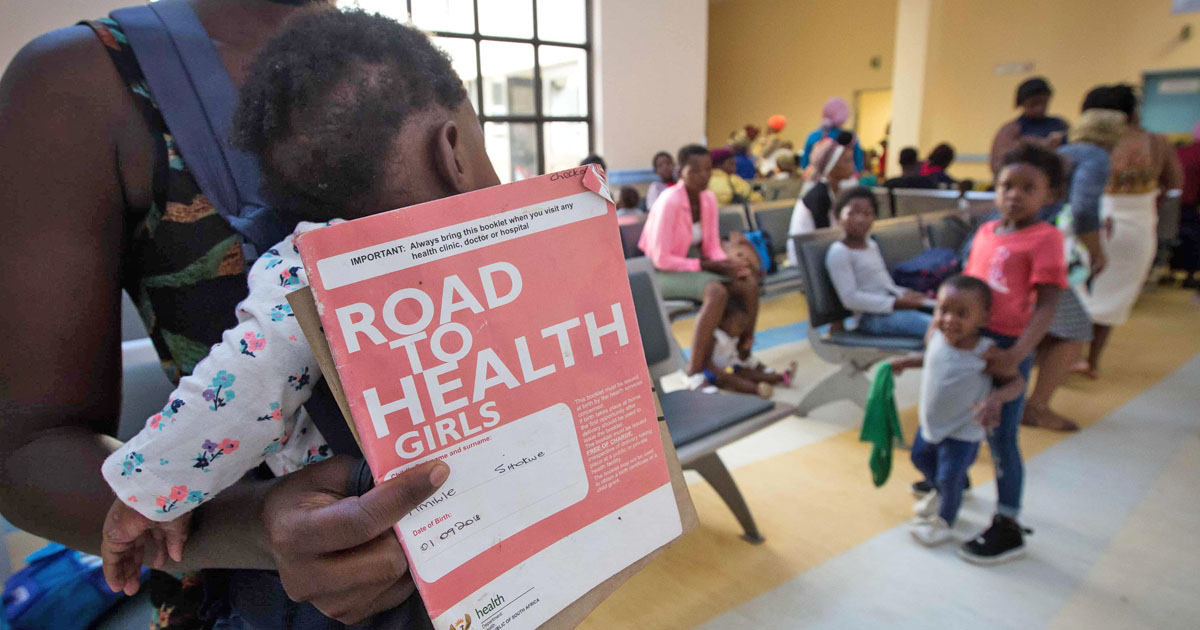
It’s a Tuesday morning at Kuyasa Clinic in Colesberg, and there is a healthy and very apparent bustle of children. Whether strapped to a mother’s back, swaddled in a blanket, or old enough to walk themselves over, Tuesdays and Thursdays are widely known as immunisation day, so the place looks more like a playground. Kuyasa Clinic is where many of Colesberg’s children come to be vaccinated.
The online health publication Spotlight has provided intensive coverage of South Africa’s immunisation programme. Although it has found this to be one of the country’s success stories, there are concerns about the decline in vaccination rates in recent years, and the hope is that this will move both communities as well as those in the corridors of power to take swift corrective action.
Spotlight’s research shows the global and local contributions made by effective immunisation over the decades. Thanks to a vaccine developed in the 1950s, much of the world (except for two regions in Pakistan and Afghanistan) is virtually free of Polio –a highly dangerous viral infection that attacks the nervous system and can cause permanent muscle paralysis and respiratory failure.
Smallpox – a once deadly disease that claimed millions of lives — has been eradicated across the globe. ‘In 1974,’ the publication notes, ‘132 of every thousand children born in South Africa died before their fifth birthday. Today, that number is at 35.’ Immunisation was a notable contributor to this positive outcome.
Furthermore, Spotlight notes, immunisation is also cost-effective and has benefits that improve cognitive function, longevity, and general prospects of a healthier life.
In South Africa, as in many other countries, immunisation is a state-run programme, managed by the National Department of Health. The current programme is encapsulated on a single one-page document. Titled ‘Expanded Programme on Immunisation (Epi SA) – revised childhood immunisation schedule from December 2015’, it outlines all essential vaccines children need from birth through 12 years of age.
This includes protection against life-threatening diseases such as measles, polio, tuberculosis, hepatitis B, and pneumococcal infections. Vaccines are administered at specific ages—starting at birth and continuing at 6 weeks, 10 weeks, 14 weeks, and throughout early childhood. The schedule also highlights important guidelines, such as not administering the rotavirus [a highly contagious viral infection that primarily causes gastroenteritis in infants and young children] vaccine after 24 weeks.
Last year, during the measles outbreak, a different health publication approached this writer to record people’s general attitudes towards vaccination in his home town. The concern back then was to check whether the response of the Northern Cape Provincial Government to that health emergency was adequate, and also to assess whether communities maintained a positive outlook towards vaccination.
Even though there are people who – due to factors ranging from superstition to misinformation –have negative perceptions of vaccination – in other words, are ‘vaccine-hesitant’ — the general trend has been positive. However, with all the controversies surrounding Covid-19 vaccines, including various conspiracy theories, there may have been shifts in attitudes to vaccination, especially on the Mother Continent.
For instance, Spotlight notes that ‘one serious concern is that vaccination rates in South Africa appears to be falling. Only 75% of children in South Africa had received all recommended vaccines by their first birthday, according to the latest District Health Barometer report. This is down from 83% five years earlier.’ Similar post-Covid patterns have been recorded in other countries as well.
‘In February 2020,’ notes the US publication Science Insights, ‘82% of Americans reported high confidence in the CDC [Centers for Disease Control]. By May 2020, that had already fallen to 68%. By 2022, it was 56%. A modest rebound to 60% by 2024 was not statistically significant.’ A host of various other health bodies experienced similar declines which they still have not recovered from. Interestingly, however, they also found that these decreases had less to do with the public’s faith in medicine itself ‘so much as in the centralized institutions responsible for pandemic messaging and policy.’
But in South Africa, views may be somewhat different. In 2023 UNICEF released a statement noting a startling 30% decline in confidence in childhood vaccines – ‘the largest sustained backslide in childhood immunisation in 30 years’ – in the country, ‘fuelled by the Covid-19 pandemic.’ The diversion of immunisation resources to fight the pandemic led to a 29.9% decline in the perception of the importance of vaccines for children.
The lockdown and similar restrictions meant that ‘children born just before or during the pandemic are now moving past the age when they would normally be vaccinated, underscoring the need for urgent action to catch up on those who were missed and prevent deadly disease outbreaks.’ Therefore, the 2022 measles outbreak can be at least partly attributed to this. UNICEF thus urges governments to identify those children who missed out on vaccination as well as to build public confidence in vaccines in general.
That said, one finds that various socio-economic barriers stand in the way of poorer communities accessing these vaccination services. The Colesberg clinic is within walking distance for most people, but in some rural communities the commute to a public health facility can sometimes mean forking out money that people simply don’t have. These are some of the social determinants of health that must be tackled if we wish to ensure that all South Africans enjoy equal access to health care.
The last word I’ll give to Spotlight which, by shedding light on this area, has indeed lived up to its name: ‘In terms of the vaccines provided [in SA], it remains excellent, but the fact that immunisation rates are lower than they should be is setting off very loud alarms. Let’s hope it is heard in the corridors of power. Many children’s lives literally depend on it.’
FEATURED IMAGE: Children in a South African public health clinics. Halden Krog / Spotlight.
What a worthwhile, informed and informative article. Thank you Phakamisa Mayaba