

By Riaan de Villiers
Politicians are slippery by definition, but Julius Malema must be regarded as the biggest escape artist in South African politics in recent times.
Smart, charismatic, and a gifted orator, he has (mis)used these gifts to fight his way to huge (if unknown) personal wealth, essentially by way of clientelist networks centred on state procurement, and using this to further extend his political power and influence.
He is also a consummate opportunist – political opponents, journalists and others have learnt that he will do or say almost anything to advance his cause or squirm out of an awkward situation, much of it delivered in an affected and highly effective ‘country boy’ patois.
Journalists who dare to raise uncomfortable issues are met with a barrage of scorn, ridicule and worse (indeed, after a damaging media article, one of the authors recalls receiving a torrent of abusive messages on her celphone).
Malema is also a master of amnesia — financial and other scandals are instantly relegated to the distant past. In any case, it’s all a conspiracy by white monopoly capital and other reactionary forces, aimed at preventing the ‘revolution’ and the attainment of economic freedom.
In an ultimate irony, Malema nowadays holds himself out as a paragon of accountability, on the grounds that he and the EFF played a key role in driving Jacob Zuma out of the national presidency.
///////////////
At least some of his chickens come to roost — or are, at least, counted — in a new book by the investigative journalists Micah Reddy and Pauli van Wyk, revealingly titled MALEMA: Money – Power – Patronage.
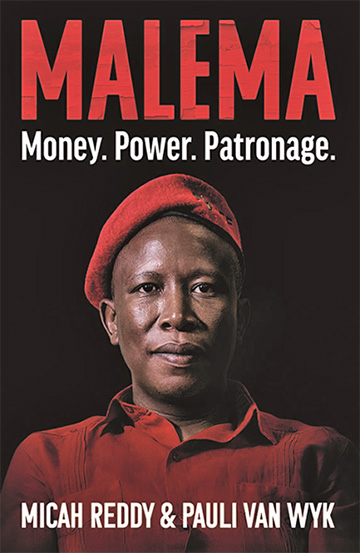
In a thematic prologue, the authors explain that the book is not a biography of Malema, but an account of how he has leveraged his growing political power and influence to accumulate resources and build clientelist networks, which he has then used to consolidate and extend his political power base in turn.
‘Throughout his relatively short but meteoric political career,’ they write, ‘he has proven to be a consummate political entrepreneur, using his growing political power to channel state resources to his allies and extract rents from them in return.’
They also say they hope to ‘tell a broader story about the relationship between money and politics in post-apartheid South Africa – about the stealthy and insidious ways in which money courses through the political world; its corrosive effects on politics more generally; and how supposedly radical politicians have exploited popular grievances about poverty and deprivation to accumulate money and power.’
///////////////
Most of the material in the book has surfaced in the media over the years, largely as a result of gritty investigative reporting (among others by the authors). Almost by definition, though, these accounts have been fragmented, and the book draws them together into a unified and coherent narrative. Among others, valuable (and highly revealing) forensic work has been added.
The result is fascinating, as well as deeply disconcerting – an extraordinary account of personal enrichment – essentially via clientelism, nepotism and patronage — centred on the public procurement system, now stretching over almost 30 years.
Today, Malema is undoubtedly a multimillionaire – the authors have put an acquisition value of something like R25 million on his property portfolio alone, but just how rich he really is, nobody knows.
The book also reveals a steady progression in which Malema’s sphere of influence expands from his home province of Limpopo to two of the biggest metros in the country; the spoils become bigger and bigger; and the methods of evasion and concealment increasingly sophisticated, with more and more layers placed between the sources of the money and their destination.
///////////////
The account plays out in four broad phases, also set in the framework of Malema’s political career. In the first, from about 2000 onwards, Malema rises to power first in COSAS and then in the ANC Youth League. At this early stage, Malema was ‘already mixing business and politics with a specific focus on government contracts’. The deals in his early years were relatively modest, but became more ambitious as his political ascent continued.
In the second phase, from 2009 onwards, Malema finds new ways to expand his political and business influence in Limpopo, notably by working with the ANC’s provincial leader and eventual premier, Cassel Mathale. Malema’s friends and relatives benefit from a range of dubious government contracts, and – in a steadily growing pattern — pay Malema increasing sums of money. This begins to attract media and other attention, but no criminal charges ensue.
The national government eventually places the cash-strapped province under administration. Mathale is initially demoted, but eventually joins the ‘old boy’s club’ of disgraced politicians in parliament, and in May 2019 he is appointed as deputy minister of police.
///////////////
Next up is the On-Point scandal, a staggering scheme in which a group of companies managed by Malema’s childhood friend Lesiba Gwangwa (with Malema pulling the strings behind the scenes) effectively hijack the Limpopo Department of Transport, extracting many millions from irregular contacts, described by the public protector, Thuli Madonsela, as ‘corrupt’ and fraudulent’. At the request of the Hawks, a former accountant for Gwangwa’s group of companies later calculates that R106,7 million had flowed to On-Point in the 18 months between August 2010 and January 2012.
As for Malema, the authors calculate that he received around R21,4 million in cash, assets and subsistence support from the On-Point scam alone – not including cash regularly stuffed into envelopes, boxes and tog bags, and handed either to him or his bodyguards.
Together with Gwangwa and several others, Malema was eventually arrested and charged with 51 counts of fraud, money laundering and corruption-related offences ‘in a pattern of wrongdoing that indicated racketeering’.
But this was the start of the Zuma state capture era. The NPA became demotivated, and the case against Gwangwa and Malema disintegrated, with the charges struck off the roll due to unending state delays. In theory, they could be revived, but attempts by Afriforum’s Gerrie Nel, among others, to revive them have been fruitless.
Bizarrely, while the main criminal case collapsed, the NPA’s asset forfeiture unit successfully seized a Limpopo cabbage farm effectively owned by Malema, on the grounds that it was bought with the proceeds of crime.
Again, political accountability seems to lag. Pinky Kekana, the MEC of roads and transport at that time, initially remained in her post and then became MEC for economic development, but was ousted by Mathale’s successor as premier. Today, however, she is deputy minister of public service and administration.
The only state agency that has managed to hold Malema to account to a degree has been SARS. In 2012, after dealing with years of evasion, dressed up as the ‘ignorance of a poor country boy just trying to make his way in a challenging world and improve himself’, it finally lost patience with Malema, and, following a forensic investigation, presented him with a tax bill of R18 million for the 2005-2011 tax years – itself an indication of the massive amounts of money flowing into his accounts in those years. A whopping R7 million of this was eventually written off, leaving Malema with an R11 million tax bill.
Malema’s estate was placed under curatorship, and SARS attached and sold a luxury three-story mansion Malema was having built in Sandton, and several other properties, as well as their contents. SARS also applied for his final sequestration, which would have prevented him from returning to parliament, thus scuppering his political career. At the last minute, Malema found some money from various ‘donors’, and the liquidation was abandoned. Little is known of Malema’s tax affairs since then.
///////////////
Then came the spectacular 2017-2018 blow-up of VBS Mutual Bank, itself a textbook example of industrial-scale patronage spanning the private and public sectors, in which at least R2,7 billion was misappropriated.
It gradually emerged that illicit VBS money had flowed through a series of conduits (notably a company ostensibly managed by Malema’s younger brother, Brian) to Floyd Shivambu and Julius Malema. The authors calculate that, between May 2017 and January 2019, Malema’s slush fund – Mahuna Investments – received R12,2 million, of which R5,3 million came from VBS Mutual Bank. The balance came from other people in Malema’s network — notably R3,75 million from the Tshwane entrepreneur Hendrick Khanyago, and R500 000 from Afrirent, a company linked to a fleet supply scandal in the City of Johannesburg.
While VBS executives were arrested and faced a barrage of charges, no charges were brought against either the Malemas or Shivambu – either in 2018 or in 2024, when the former VBS chairman, Tshifhiwa Matodzi, finally pleaded guilty to 33 counts of corruption, theft, fraud, money laundering, and racketeering, and testified to a meeting between him, Malema and Shivambu in which he agreed to pay them in exchange for political favours.
Failing this, both the DA and Afriforum have laid repeated criminal charges against Malema, Shivambu and the EFF, to which the state has not responded.
In one statement, Gerrie Nel, head of Afriforum’s private prosecution unit, said it was ‘inexplicable’ that the Asset Forfeiture Unit had not seized assets suspected of being purchased with criminal proceeds. ‘The irresistible inference is that Malema and Shivambu are for whatever reasons sheltered from prosecution and related processes.’
In 2024, the DA also referred what it referred to as SAPS ‘inaction’ to the parliamentary portfolio committee on police. But no response from the SAPS, the NPA or the portfolio committee is on public record.
///////////////
The last phase, and perhaps the most disconcerting, encompasses events from 2016 onwards in two of South Africa’s biggest metros, the City of Johannesburg and Tshwane, where the EFF had gained some political representation. In a section titled ‘Milking the metros’, the authors walk readers through a dismaying array of irregular contracts — City Power and Afrirent in the City of Johannesburg, and the notorious fuel tender in Tshwane.
Huge sums of money are involved, and a lot of money (traced in the course of diligent forensic reporting) continue to flow to Malema behind the scenes. By now, his methods have been perfected to the point where the only sign of EFF influence in the R1,2 billion Johannesburg fleet contract is a blue Landini tractor ‘donated’ to a farming cooperative in a area of the old ‘Venda’ homeland.
As regards Johannesburg, this was the time of coalition governments in which the EFF played kingmaker, and its vote was needed to pass a vital budget. Indications were that the R1 billion-plus fleet contract ‘had become a bargaining chip and that the EFF was holding the budget hostage so that it could influence the tender’. Political representation had become yet another strategic lever.
///////////////
The book also chronicles parliament’s failure to hold Malema to account under its code of conduct, which supposedly outlaws all forms of nepotism and patronage in the name of parliamentary integrity and the oath sworn by MPs to respect and uphold the constitution. It is able to consider complaints, and impose penalties.
In 2019, DA leader John Steenhuisen lodged a complaint against Malema based on reports that VBS money had flowed into his slush fund, Mahuna Investments; that he was involved in a scheme to mask the origins and ultimate beneficiaries of these funds; and misled parliament into believing that he was not connected to the fund.
When the registrar of members’ interests wrote to Malema requesting a response, he responded that he had ‘nothing to do with the company in question. … Next time, come with something solid and not this newspaper junk.’
The ethics committee eventually announced it was ‘unable to make findings’ because it lacked sufficient information, and had therefore decided to ‘close the file in the matter’. Subsequent to this, Malema repeatedly declared the committee had found that he had ‘not received a cent’ from VBS.
///////////////
As the authors point out, the book is not about Malema alone – it provides a vivid transection through post-apartheid South Africa, laying bare, as they put it, the ‘toxic and often corrupt nexus between money and power’.
Specifically, it illuminates a structural imbalance that has worked to cripple South Africa’s emerging democracy. One is reminded that democracies don’t exist in a vacuum, and function best in reasonably healthy and stable societies with a good spread of economic opportunities, both state and private, which reduces the need to compete for political power as the only gateway to prosperity.
In our case, an open and formally equal democratic system was suddenly grafted on to a deeply unequal society emerging from a lengthy political conflict, providing a disadvantaged majority almost overnight with access to the bulk of political power as well as the entire state procurement system – and all of this in a setting of explicit economic empowerment and redress. It could be argued that the outcome was more or less inevitable.
In this setting, despite the negotiated constitutional settlement, the postcolonial state has still been regarded as a foreign construct, a product of colonialism and ‘white monopoly capital’, to be looted and exploited rather than regarded as a common resource, to be nurtured and utilised for the common good.
Most importantly, in this fractured setting, mechanisms of accountability (notably the criminal justice system) have lagged, partly because they have either been compromised themselves, or have not had the will or capacity to address this massive challenge.
Ultimately, as co-author Reddy has pointed out, despite Ramaphosa’s promises and protestations, the political will to prosecute members of the same previously disadvantaged group – often members of the same liberation movement – has been lacking – another unfortunate, antidemocratic hangover of our particular political trajectory.
Yet another, of course, is the need for Ramaphosa to continue rewarding disparate ethnic, geographic and other factions with political positions, just to keep the leaky ANC boat afloat, and to stay in power at all.
///////////////
All of this speaks to what could be referred to as an age of impunity, in which mechanisms of accountability have not kept pace with rapidly unfolding political and social dynamics in post-apartheid South Africa.
Whatever the reasons, we need to find a way of exiting this era soon. Otherwise, any remaining chances of becoming the sort of country envisaged in our constitution will drift permanently and irrevocably out of reach.
Riaan de Villiers is an author, contract publisher and former journalist (and Toverview’s webmaster). He edited the book under review, but does not profit from sales. This article has also appeared on Politicsweb.
FEATURED IMAGE: Julius Malema in November 2024. (EFF Youtube channel / Wikimedia Commons)
An excellent report from Riaan de Villiers. He has set it all out systematically and carefully and revealed the heinous part Julius and his cohorts, have played in the ruination of South Africa.
Riaan is to be congratulated on all the work he has done.