
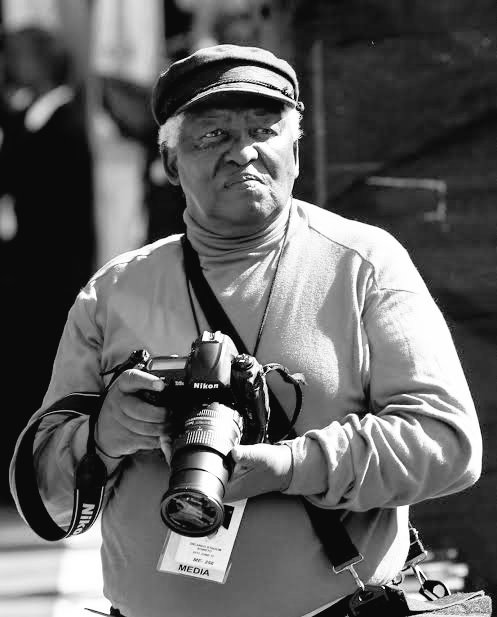
Among the journalists and photographers who witnessed events in Soweto on 1 June 1976 was he renowned photographer Peter Magubane. He spoke about his experiences on that and subsequent days at a special hearing of the TRC held in Soweto in July 1998. It provides a vivid picture of events on the day, as well as the extreme challenges faced by black reporters and photographers who sought to cover this and other instances of popular resistance to apartheid. At the request of the commission, relevant images by Magubane were exhibited at the venue.
Magubane witnessed and photographed many of the most significant events in modern South African history. He died aged 91 in January 2024. In the words of Kylie Thomas, an academic reseacher, he left a ‘vast archive of extraordinary images’, including of ‘signature images of some of the worst atrocities committed by the apartheid regime’. Links to her article on the academic website the Conversation as well as a profile on South African History Online appear below.
Peter Magubane: courageous photographer who chronicled South Africa’s struggle for freedom
An edited version of Magubane’s testimony follows.
///////////////
ON 15 JUNE there was a report in The Star which said that students in Soweto would march on the 16th. We didn’t pay much attention to this, because there hadn’t been any marches by students, but I thought it wise to contact my office, the Rand Daily Mail, and ask them to provide me with a car.
On the 16th I drove into Orlando West. In Mafulo, I came across schoolchildren running towards the vocational training centre. I got out of my car and started taking pictures. I had just shot two frames when there was an objection from the crowd that I should not take pictures, because they might be identified by the police.
I said to them, no, I think you are mistaken, because if you are brutalised and you are killed by the police, no one will know what had taken place. I said, it is necessary for the press to be allowed and do their work as easily as possible. It is necessary to document this event so that your people and the world can see as to how apartheid operates in this country. Fortunately, they relented and said, this is fine. I said to them, I ask you that even those [photographers] who are not of our colour should be allowed, because they are also documenting. They said, fine, there will be no problem.
Immediately after talking to them there was a van, driven by a Western Board [West Rand Administration Board] official. They went over to the vehicle and tried to pull this man out. I stopped taking pictures and went over there, and said, this will not help your cause at all. Leave this man alone, let him go wherever he’s going to. Don’t do anything to him. Fortunately, they listened to me, and this man was able to drive where he was driving to.
I then went to Sizwe intersection. When I got there, I found schoolchildren with placards that read, ‘Away with Afrikaans’; and ‘We do not want Afrikaans in our schools’. As I got out of my car and started photographing, a white policeman pulled out his gun, and the children ran in different directions. The policeman chased one youngster, but he did not fire, and the youngster managed to escape.
Round about ten o’clock we heard that a child was killed in Orlando West. That is when everything went wild. The tone of the morning changed. The students became angry. Anything that belonged to the Western Board was set alight. Any car that belonged to a government official or white businessman was set on fire.
Soweto was a different place altogether. Police were not able to come into the township after they had killed Hector Pieterson — they were kept at bay, out of the township. It was only late in the afternoon that they made their way back into the township and began firing teargas and rubber bullets.
I again drove up to Orlando West, where I found the body of Dr [Melville] Edelstein, surrounded by police. A placard had been put on his head that read, ‘Afrikaans is a drug to our children’. I photographed that, and went to Tshabalala Garage in Jabavu. There I found the body of a man that was driving a truck that belonged to his employer. He was asked to hand the truck over. He refused and said, I am working for my children. He was mercilessly killed and set alight. This was the first time I saw the charred body of a human being.
It was becoming dark. The Maponya corner was on fire. Cars were burning, police could not come into that area. Even if they tried to come in, it was difficult. It was also difficult for camera people to take pictures openly, but we managed to do our job. Then I went down to Mafula North where I found a man killed. His wife was next to the body.
The next day, the 17th, I went to Alexandra Township. This was a different story from Soweto. The police went in there with the aim of killing people, for they did not use teargas or rubber bullets. I saw a man being hit who was right inside the toilet, who had done absolutely nothing. He was sitting in the toilet relieving himself. He was shot and killed.
After taking pictures of that man, one of the policeman came and put the muzzle of his gun on my temple and said I must “Fxxx off”. I did, and went to another section.
A Chinese shop was on fire, and the Indian section of Alexandra Township was also on fire. The police tried to use the Indians against our people by using their shops as places where they could pick up food and cold drinks, and this annoyed the residents of Alexandra, for they thought the Indian community were in cahoots with the police.
I saw children, adults, mothers die at the hands of the police in Alexandra. A young woman who was not far from me on Second Avenue was hit with a bullet on her stomach, ripped open her stomach. My picture of her is there, on the wall. Whether she died or not I don’t know.
After taking that picture, a police captain hit me across the face with a baton, fracturing my nose. I fell to the ground. When I got up, he said, take out your film and expose it to light. I said, I can’t do that. He said, I’ll hit you again. I slowly took out the film. As I opened the cassette, I realised that this was history that I am about to destroy, history that I could never regain. To me that was more hurtful than my fractured nose. I knew my nose could be fixed, but with the images that I had got for the day, I knew I could never have those images again. This is why I have called my exhibition ‘June 16 — Never, Never Again’.
I reported that matter [to the police], but nothing happened. I was never told whether he was being prosecuted, or whether the case was going on or not.
In the days that followed, I saw policemen ferry hostel dwellers … with trucks and cars. I waited for the hostel dwellers as they were marching on to Mzimhlophe. I took a picture from a distance. The picture is there too.
Things were getting worse. I immediately reported the matter to the Orlando Police Station. I spoke to the station commander who said to me, we have requested your help, but the community did not want to help us. We now have our own people to help us. There is nothing that I can do for you.
I went back to where I was in Meadowlands. I saw children die in the hands of the police. One child was hit in front of me, but because the police were watching I could not take any pictures. As they left, I took the child, put the child in my car and took her to the hospital, came back, and carried on with my work. The same evening I went to Mzimhlophe Hostel, which was on fire. I took pictures there, and went back to the office.
On my way to the office, I went past my home in Diepkloof. I found that my house was on fire. I looked, there was nothing I could do, I had to get back to the office to process my films, because a good story that does not make the paper is not a story. Fortunately, the Rand Daily Mail was able to get me accommodation for the week. I could not go to my house, everything was burnt out.
I made a report [to the police] the next day. I was told, we have too many things in our hands, there is absolutely nothing we can do for you It is you, the community of Soweto, that started this, and therefore stay with it.
The next day I went back to Mzimhlophe. The hostel dwellers were on the warpath — anything that was young was killed and injured. Even us camera people and reporters, we could not work openly.
That very evening I called Mangosuthu Buthelezi in the presence of my editor. I asked him to come to Soweto to try and speak to the hostel dwellers, for things were getting out of control. He promised to come. The next day, he arrived at the hostel. There was a big Mbizo attended by the hostel dwellers, the police and some members of the community.
Now these men were being paid by the police. They were given a carton of mageu and a loaf of bread to kill their own people. Then the community of Meadowlands, Mzimhlophe and Killarney came together and drove the hostel dwellers out of the Mzimhlophe Hostel. For about six months the hostel was empty, there was no one in the hostel, but they had already done their dirty work.
A lot of people were killed in Mzimhlophe. A lot of people were killed in Zone 1, Meadowlands. At some point, when it was difficult to operate, I got into a rubbish bin with the help of the community, and I was able to take some of the pictures that you see today, that are making history.
If it had not been for the community, we, the press people, would not have been able to do the type of work that we did from 16 June onwards. Because it did not end there – it went up to the beginning of the 1980s.
I did not only do Soweto and Alexandra township. I also did Katlehong, Kwatema, Mamelodi and Duduza. I went to Middelburg, and the furthest place I went to was the Eastern Cape. In all these places, people were crying about police brutality. I was able to see the differences in the action of the police, in Soweto, Alexandra, and these other areas.
After the first day, Soweto was again different from any of the other townships, for the police were now not playing but killing. When you woke up in the morning, you would find ten bodies lying in the street, covered in newspapers.
Students were not people who bought newspapers, but from the first day the circulation of newspapers rose. Students began to read newspapers. The community began to read newspapers. These newspapers we also used to cover the dead.
Then there was the notorious green car. I followed that car from township to township. It used to kill men, women and children indiscriminately. If it came across people standing in a group, they would just open fire. It was driven by two white policemen. I was following behind in my Volkswagen, and I don’t understand why they did not recognise me. Wherever they shot, if there was someone that needed assistance, I would become an ambulanceman, pick up the body, take it to the hospital if the person was still alive.
Sometimes my colleagues wanted to know from me whether was it right for me to assist, because my work is to photograph, and I said, if my editor ever said to me I should not give help when this was necessary, then my editor can go to hell. I am the one who feels the pinch. I am the one who should make that decision, for I am the one who is taking pictures.
And I made those decisions. In cases where I can take pictures and not help, I will do so. In cases where I have to assist, I stopped taking pictures. As long as I had one picture that I could show, I stopped and gave help. This is a very high price to pay, but in some instances you have to do it. If it was not for the community of all these places, I would not have survived. I would not have made the history that is made today.
My banning orders were lifted just before ‘76 – in fact, the had not been lifted but expired. Prior to that, I had been detained, and held in solitary confinement for 586 days. Then I was banned for five years, which meant that for seven years I was not a photographer, and did not earn a living as a photographer. When ’76 came, I was hungry for pictures. I was hungry to get back to my community, and this is why I did not think of my life first. I was more concerned about what was happening to the students and to our people.
In 1985 I was covering a funeral in Katlehong when the police opened fire and shot me 17 times [with 17 buckshot pellets] below my waist. But I survived because of the community in Katlehong. The very schoolchildren who were there to bury their colleague came to my rescue. They pulled me into the house, when the police had left me for dead. I am grateful to those people. Had it not been for them, I would not be alive to show you this history.
I know there are many people who have paid a price for what they believe in. And I know there are people in other countries who have worse lives than some of us in this country. But to have lived under apartheid was worse than any other type of life led by people who are free.
Our children were told that they were not supposed to study above Standard 2. There would be no need for them to know mathematics, history and geography, for they would not be going to Europe. The only language they would understand was the language of the master/servant relationship.
And our children refused and said, you may have done it to our parents, but we are not prepared to take it. You can come with the might of your guns, we will fight with our stones. Our children did not use any guns then, all they used were stones, fighting guns with stones.
When you tried to talk to the policemen, and you say, what is it that you are doing, the answer you get is, you have asked for it.
Some of those children left their homes at a tender age and went to strange countries in Africa to become refugees. They left their mothers and their fathers behind, and did not have motherly care, while the white people had their mothers – the mothers of those very children who had fled the country — to bring up their own children.
I will never, never forget 1976. I had never seen such brutality. Yes, I had seen the Sharpeville massacre. It happened on one day. The next day, everybody went to work as if nothing had happened. But June 16, you kill one, you kill all.
… I went from one place to the other to make sure that I documented those events. What I had in the back of my mind was history, and I did not bother about myself and my children. I said, if other people can sacrifice, why can I not sacrifice. There are people out there who have sacrificed their lives, and who am I to say I am afraid, I am going to die.
When I went out with my camera that particular day, I said to myself, whatever happens and how difficult it may be, I will come back with pictures. Even if I had died in the course of my duty, I know my children would have been looked after by other people. At least I shall have got one or two pictures that would make history.
An absolute tragedy that has destroyed the lives of so so many people thereafter.
Now 50 years later, Afrikaans not being the problem , has education improved in any way ????
Having taught for more than 50 years, one can view the era and see what has happened to it.