
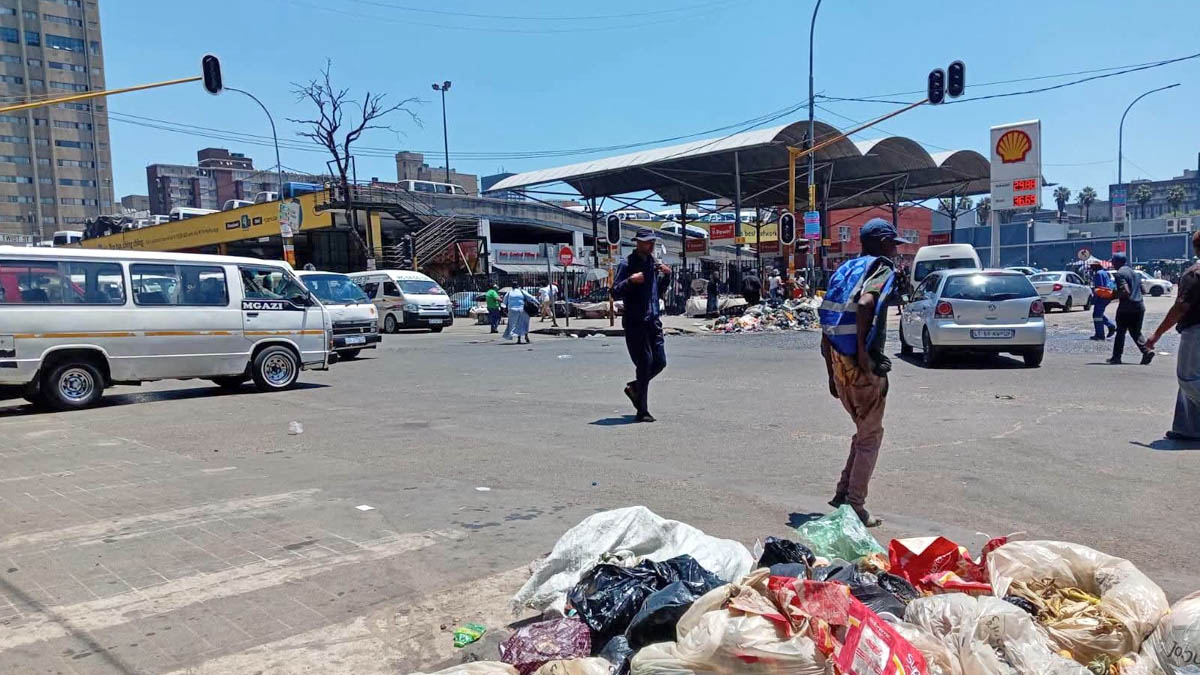
In four days’ time, on Wednesday 4 November, South Africans go to the polls in what could be one of the most important elections of their lifetimes. But many will be snoring through it.
The local government elections will decide who runs the country’s cities, towns and rural districts: who is responsible for keeping water in the taps and sewage in the pipes, the lights on and the rubbish collected. A municipal vote may not sound exciting, but this one matters for other reasons.
South Africa’s local elections are held between the national ones and have increasingly become a dress rehearsal for them. It was the ANC’s slide below 50% in the 2021 local elections that set the scene for the 2024 national election. There, too, its share fell below half, forcing the party into a Government of National Unity (GNU) with its main rival, the Democratic Alliance (DA), and eight smaller parties.
If the polls are right this time, support for the ANC, the party that led South Africa into the democratic era and has held it together for the past 32 years, could fall to the low 30s nationally.
This raises the question many South Africans are now asking: what does life after the ANC look like?
The broad outcome of the election itself is largely baked in. The DA will do well in most of the big cities, though it will need coalition partners in virtually all of them except for Cape Town. Jacob Zuma’s Umkhonto we Sizwe (MK) Party will dominate KwaZulu-Natal and could secure an absolute majority in eThekwini (Durban). The ANC will lose ground almost everywhere while remaining the largest party in the country.
The real battle
The real battle will begin after 4 November, as the country prepares for the 2029 national election. With President Cyril Ramaphosa, probably the last ANC leader who played a major role in the 1994 democratic transition, term-limited out, no-one knows which ANC will emerge on the other side. And there are no obvious leadership replacements.
The changing of the guard coincides with the rise of Zuma’s Zulu nationalist MK Party on one side, and, on the other, the white right and Afrikaner nationalists, who are a small yet a potentially formidable force. These are not new tendencies but old ones, largely since the 1994, that have come back from the country’s past to haunt the future.
Facing this challenge, are the parties of the GNU capable of putting aside narrow party interests to become more than just a marriage of convenience? Can they forge a distinct vision reflective of a broader South Africa to counter the politics of fragmentation that is emerging from the shadows?
Can they offer a better alternative to the people of South Africa than the parties currently on offer?
Despite the high stakes in this election, voters are unenthused. Helen Zille, the DA’s candidate for mayor of Johannesburg started her campaign with a splash, putting on a swimsuit and swimming in a flooded pothole in the suburb of Douglasdale. But since then, the campaigns have become, as one commentator put it, a big yawn.
Although the DA leads in a city run down by successive local governments, and is offering to fix it, its support has barely moved over the course of the campaign.
The reasons became clear as we interviewed township voters in three of the most contested provinces — Gauteng, KwaZulu Natal, and the Eastern Cape. What I found is that, from Soweto to Alexandra to KwaMashu, young people and ordinary residents say they will stay home. Services are broken, but people are tired and no longer believe voting will fix anything.
Despite an uptick of more than a million voter registrations since 2024, only 29.2 million out of about 39 million voting-age citizens have registered to vote. While the IEC is unwilling to speculate on turnout next week, an Ipsos-based assessment, cited by Professor Dirk Kotzé, predicts about 42% of registered voters will vote. That means that less than a third of South Africa’s eligible voters will turn out this week.
Gauteng: The DA leads, but many will stay home
In Johannesburg, Tshwane and Ekurhuleni, the races are tight and coalitions are certain to emerge.
The latest Social Research Foundation numbers put the DA ahead in Johannesburg on 36%, with the ANC on 22%, MK on 11% and ActionSA on 9%. In Tshwane, the DA is on 32% and the ANC on 26%, while ActionSA has climbed to 12%. Ekurhuleni is closer still, with the DA and ANC within a few points of each other.
On the ground, the picture is one of water shortages and protests. In Johannesburg, residents of high-lying areas have gone a week or more without a reliable supply. At St Giles, a home for people with disabilities in Dewetshof, dirty nappies and unwashed linen piled up during a five-day outage. Manager Palesa Nhlapo called it “hell”. People have been breaking open fire hydrants just to get water.
On 28 October, residents of Melville, Westbury and Coronationville blocked roads over water outages that had lasted weeks. The next day, people in Kensington and nearby suburbs, whose taps had been dry since 22 October, protested and demanded emergency tankers.
In Tshwane, the problem has turned dangerous. In Bronkhorstspruit and Ekangala, improperly treated water made more than 800 people sick, most of them young children. Sewage runs in the streets, and tankers often fail to arrive.
Tumisang Yende said voting on 4 November won’t bring immediate solutions. “Even if you vote, what’s going to change? They don’t help us now. When we vote, what’s going to change after that? Nothing’s going to change,” she said.
Katlego Mojafi of Ekangala fell ill after drinking the contaminated water. “I feel like they did it on purpose,” she said. “Now we have to buy bottled water for a family of seven and it is expensive for the many households that don’t have work.
Rand Water has restricted supply to both Johannesburg and Tshwane because the cities are using more than their share. Ageing pipes, high water losses and political blame games continue while residents suffer.
In the townships, the mood is sceptical, especially among the young.
Precious Khumalo from Soweto says he will not vote. “Honestly speaking, I don’t see the need. Our needs are not met at any point. We are being oppressed, and we are voting for oppression.
“We’ve been promised job opportunities and service delivery. Our grandmothers and mothers were promised RDP houses. Some of them are still waiting. There are no jobs. It’s only connections. You must know someone. If not, you must sleep with someone to get a job. We are voting for these people to become richer and for their families to prosper while fraud continues.”
The political authorities are failing young people, he said, “Our own government is the one that is failing us as the youth. There is no change. Things are still the same. I will not vote, and I advise everyone not to vote.”
Nono Radebe from Alexandra sees the same pattern. “A lot of young people do not understand what is going on. The only thing ringing in their brains is TikTok challenges and following other people’s business. When you ask them what they are voting for, they say, ‘What’s the point? Nothing we say is heard by the government.”
“Many have not even registered to vote. Some will go just because it is trendy to have the ink on their thumb. About 30% understand what is happening and are fighting for change. The rest either don’t care or just follow the crowd.”
A community leader in Alexandra confirmed the trend. “Nothing serious this time, but what I’ve realised is that most of the people will abstain from voting. People are no longer interested at all.”
In Kagiso, Brenda Yumba, a Rise Mzansi council candidate, has been encouraging young people to vote. “I feel the youth is still as nonchalant as ever. Many have indicated that whether they vote or not, nothing will change. It is a sad reality.”
eThekwini: MK leads, but the taps are dry
In eThekwini, formerly Durban, Zuma’s MK Party is clearly ahead. October polls put it first: MarkData at 48% and the Social Research Foundation at 43%, with an earlier Ipsos poll as high as 55%. The DA is second on 25–30%. The ANC has dropped to third on just 11–15%, and the IFP and EFF are in single digits.
Analysts say MK will almost certainly be the biggest party, but whether it clears 50% and governs alone is still unclear. Some expect a hung council and coalition talks. But on the streets, people are not talking about party colours. They are talking about water.
Themba Mbonambi from Glenwood says he will not vote. “I am confused about who to vote for, because no party has convinced me that they can make the change that I need to see. We have many power and water outages in the area. I do not think that my vote will change the current situation.”
Thozama Makhubela from Hillcrest Central, a keen runner, has stopped jogging because of crime. “We are always struggling. As a woman, being on the streets jogging puts my life at risk due to the high level of crime,” she said. She pointed to what has happened to women in Ekurhuleni, among them Elizabeth “Tsontso” Moselakgomo, who left home for a jog and was later found dead.
She is just as weary of the outages. “If it is not water outages, it is the power. I believe that the local government elections will not create any change.”
In KwaMashu, Thando Mbutho is blunt. “Voting will not make a difference. Sewage is running on many streets in my area, and it is stinking. Last week alone, we went about four days without power in the name of load reduction,” she said.
In Enkanini, near Bonela, raw sewage has flooded the main road for more than three months. On 8 and 9 October, frustrated residents barricaded Pendlebury Road with burning tyres after three months without reliable water and electricity at Wema Hostel.
Ratepayers are also fighting inflated smart-meter electricity bills that jump overnight from a few thousand rand to tens of thousands. Residents of Effingham, Avoca and Sea Cow Lake say their water is cut without warning and with no clear schedule.
The city loses billions of litres every month through leaks, and water tankers have become big business.
MK promises better infrastructure and clean government. The ANC warns that MK will hollow out the city. Ordinary people just want water in their taps.
Eastern Cape: Neck and neck, and a long wait for houses
Nelson Mandela Bay and Buffalo City are among the closest contests in the country.
In Nelson Mandela Bay, polls put the DA and ANC almost level at around 37% each, leaving the EFF, the Patriotic Alliance and ActionSA to play kingmakers. The metro has already cycled through several mayors and shaky coalitions since 2021. Residents complain about uncollected rubbish, potholes, sudden water cuts, power outages and crime, and many believe the metro has been “terribly run” for the past five years.
In Helenvale on 13 October, sewage flooded homes. Residents dug trenches and fled, disputing the municipality’s claim that security problems were holding up repairs.
Housing remains a deep wound. The backlog stands at about 100,000 houses. A few new projects have been launched, but thousands still live in informal settlements without proper services.
In Buffalo City (East London), older polls showed the DA ahead of a weakened ANC, with the EFF strong. Residents of places like Duncan Village say they still live with open sewers, broken roads and dangerous electricity lines.
In Pefferville, raw sewage is still overflowing from manholes nearly two years after a formal directive ordered the city to stop it. Delayed housing projects and stories of money spent with little to show for it have left many cynical about election promises.
In both metros the message is the same: people want councillors who fix problems, not ones who just put up posters at election time.
Abahambe at the ballot box
The local government elections will test the support of the Abahambe anti-foreigner movement that has scarred South African politics this year.
To many Africans beyond South Africa’s borders, the impression has taken hold of a movement that speaks for most South Africans, with the authorities acting too late or doing too little to stop attacks on their brothers and sisters.
But listening to voters in the townships of Gauteng and beyond, and a different picture emerges. People we spoke to in Soweto, Diepsloot, Tembisa, Kagiso, the North West, Palm Ridge and Alexandra repeatedly separate the two issues.
They acknowledge frustration with undocumented migration yet insist that on election day they will judge parties and candidates by water, electricity, roads, refuse collection, jobs, and whether their leaders showed up when things fell apart. Many are not sure whether they will vote at all.
The evidence from the streets, and from the polls, suggests the Abahambe movement matters a great deal in KwaZulu-Natal and the Zulu-speaking hostels and townships of Gauteng, but far less almost everywhere else.
“People are suffering,” says Sam Morake, from Naledi in Soweto. “In many townships, residents are still experiencing power cuts in the name of load reduction, water shortages, potholes, decaying infrastructure and everyday service delivery issues. People will vote for parties that they think will address these issues, not for slogans like Abahambe.”
Morake believes the marches were led by opportunists who were paid to spread hatred among people who had lived side by side for decades. It was all about money, he said: the organisers lived lavishly, while those who joined the marches were left poorer, unaware that their leaders had profited from organising them.
The leaders of these groups, he said, knew that the country’s problems were caused not by foreigners but by corrupt politicians. “I don’t think people will vote for parties that are associated with anti-immigration groups.”
It is important to separate anti-foreigner sentiment from support for vigilantism. The Human Sciences Research Council’s South African Social Attitudes Survey recorded a clear hardening of anti-immigrant attitudes in 2025: only 15% of adults said they would welcome all immigrants, while 42% said they would welcome none, the highest level of hostility since tracking began in 2003.
Yet a GeoPoll survey conducted in June 2026, at the height of the marches, found that three-quarters of respondents (75%) believed violence and ill-treatment of foreigners was never acceptable. Only 12% said they actively supported the protests targeting foreign nationals; a majority (52%) said they understood the frustrations but did not support the actions, and a further 23% rejected them outright.
The violence and looting that followed the peak marches also produced a backlash among some voters. Even one of the movement’s former figureheads now believes its moment has passed.
If anything, the evidence points to a decline in the electoral pull of anti-foreigner politics outside the Zulu-speaking areas.
The parties that have embraced it most loudly beyond KwaZulu-Natal include Gayton McKenzie of the Patriotic Alliance who has placed the “Abahambe” slogan at the centre of his campaign. At its manifesto launch in Bloemfontein, he said: “Abahambe is a national job… but the pool of “Abahambe’ is local government.” The PA has campaigned on using municipal by-laws to target businesses that employ undocumented foreign nationals. It may do well in working class coloured communities, particularly in the Western Cape.
ActionSA leader Herman Mashaba has taken one of the hardest positions of all. “In municipalities where we govern, illegal undocumented foreign nationals are not welcome,” he said. “I will not accept even one undocumented person. I will declare war against them… March and March is calling on the South African government to mass-deport those people, and I’m in full agreement with them.”
Mashaba is the clearest test case. In the 2021 local elections, held just months after Operation Dudula was launched in Soweto and while anti-foreigner mobilisation was at its height in the townships of the Witwatersrand, ActionSA won 16% of the vote in Johannesburg, making it the city’s kingmaker. In fact, it was this showing that proved to other parties that mobilising around xenophobia was a vote winner in local government elections.
This time, despite an even harder line on immigration, the polls put Mashaba’s party at between 9% and 14% in the city. If those numbers hold, the loudest anti-foreigner voice in Gauteng’s biggest metro will have lost ground, not gained it.
So where does the anti-foreigner mobilisation draw its strength?
Nkala said the leadership of the protests was largely drawn from one ethnic group: Zulu people from KwaZulu-Natal. In his view, the movement has a strong regional and ethnic base, rather than representing a uniform national response to undocumented immigration.
He said parties associated with the protests were unlikely to gain significant additional support in townships around Johannesburg where the hostel system, with its concentrations of isiZulu-speaking migrant workers, is absent. He also pointed to Limpopo, Northwest, the Free State and the Northern Cape, where the protests had been limited or absent, arguing that the smaller isiZulu-speaking populations in those provinces had constrained the movement’s reach.
The polling points the same way. The HSRC found that anti-immigrant sentiment is strongest by far in KwaZulu-Natal, where the share of people who would welcome no immigrants at all reached 60% in 2025, against 42% nationally, and among poorer and working-class respondents.
Abahambe, in other words, is best understood not as a national uprising against foreigners but as a new expression of Zulu nationalism: a current that has run through South African politics since the days of Inkatha in the 1980s and 1990s, and which, after years in which it was contained within the ANC and a weakened IFP, has found new outlets.
It surfaced in the July 2021 unrest that began in KwaZulu-Natal, in the rapid rise of Jacob Zuma’s MK Party among Zulu-speaking voters in 2024, and now in the protests of March and March. Anti-immigrant sentiment has given that nationalism a cause, a slogan and a street presence. That is not to say that every isiZulu-speaking voter shares it. But it is where the movement draws its strength.
A big step into the unknown
These elections will not hand any party a clean national win. Expect hung councils, minority governments and difficult coalitions.
But the true result will only become clear in the months that follow, when the new councils either start fixing the taps and the streets or prove that nothing has changed after all.
As for the Government of National Unity, the current evidence points toward a working arrangement rather than a shared vision. But some things could push it further either way, and the next few weeks matter a lot.
After the Constitutional Court ordered the IEC to put 181 excluded ANC candidates back on the ballot, ANC secretary-general Fikile Mbalula called on the party’s leadership and GNU partners to reassess the DA’s continued participation, arguing that the DA’s opposition to the ANC’s case was at odds with the statement of intent that created the GNU.
The DA’s response was blunt: its federal council chair Ashor Sarupen said the DA is not in the GNU to get along, and that it will vigorously defend the rule of law.
The DA’s tone has also hardened under its new leader. In July, Geordin Hill-Lewis accused the ANC of refusing to consult or compromise on government policies and said the DA would make public the positions it had taken inside the GNU. He also openly framed the moment as preparation for a post-ANC future, which is not the language of partners building something together.
On the ANC side, pressure is again growing within the party and its Tripartite Alliance partners to “kick the DA out of the GNU”, and the SACP has long cast the arrangement as a construct of “right-wing, DA-led anti-ANC neoliberal forces.”
The ANC’s 2027 succession battle could change the equation entirely, since some candidates for the ANC’s top job are not supportive of having the DA as a ruling partner.
On the other hand, the coalition has survived repeated crises: One analyst summed up South African politics as “we do crisis”, meaning that brinkmanship hasn’t yet produced collapse.
Both sides keep choosing to stay. The DA has ministries and influences it didn’t have in opposition, and the ANC lacks a majority-forming alternative that its pragmatic wing finds acceptable.
The original logic still holds: the GNU saved the country from a potential “doomsday coalition” with the EFF and MK, and that fear of fragmentation is the closest thing the partners have to a shared vision.
But that might not be enough in the years ahead as South Africa enters a very different and more challenging political and economic environment.
This is a guest piece by the award-winning journalist Everson Luhamba, drawn from Phillip van Niekerk’s substack Africa Unscrambled. Used with permission.