

By David Willers
I live on the island of Anglesey, in a quiet Welsh village overlooking the stunning Menai Straits, as well as the Menai Bridge itself — the world’s first modern iron suspension bridge, opened exactly 200 years ago last month, in January 1826.
The bridge is a triumph of engineering, joining the mainly Welsh-speaking Anglesey with the mainland. It leads onto the road to Holyhead, the ferry gateway to Dublin.
To mark the anniversary, I attended a conference on the bridge at the local Bangor university, extolling the genius of the British engineer Thomas Telford, who designed and built it. Following the 1800 Act of Union it became paramount to have a fast, safe route to Ireland, and so construction began in 1819. Wrought iron suspension chains, resembling modern bicycle chains, support the ‘deck’ of the bridge which is 579 feet long.
One immediate advantage, apart from enabling faster mail and coach times, was that it allowed cattle to cross the straits without having to swim across it, braving the turbulent currents which protected the Druid headquarters from the Roman legions. The Druids were a strategic influence in Celtic Europe at the time (mainly France and Spain), and Anglesey was twice invaded by the Romans to quell them.
However, the shrieking Druid priests and their bare-breasted female followers intimidated the superstitious Roman soldiers, and instead, dependably efficient German mercenaries were brought in to slaughter every man, woman and child on the island. Or so Tacitus tells us, in any event.
A curious coincidence is that my house is at the bottom of Druid Road, leading to the site of the Druid’s Sacred Grove. It’s still a spooky place, especially at night. Their pagan reputation lingers – many a Rowen tree is planted here to ward off spells and witches.
Today, the Menai Bridge stands as a testament to industrial-age ingenuity, but it’s immediate cultural impact was more dubious, triggering a subtle erosion of Welsh cultural identity as more and more ‘foreign’ English-speaking travellers flooded across Anglesey, or Môn, as it is known in Welsh.
Victorian tourists came in search of romantic landscapes and enchanted regions, rather than the cultural specificity of the Welsh, now reduced to a Celtic fringe curiosity. The bridge provided ‘imperial connectivity’ for the English. It also provided a physical crossing for newly arrived grey squirrels from America in 1876. Stronger than Britain’s native domestic red squirrels, the greys decimated them with fatal diseases. Because of its relative isolation, Anglesey had been one of the last refuges of the Red squirrel.
It’s taken 100 years to get rid of the greys on Anglesey and restore the red squirrel populations. Unfortunately, the message hasn’t reached everyone: last week Baroness Hayman of Ullock surprised environmental campaigners by wearing a ‘marked down’ 22 000 rand grey squirrel Dolce and Gabbana dress at an event promoting the protection of the endangered reds! Usual first-world tin ear nonsense.
There’s a neat arabesque in the saga of the squirrels. What was happening to the reds was also happening to the distinctive Welsh culture. And while the Menai Bridge was an economic necessity, contemporary Welsh poetry spoke of apprehension about the ‘iron’ future it ushered in, enabling the outside world to pierce the heart of Welsh-speaking, rural life, initiating cultural change that many lamented.
Fortunately, Welsh has reasserted itself as the dominant language of north Wales and Anglesey, and the Welsh nationalists are driving a political agenda which includes tourist taxes and painful council taxes to discourage English second-home owners. The Menai Bridge has been totemic in all this, its importance far wider than simply a way of crossing water.
This set me to thinking about other bridges in the world, and their metaphorical message. We are all familiar with many of them through such famous products of the cinema as the bridge over the River Kwai, the bridges of Madison County, a bridge too far at Arnhem, the bridge at Remagen, the bridge of San Luis Rey, 21 Bridges, the seven mile bridge in True Lies, and so on. Plenty more no doubt in other languages.
My thoughts turned to the country of my birth, South Africa, the Rainbow Nation, a term coined by Desmond Tutu. He saw post-1994 South Africa as a country needing to build symbolic ‘bridges’ across the different racial divides.
But in a country marked by spatial separation, there was also a need to close the gap physically. Well-meaning architects have beavered away at this rectification of the past. One result is the Nelson Mandela Bridge in Johannesburg, which links historically divided business districts. The bridge is intended to remind us of Mandela’s life work in overcoming or bridging racial divisions.
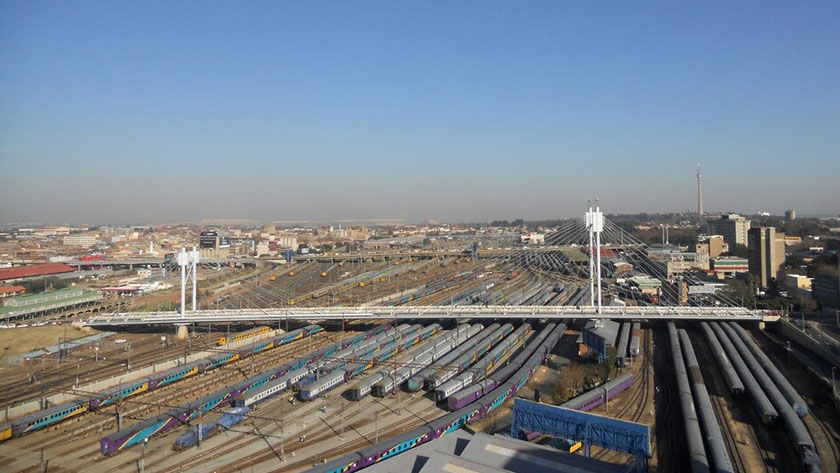
The Nelson Mandela Bridge in Johannesburg, connecting two previously disparate parts of the city. (Wikimedia Commons)
Another Jo’burg bridge with a similar ambition, The Great Walk Bridge, or the Grayston Pedestrian and Cycle Bridge, gives pedestrians and cyclists a route across a motorway. It bridges two dramatically different worlds, one rich, one poor, Sandton and Alexandra. I think the social hope was a thermodynamic one, in the way that jam mysteriously dissolves into hot porridge.
Another bridge I confess I haven’t visited but have read about is the Musina Hand Bridge, near the Zimbabwe border. Giant sculpted hands support the deck of the bridge, and the title of this edifice is “Hands Across Borders”.
Other bridges in South Africa are also seen as positively helping local poor people. One example is the Bloukrans Bridge which offers the world’s highest commercial bungee jump. Tourists stream there, and the bridge provides vital employment for locals.
Many of these bridges begin with the letter M, which is odd – the Menai Bridge, the Mandela Bridge, the beautiful Millau Bridge in France, the remarkable Malmo Bridge linking Sweden and Denmark. And then there is the extraordinary Straits of Messina Bridge, at least on paper, linking the toe of Italy with Sicily. The letter M even looks like a bridge, come to think of it.
The Messina Bridge was to have begun construction this year. It would have been 200 years since the Menai Bridge started the fashion in suspension bridges (except for those suspension bridges made of vines which Harrison Ford so deftly swung from in his jungle flics) – and I even thought of writing a letter to the Italian consul suggesting a ‘twinning’ of the two.
But even though it had been approved by the Georgia Meloni government (another M, I notice), it was abruptly cancelled following large demonstrations in Sicily decrying the potential erosion of Sicilian cultural identity. Blow me down – they must have read the Welsh bards.
Same objections, but a meaningful result in the Sicilian case. Of course, the immediate local population on the Italian side has also had its doubts about the wisdom of the project, but for different reasons that have more to do with Mafia infiltration fears. Feeding perhaps off the massive investment of 15 billion dollars.
But for me, the most emblematic of all bridges, which seems to capture all the worst and best of the human condition, is the Ponte Vecchio, bridging the Arno River at Florence, that most exquisite of all Italian cities, a badge and celebration of the art of the Renaissance which lifted the spirit of Man from the dark ages, although I’m not sure in our woke era whether I can get away with calling it that any longer.
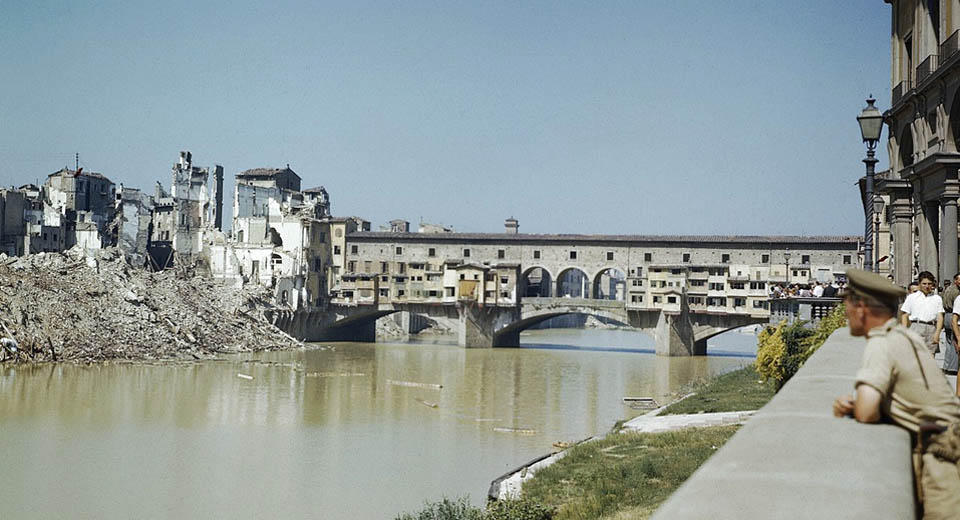
The Ponte Vrcchio on 14 August 1944, three days after the German retreat from the city. (Wikimedia Commons)
The saga of the Ponte Vecchio and the destruction of almost all of Florence’s historic bridges along the Arno by the Germans to slow down the Allied advance culminated in the Night of the Bridges as it is known in Italy, on 4 August 1944.
South African troops of the 6th South African Armoured Division were also part of the drama as they fought their way together with Alexander’s 8th army through the German defensive lines north of Rome.
As they approached Florence, the Germans systematically blew up the Ponte Santa Trinita, the Ponte alle Grazia, the Ponte alla Carraia, and the Ponte alla Vittoria – all constructed in medieval times hundreds of years before. However, thanks to the moral courage of the art-loving German consul in Florence, Gerhard Wolf, the army spared the Ponte Vecchio. Wolf risked a firing squad by countermanding the sabotage order.
South African soldiers were the first allies to cross the bridge and liberate the centre of Florence later that same day. Italian partisans later claimed credit for cutting the wires before the plunger could be depressed. Could have been some coordination. It’s also worth mentioning that every destroyed bridge was rebuilt using stones retrieved from the bottom of the Arno.
One bridge never built was one between France and Britain. But this was because of military considerations. Napoleon on the other hand envisaged a tunnel, dug in secret, in order to invade England. Eventually it took a pugnacious South African, the late Sir Michael Edwardes, celebrated Chairman of companies, to realise Napoleon’s vision. He headed up the project during the Thatcher era, finished the tunnel on time and on budget, and was knighted for his achievement.
During the heyday of Britain’s membership of the European Union, the tunnel opened up enormous two-way traffic under the English channel, and augmented rather than eroded mutual understanding. Sadly, those days are gone, since Britain left the EU, with schools everywhere closing their foreign language classes. Even our local university, Bangor, has shut its German, French and Spanish departments. The tunnel has served its social purpose, and now the main traffic consists of thundering freight lorries.
FEATURED IMAGE: The town of Menai Bridge and the bridge itself, photographed in the morning mist in 2004 by (Andrew Dixon, Wikipedia)
What a lovely piece, playing out an intriguing theme across geography and time …
Nice one, David. I look forward to crossing one of these bridges to see you soon.
Beautiful. So love reading this, especially the South African parts.
Anne Munnik
Brilliant!
Glen Moreno