
The 2030 Reading Panels 2026 Background Report which reveals – among other things – that only 30% of Grade 1-3 learners are reading at grade level, and up to 25% of Grade 3 learners in certain language groups are ‘unable to read a single word’, sent shock waves throughout the country. Although media reports have been scathing, is the situation really as bad as these figures seem to suggest?
The Reading Panel, comprising some of the country’s most illustrious intellectuals, and chaired by former deputy president Dr Phumzile Mlambo-Ngcuka, seeks to address SA’s reading crisis, and asks the question: ‘What needs to change for us to ensure that all children learn to read by 2030?’
We thought we’d been here before. In 2021 a Progress in International Reading Literacy Study (PIRLS) report which found that a staggering 81% of Grade 4 learners could not read for meaning resulted in a national scandal. Five years prior, up to 78% of 4th Graders could not read for meaning in any language. These figures showed a stark regression to 2011 figures, placing the country amongst the lowest-performing globally.
Those findings seemed to cast doubt on President Cyril Ramaphosa’s celebrated (or infamous) 2019 policy announcement that all 10-year-olds should be able to read for meaning by 2030. Around the release of the PIRLS study, the Covid-19 pandemic was indeed a legitimate excuse. Its effects, which showed vast disparities between fee and non-fee paying schools, laid bare the deeper social determinants of education. This study has been cognisant enough to conduct a systemic assessment that is not simply confined to the classroom, not least of which is a compulsory national review of all initial teacher education – an evaluation last conducted in 2005.
In 2023, for example, the Presidential Youth Employment Initiative (PYEI) Educator Assistant Programme, aimed at taking on nearly 30 000 ‘reading champions’ to improve reading in the foundation phase, was lauded as one of the more visible government interventions. However, even this effort – which only required a 30% pass mark to qualify – was met with scepticism from experts.
In the Reading Panel’s 2023 report, the Stellenbosch University education expert Nick Spaull stated that ‘to reach the 2030 goal, fundamental reforms are required in the ways that teachers are recruited, trained, certified, supported and evaluated, as well as far-reaching reforms on education financing and the resourcing of schools’. However, except for the Western Cape and Gauteng, there was currently ‘no National Reading Plan, no budget for reading and no reporting on reading’. Even large-scale government-backed programmes like the National Education and Training Council’s (NECT) Primary School Reading Improvement Programme seemed hopelessly underfunded.
Fast forward to 2026, and there are slivers of promise. According to the latest report, ‘six of the nine provinces are implementing evidence-based reading
interventions, when not a single one was doing so just four years ago. Moreover, the introduction of FUNS assessments has ‘expanded insight into foundational skills and strengthened provincial assessment systems’.
Whilst the report laments the absence of a national literacy drive, it also notes that, in the 2026/27 financial year, the Department of Basic Education is due to roll out an updated national foundation phase catalogue. Similar efforts will be made in respect of home language education.
Moreover, it records that, in smaller trials, appointing visiting reading coaches as well as well-resourced and well-trained Educator Assistants have proven to be effective forms of intervention. It recommends the following: annual reading assessments at every school; the allocation of new national budgets for reading programmes; equipping Foundation Phase classrooms with a standard minimum set of reading resources; and ensuring the auditing of teacher education programs prior to graduates entering the workplace. Although there is a long way to go, it seems as if at least the foundations for real future progress are being laid.
In the meantime, the statistics still don’t look too good. Among them are those for mother tongue education — among others Sepedi (11%), isiNdebele (14%) and Xitsonga (16%) learners were among thet worst performers to reach the required literacy targets by the end of Grade 3. At 48%, English-language speakers were the best performers.
More positively, the Eastern Cape in particular is said to provide an extensive roll-out of materials to some 1 652 poorer schools. The Free State’s efforts are set to reach 433 schools, 588 in Gauteng, and Mpumalanga has its R100-million Grade R Capacity Building Programme and equipping 965 quintile 1-3 schools.
These small hopes notwithstanding, the research panel is unconvinced that the country will meet Ramaphosa’s 2030 goals. Looking at the present data, it believes the president’s announcement might have been a bit ambitious, because such drastic shifts, particularly in education, do not occur overnight.
The report goes on to advise that interventions at the provincial level tend to be highly effective, as this is often where the necessary resources usually are. It then goes on to recommend standardised reading assessments, funding specifically towards reading, minimum reading resources at the foundation level. and improving teacher preparation.
Given the flak from opposition parties as well as the general public directed at government in the wake of the PIRLS findings, one would’ve expected swift, vaccine-like interventions, not least because the findings affect the most vulnerable citizens – the children. But seemingly government has been in no particular rush to tackle the crisis.
And, with only six provinces seemingly trying to turn the tide, we might be asking why the rest aren’t coming to the party. However, we forget that just a few years ago the programmes that are currently being rolled out and the efforts to expand them did not exist at all. Not quite at the recommended national level, but perhaps we can appreciate the small little shifts forward.
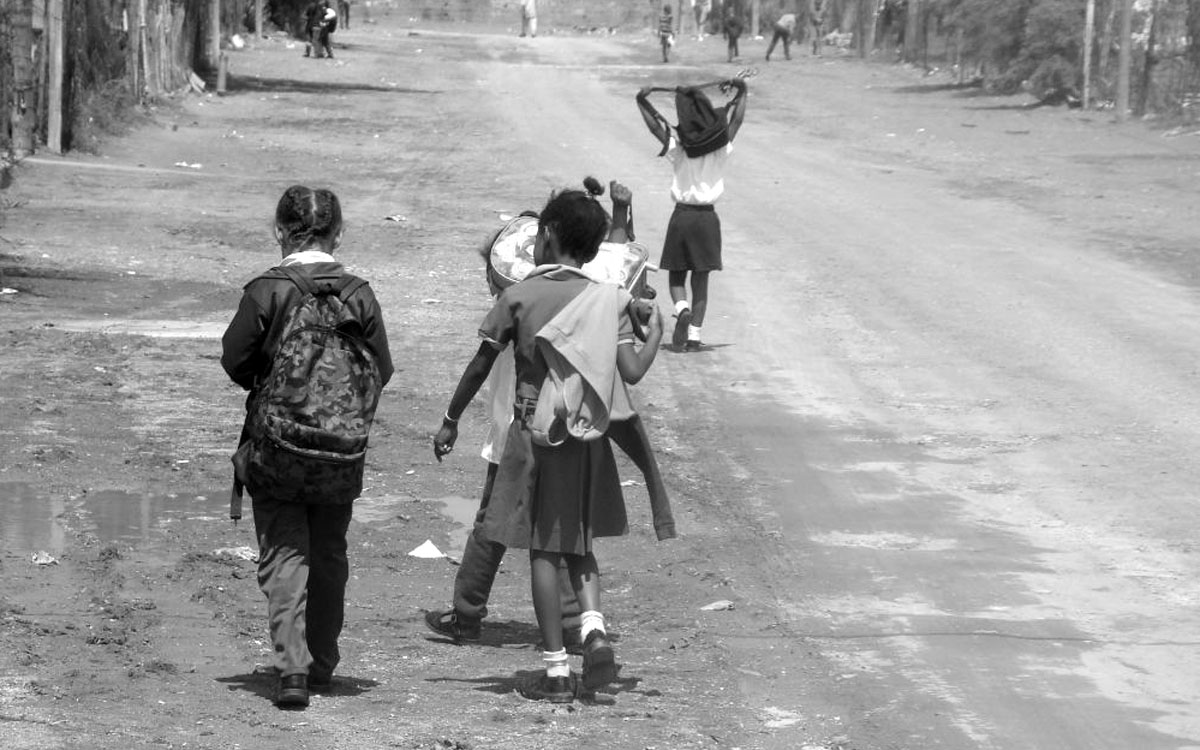
Featured image: Children walking back from school. Source: eParkeni.
This is an edited version of an article on Phakamisa Mayaba’s website, eParkeni. Used with permission.