
By R.W. Johnson
The ANC panic over the renewed threat to Ramaphosa’s leadership (in the form of the resurgent Phala Phala scandal) is extremely revealing. When Luthuli was leader, the problem was not a lack of potential successors but rather the reverse: Mandela, Sobukwe, Tambo, Buthelezi and Sisulu were all shining stars. If Mandela’s leadership faltered, there was always Mbeki and — but for Mbeki’s habit of disposing of any possible leadership rival — there would have been several others. When Kgalema Motlanthe was caretaker president before Zuma, not a few wished this could be permanent. And, of course, when Ramaphosa became deputy president, extravagant hopes were held of him.
Now, however, the thought of Paul Mashatile or Fikile Mbabula as president creates a rush for the exits – and much speculation about drafting in Patrice Motsepe, although he’s never held either elective office or any position in the ANC, and disclaims interest in the position. Earlier it had been thought that Ramaphosa was preparing the succession for Ronald Lamola, but Lamola spoiled this by his rather leaden style and apparatchik views. Senzo Mchunu was another possibility but got caught up in the scandal over police corruption. So the cupboard is pretty much bare.
How and why has this happened? One may start by looking at the various institutions which flanked the ANC and provided it with much of its talent. Pride of place goes to the SACP which, despite its small size, played a crucial role from the 1950s on in providing intellectual leadership and the training of cadres. That it was able to do so was in good part due to the presence within Party ranks of a talented generation of Jewish intellectuals who had been attracted into the Party by the international anti-fascist struggles of the 1930s and 1940s.
The best known of these were Michael Harmel, Jack Simons, Ray Alexander, Joe Slovo, Ruth First, Lionel Bernstein, Harold Wolpe and Denis Goldberg but there were many others at a lower level in the country’s major cities – for example, Tolly Bennun played a pivotal role in Port Elizabeth, as did Rowley Arenstein in Durban.
The SACP also recruited many promising young Africans from within the ANC, including Nelson Mandela and later, Chris Hani. From the 1960s and 1970s on the large majority of the ANC elite were also SACP members. The Party’s African members were usually much less well educated than its Jewish elite, but the latter played a vital role in infusing Communist methods of thought and organisation – usually of a completely Stalinist type.
By the time the ANC came to power in 1994 this generation of Jewish Communists was beginning to die off, and within a decade or so it had largely vanished. It has not been replaced. The only post-1994 Jewish intellectual in the same tradition was Andrew Feinstein, and he quickly ran foul of the ANC leadership for asking awkward questions about the arms deal. He had been the outstanding intellectual voice in the ANC’s parliamentary party, but his collision with ANC corruption told its own ironic story. The fact was that the ANC was no longer a comfortable home for radical intellectuals in the Ruth First tradition.
Instead the Party was taken over by Blade Nzimande – a man of far inferior talents with no Struggle record at all – and within a few years it was a shadow of its former self. At the same time the substantial Indian membership of the Party also faded away. As a result it could no longer play its old role of helping to develop, educate and train key leadership cadres for the ANC. Even more significant was the way that the Party ceased to be able to exercise its intellectual leadership of the whole Congress movement. The most striking proof of this was the ease with which the frantic objections of the SACP to the ANC’s 2024 agreement with the DA were simply ignored and brushed aside.
A somewhat similar story of organisational decay and decline affected the other major ‘feeder’ organisations which had bolstered the ANC – the ANC Youth League, the Women’s League and Cosatu. In its heyday the ANC Youth League, led by the Mandela group, had played a pivotal role in radicalising the ANC and leading it into the post-war era. Briefly after 1990 there were hopes that another generation of ‘young lions’ would play a similar vanguard role.
However, the radical ANCYL leader, Peter Mokaba was a controversial figure. An Aids denialist – he claimed Aids was ‘an international Western plot’ aimed at returning Africa to colonial rule – he was suspected of being HIV-positive himself. He was also accused of having spied for the apartheid regime, accusations he was unable to shake (indeed, it was alleged that the ANC leadership had known the truth of these allegations but had decided to conceal it in order to avoid a demoralising scandal). Mokaba’s early death at age 43 was widely believed to have been due to Aids.
Then the ANCYL was taken over by another dubious figure, Malusi Gigaba, and then by a wild populist group led by Julius Malema – who, like Gigaba, also had no Struggle record. Within a few years Malema had openly challenged the ANC leadership, been expelled, and led away much of the League into his own EFF party. The ANCYL has never recovered while the EFF has become a by-word for corruption and for the personality cult around Malema, apparently its leader for life.
The ANCWL story is similar. It played an important role in the 1950s, but by 1990 it had become very much an ANC Wives’ League. ANC leaders accorded it an exaggerated respect, but when it mattered it was largely ignored. Moreover, just as the ANCYL had a Malema problem, the ANCWL had a Winnie problem. When she wanted to be, she was always the dominant figure, and others were afraid of her — with reason. Inevitably, sensible younger women in the movement tended to keep their distance from the League. There were recurrent calls for women in the top ANC posts, but these normally came to little or nothing.
Finally, Cosatu entered the 1990s flush with its successes in the previous decade, and a large number of its key leaders went into parliament or government. For some time this gave an impression of strength but over time the movement lost momentum. Its claimed membership figures were always exaggerated and over time it lost ground in the private sector and became almost completely reliant on the public sector unions which were normally defending the interests of relatively privileged groups of workers. In addition, corruption became a serious problem in many unions. As unemployment soared, union membership fell and Cosatu was in the uncomfortable position of being a major support for a party responsible for greatly increasing unemployment.
On top of this the largest union, Numsa, left Cosatu and a whole rival trade union federation, SAFTU, appeared – led by the previous Cosatu leader Zwelenzima Vavi. Moreover, Cosatu had been playing politics for so long that it now instinctively took up political positions first, even where they conflicted with the interests of workers. The overall result has been a very considerable weakening of Cosatu, which accordingly plays a much reduced role in ANC affairs.
Taken together, the decay of these ‘feeder’ organisations has had a stultifying effect on the ANC. Able and ambitious young cadres are now unlikely to come up through any of these organisations to take their place in the ANC.
Finally, there is simply the fact that ANC rule has been a colossal failure. In 1994 the ANC brought out a paper entitled ‘Ready to Govern’, but there has seldom been such a huge misnomer. Thabo Mbeki frequently mentioned the claim, often heard from despairing Westerners in Africa. that ‘Africans can’t govern’. Mbeki naturally resisted such a claim, but also seemed troubled by it, as if fearing it might be true.
The problem was that elsewhere in Africa African nationalist parties had inherited power in relatively simple economies built around one or two cash crops, with harvests brought down to a coastal capital (often the country’s only large city) by the sole major railway line. South Africa, on the other hand, presented a unique challenge. The country was large, had by far the largest rail network in Africa, had a modern economy with the continent’s largest mining industry, a sophisticated financial sector, an impressively productive agricultural sector, a powerful army and a number of large modern cities. The ANC, on the other hand, had only a small number of well educated cadres and couldn’t possibly staff even the civil service, let alone the multiple modern roles in the economy, without a calamitous fall in standards.
Moreover, the ANC didn’t even understand that economy, or the huge gap between its own capabilities and what was required. Its blithe confidence that it could displace and replace the white ruling class was based entirely on ignorance. The only real hope of avoiding a major crash was to retain much or all of the existing civil service and keep as many of the white, Coloured and Indian white collar, administrative and managerial personnel in place while a maximal effort was made to educate and train Africans to take over at least some of these roles.
But the ANC cadres were hungry for all these positions, and were in no mood to wait. And there was no shortage of ANC spokesmen happy to rationalise that hunger into ideological imperatives. So in short order they did indeed take over the civil service and the substantial public sector of the economy. The result was disastrous. The civil service was largely destroyed, creating a broken-backed state, and the large public industries plunged into chaos and chronic deficit. Only the private sector’s much stronger performance saved the state from complete collapse. The major crash came but was spread out over many years with the public sector kept alive only through huge and continuous bail-outs.
The electorate was slow to understand what was happening. The onset of power cuts in 2007 was a major shock: nothing like that had happened under apartheid. The awful failures of Transnet became increasingly obvious and these public sector failures badly impacted the private sector. The huge increases in unemployment – far beyond anything seen under apartheid – made it clear how poorly the economy was now faring and, finally, the growing crisis of virtually all the ANC-ruled towns and cities made it clear that the ANC was driving South Africa backwards, not forwards. Moreover the runaway corruption of the ANC was increasingly visible, and made it clear that the ANC was far more focused on individual enrichment than on the public good.
All of these factors weighed increasingly heavily on young black people. It was deeply demoralising, and the ANC were quite clearly the villains of the piece, ‘Accused No.1’, as Ramaphosa himself put it. The only motive now for joining that party was the pursuit of jobs and contracts – and even there, the private sector offered more certain rewards.
Looking back, the ANC’s fatal error was its betrayal of its promise to be non-racial. In the course of the Struggle the ANC had benefited from many crucial contributions from white, Coloured and Indian supporters. It was essential to keep that broad non-racial alliance together. Instead it instituted a narrow African nationalism with a host of new racial laws. This was a huge handicap for the economy and it also meant that the ANC itself quickly became a uni-racial party, with a large consequent loss of talent. A broader South African patriotism would have served the party and the country far better. Political corruption should have been denounced as ‘betraying the nation’ and firmly punished from its very first appearance.
Secondly, the ANC erred in not making African education its number one objective. Instead of encouraging the best white teachers to retire, they should have been kept in service as long as possible, and everything should have been done to increase the resources available to black schools. This would have entailed the firm cutting back of SADTU’s powers, with every effort made to upgrade and improve black teachers, enforced by rigorous inspections. Instead of denouncing talk of ‘standards’ as racist, there should have been a determined push for higher standards.
If such steps had been taken, a different atmosphere would have been created. Without doubt we would not now be facing a situation where the political succession seems to be a choice between the dregs of the movement. On the one hand Mbalula can’t explain how he afforded a R680 000 family holiday in Dubai, and Mashatile can’t explain where his wealth came from in general. In addition Mbalula struggles to be taken seriously. Both men are a very long way from being the best that the ANC can produce – or used to produce. In 1994 they would hardly have been considered as possible Cabinet choices, let alone presidential contenders. As with so much else, we have gone sharply backwards.
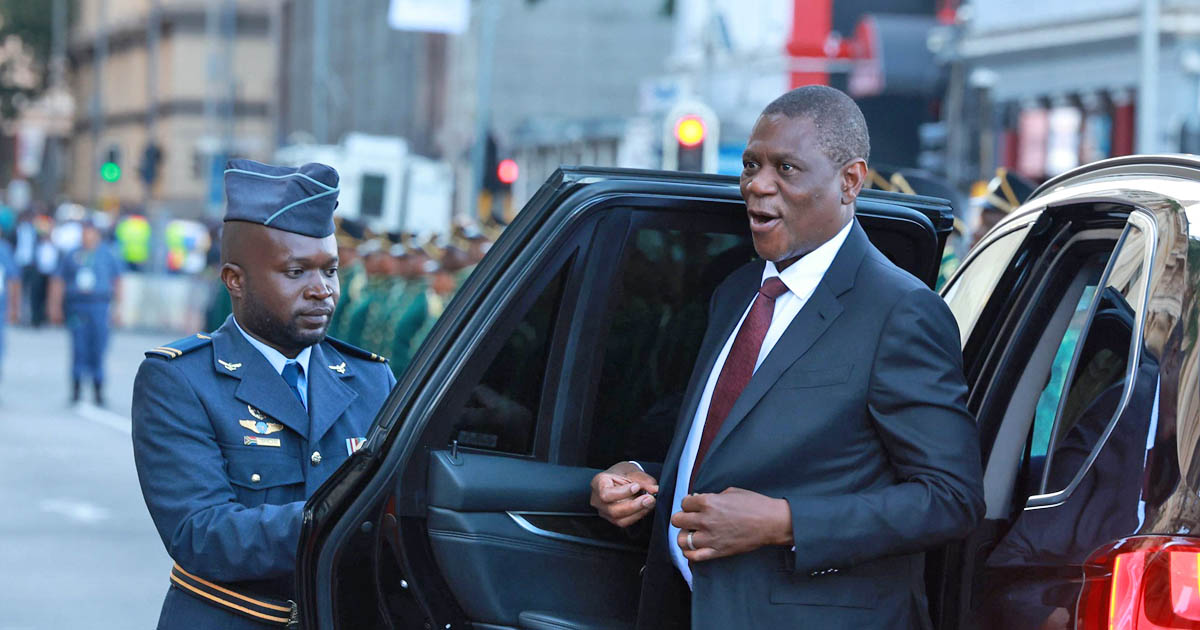
FEATURED IMAGE: Deputy President Paul Mashatile arrives at Parliament for the State of the Nation Address, February 2026. There is little appetite – even in the ANC – for a Mashatile presidency. (GCIS / Flickr)
Great article. Essentially it seems we are back to the ANC of the second world war years under A B Xuma. Basically a pan Africanist Party again. The SACP’s Walter Sisulu and Bram Fischer were key to the post war multiracialism of the ANC and the ousting of Xuma. But now…?
This challenging Bill Johnson’s article, reminds me of the commendable role of public affair commentators. My appeal is for wider more nuanced less personalized commentaries on public affairs. I fear any trumpian-like tendency to either showcase or ambush party political personalities. This can often come across as sideline distortions, even vendettas: both by targeted commission or by omission. That seems to me to be a danger of personal bashings, or lapses in memory, detracting from commendable projections and advices for our many and diverse hearts. My appeal is that commentators focus their challenges to systems and processes, and to the constitutional challenges unfolding before us, beyond person bashings, More particularly in these patrimonial times for encroaching local government elections due on November 4 this year. We see every day the needs for the best possible and widest possible broad ‘church’ of local government representatives, accountable to the many hearts of vastly talented and generally widely supportive electorates at ground levels. This seems to me especially to highlight and trust for more youth to register and to vote for the futures they deserve. This appeal is also on behalf of the widest achievable outgoing constituency which in all sorts of diverse ways also well beyond party political personalities, sacrificed and helped build a more equitable, transparent, and democratic body politic in process.
What more can be said after RW Johnson’s and Maeder’s reviews. I certainly understand both points of views. We all want a BETTER South Africa