
By R.W. Johnson
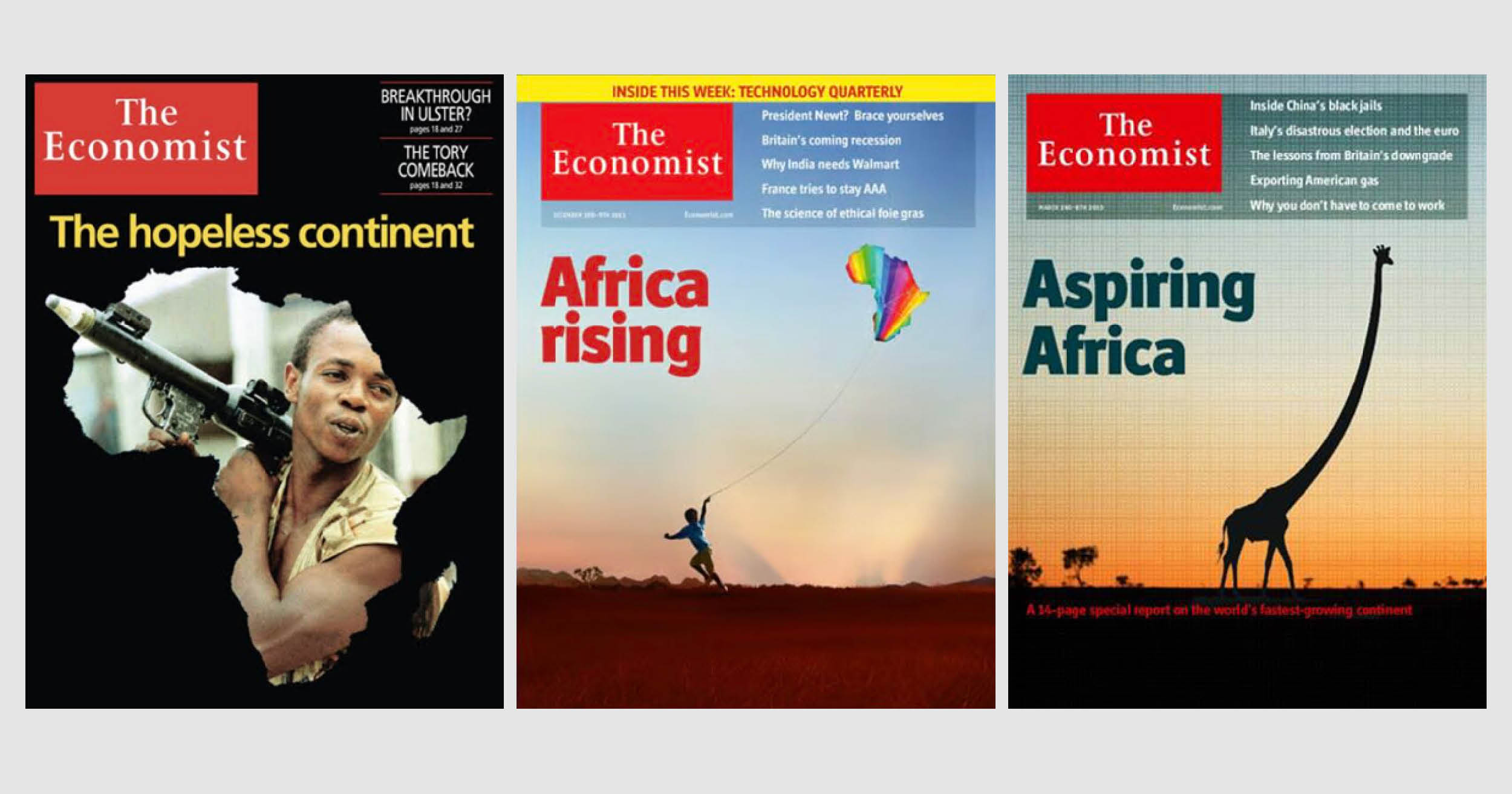
Writing about Africa carries special difficulties, as The Economist found out in May 2000 when it ran an issue entitled ‘Africa: the Hopeless Continent’. Appalled by ‘Africa’s many dreadful wars’, the magazine editorialised that ‘Most of the continent’s shortcomings owe less to acts of God than to acts of man. These acts are not exclusively African — brutality, despotism and corruption exist everywhere – but African societies, for reasons buried in their cultures, seem especially susceptible to them.’
This enraged Thabo Mbeki, who had only recently proclaimed the African Renaissance, and he complained bitterly. The editor of The Economist – at that time one of my former students – took this to heart and effectively apologised, and thereafter in 2011 ran a more Afro-optimist issue entitled ‘Africa Rising’. The problem, though, is that Afro-pessimism is castigated as a sort of moral sin, so a great deal of journalism about Africa strikes an Afro-optimist note simply as a matter of political correctness. Which, awkwardly, leaves the matter of objectivity right out of the question.

Then president Thabo Mbeki speaks during the World Economic Forum on Africa in Cape Town, South Africa, 2008.
Eric Miller / Wikimedia Commons.
It is therefore a relief to turn to a more balanced contemporary assessment, also from The Economist, which warns that ‘the economic gap between Africa and the rest of the world is growing. Business as usual will not narrow it.’ This is reflected in a graph showing GDP per person at purchasing power parity: In 1990 Africa plotted at $4,000 per person which, by 2023 had risen but still not reached $5,000. In the same period the figure for the rest of the world had risen from $11,000 to just over $20,000. So African income had increased by less than 20% while the rest of the world’s income had almost doubled.
Thus overall, Africa has been becoming relatively poorer. On current trends — with Africa’s population surging but its income rising only slightly – Africans will make up 80% of the world’s poor by 2030, up from only 14% in 1990.
This is not very surprising if you live in Africa and watch what is happening. In order to break out of the patterns already well established by 1990 – ineffectual and corrupt governments, many natural disasters and continuous wars and crises – one would have had to see a major step-change, and that we haven’t had. Meanwhile, one is almost daily regaled with news of how Asian nations are pulling themselves up by their own bootstraps and, at a more leisurely pace, Latin American nations are, with some exceptions, steadily growing.
What this means overall is that the Third World/the Global South is shrinking fast, and as soon as 2030 it will consist mainly of Africa together with a few recalcitrant countries elsewhere (Cuba, Venezuela, Myanmar, North Korea etc) with more or less crazy regimes.
The striking thing about Africa is what’s missing. The continent is urbanising and thus experiencing a massive social change. In 1960 only 15% of Africans lived in cities; today, 43% do. By 2035 Africa will have six cities with over 10 million people and 17 more with populations of five million.
But whereas elsewhere urbanisation has taken place because of industrialisation, because of a green revolution in the countryside (with much higher productivity creating a rural labour surplus which then moves to the cities), or because of a massive growth of service industries — in Africa, all those revolutions are missing, yet urbanisation goes on.
In Africa, urbanisation is not the result of rural development but an alternative to it. One consequence of this is that whereas elsewhere urbanisation took place in the context of rising economic growth and rising incomes, Africa is urbanising amidst continuing poverty. The result is that instead of African cities having areas of working-class housing (as in Europe), instead urbanisation means a sea of shacks.
African agriculture remains backward – and mainly subsistence. Much of it has less than one fiftieth of the productivity of the most productive farms in developed countries. Fertilizer usage is only one tenth of that in Asia, and only 3.5% of agricultural land in sub-Saharan Africa is irrigated. Agriculture is mostly 19th century – low-tech or no tech. There are hi-tech farms – mainly white-owned in South Africa, Kenya and Zimbabwe, but they are tiny exceptions. A general lack of cold storage facilities means that large quantities of food rot and are wasted.
The drift from the land is not mainly due to the growth of industry. Only 11.5% of workers in sub-Saharan Africa work in industry, a figure not far above the 9.9% that did in 1990. So, many of the newly urbanised are unemployed or hustle for a living in temporary, informal or criminal occupations. And unproductive agriculture means that food is often expensive, which is perhaps why African labour costs are usually far higher than in Asia. So Africa has not been able to attract large-scale foreign investment in the same way that cheap labour countries in Asia have.
Many African leaders like to boast of the large numbers of would-be entrepreneurs in their countries, but this is something of a mirage. There is indeed a multitude of micro-enterprises, but often these represent a desperate attempt to escape unemployment rather than sustainable occupations. There are very few large African companies apart from those created and run by whites or Asians. And even when African enterprises succeed, they usually die with their founders: multi-generation family businesses are very rare.
One reason for this is simply the tough environment. No less than 78% of all African firms in 2018 reported having suffered power cuts in the course of the year. Interest rates are usually far higher in Africa, partly because African banks are not very competitive, but also because banks have to shield themselves from a high rate of bad loans. And the dice are loaded against much capital accumulation: the domestic savings rate is sub-Saharan Africa in 2010-2021 was only 19% compared to 37% in East Asia.
Another thing which made it hard to grow companies was poor and expensive transport. Only a quarter of African roads was paved, railways had far less than comprehensive coverage, and road density was only a fifth of the global average. In addition, the theft of goods in transit was common. All of which meant that transport costs were 3.5 to five times what they are in the US, for example.
This is not an appealing picture, and unsurprisingly it doesn’t appeal much to foreign investors. FDI in Africa in 2023 was $53 billion – only 4% of the global total. On top of all that, the African elite quite normally has little faith in its own country or continent – the failures of governance are obvious for all to see. One result of this is major capital flight. Of all Africa’s wealth, roughly 30% is held offshore, compared to a global average of 8%.
Thus the talk of this being the ‘African century’ looks misplaced. By 2050, Africans will be a quarter of all humanity, but unless there is a truly transformative change from the present situation, the result of that will be an ever greater number of the African poor and a continent which, despite occasional bright spots, is falling further and further behind the rest of the world.
Thus The Economist’s take on the contemporary situation. I’m not sure that anyone still believes in the African Renaissance – always a wishful concept, and founded upon a clearly incorrect analysis of post-colonial realities. What lends weight to the less optimistic analysis above is precisely the regression visible in southern Africa. For this was, after all, the region in which many of the weaknesses identified above had been overcome.
Thanks to the notably effective white farmers of South Africa and Zimbabwe, this region alone was producing a large food surplus. Much of the land was irrigated, modern hi-tech farming was quite common, and agricultural productivity continued to climb.
Yet in Zimbabwe Mugabe drove out almost all the productive farmers. They were replaced by far less capable farmers, subsistence agriculture, or the farms were no longer cultivated at all. The result was a huge slump in agricultural output and productivity. Zimbabwe ceased to be an agricultural exporter and became dependent on food imports and even famine relief.
In South Africa too, many productive farms were taken over by the government and as many as 90% of them failed thereafter. The result was a large fall in agricultural productivity. Luckily for the government the remaining large scale white-owned farms were able to keep increasing their production, so the country didn’t starve, but instead of building on its advantages the state had led the sector backwards overall.
The key failing here was a romantic African nationalist assumption that once land was released back to ‘the people’, it would prosper. Yet modern farming is not for amateurs. The right approach is to be seen in Botswana where the Botswana University of Agriculture and Natural Resources (BUAN) produces graduates trained in the application of science-based solutions to the country’s needs. Virtually no black farmers in South Africa have had such training, so usually the best they can do is to hire a white farm manager. Even so, land reform has overall been a colossal failure.
Similarly, South Africa was an exception when it came to transport. There was an extensive and well-maintained road network in 1994, and by far the most comprehensive and equally well maintained rail network in Africa, plus several world-class ports. On top of that there was a sophisticated and nationwide system of water distribution, enabling crops to be grown under irrigation in virtually every part of the country.
This was a highly promising basis on which the new government could build – but as we know, the result has been a hideous tale of regression, a ruined railway system, deteriorating roads, ports ranked the worst in the world, and widespread water problems all over the country.
This huge regression in southern Africa is sadly ironic. If Mbeki’s dream of an African Renaissance was to work, it was essential that the states of southern Africa, the continent’s most highly developed region, should lead the way. But the very opposite has happened. Largely due to poor governance and poor policy choices, South Africa has squandered most of its advantages, and if the rest of the continent follows South Africa’s lead, it can only go backwards.
Moreover, the era when in the developed world African poverty was deemed a ‘good cause’ — worthy of special charitable efforts, aid programmes and the like – is now over. It seems clear that in future Africa will either have to pull itself up by its own bootstraps, or it will fail.
For example, at present African governments are yet again appealing for debt relief – essentially wanting developed countries to forgive African debt, as they have before. Yet the world’s patience with that has diminished and will doubtless shrink further. No other part of the world has managed to develop thanks to successive acts of debt forgiveness. In the grown-up world, you’re expected to pay back what you borrow.
All is not lost. Many of South Africa’s comparative advantages are still at least partially in place and, what is of great importance, there is a large public awareness and, indeed, anger, that the ANC and Zanu-PF have led their countries backward. So there is a huge public desire for these countries to pick up the ball they have dropped, and run with it.
But for that to work there has to be an entirely sober appreciation of the mistakes hitherto made, and a determination that in future policies cannot be determined by ideology and emotion. If you consider the relative situations of Botswana at independence (1966) and South Africa in 1994 it is truly fantastic that we are now saying that South Africa should learn from Botswana, but there we are. Pragmatism, common sense, and a real patriotism about one’s country are all that one needs.
FEATURED IMAGE: The Economist’s infamous ‘Hopeless continent’ cover (2010), followed by ‘Africa Rising’ (2011) and ‘Aspiring Africa’ (2013).