

By Destine Nde
On Monday 29 September 2025, the Minister of Basic Education, Siviwe Gwarube, convened an urgent meeting with the premier of KZN, Thamsanqa Ntuli, and other top-ranking provincial authorities to discuss a crisis faced by the KZN Department of Education. It ermerged that the Departments urgently needs about R3,4 billion to continue operating at the current level.
The provincial representatives reportedly informed the minister that some early childhood development centres had been closed because the salaries of teachers and service providers could not be paid. Gross mismanagement of the Department’s funds was also alleged.
While this meeting was held to try to resolve the crisis in KwaZulu Natal, the minister made it clear that the challenges faced there are unique to KZN but are a nation-wide issue. She sated that she had had to invervene because the KZN department of education is the biggest in the country, servicing more than two million learners, and the largest number of matriculants.
So the solutions proposed in this meeting have wider implications for all other provinces. Therefore, before diccussing them, it would be worth recapping how our schools are funded.
How our public schools are funded
Firstly, the National Treasury sends money every year to provinces using the Equitable Share Formula. Simply put, the money is distributed according to the needs of each province, so that provinces with the highest needs receive the biggest amounts, while those with relatively smaller needs receive the least. Added to this, provinces receive additional funding from the Department of Basic Education (DBE).These allocations are referred to as Conditional Grants, because they are meant to be spent on specific goods and services, such as infrastructure or meals.
Once provinces get their Equitable Share, provincial governments decide how much of it must be reserved for education. This amount, plus the Conditional Grants, then make up the budget of the Provincial Education Departments (PEDs). According to government statistics, the nine provinces spend an average of R4 out of every R10 of their yearly budgets on education.
Learners at public schools are not supposed to pay school fees. However, in order to improve their infrastructure, employ better teachers and maintain higher standards, some schools do charge fees. These are schools in wealthy (Quintile 4) and the wealthiest areas (Quintile 5). All other schools outside of these are No Fees Schools, and include Quintiles (or categories) 1, 2 and 3.
Thus the PEDs are responsible for paying the salaries of all the government-employed staff in public schools. Therefore, it is their prerogative to determine the number and qualifications of teachers posted at different schools, based on their budget, current laws and policies. So public schools do not pay their teachers directly, except those in Quintiles 4 and 5, which pay for extra teachers with the money they receive from school fees.
How our public schools are governed
The PEDs also allocate certain sums to each school every year. These are the schools’ own budgets, which are also allocated eqjuitably, according to the number and needs of every child. It is known as the Per-Learner Funding. As of 2025, it is R1,702 per learner in Quintiles 1, 2 and 3; R838 in Quintile 4, and R289 in Quintile 5.
These budgets are managed by the School Governing Bodies (SGBs). They use it for such things as text books, furniture, infrastructural improvements, water, electricity, and — for those with Conditional Grants — meals. SGBs that control this money directly are in Section 21 schools, whereas those who control it indirectly are in Section 20 Schools. Nonetheless, the latter are still responsible for deciding how their money is spent. In fact, the only difference between the two is that the budgets of Section 21 schools are held in private accounts, and the budgets of Section 20 schools remain in the PED’s account.
Clearly, SGBs play a very important role, and as a result they receive regular support and training. They are in charge, either directly or indirectly, of all non-staff spending. They literally govern the schools, together with the principals— who are ex officio members of the SGB. As such, they are responsible for opening and managing school accounts, and taking care of school property.
Regrettably, the money received for non-staff spending is often insufficient. For example, Quintile 4 and 5 schools receive significantly smaller amounts. But schools may have plans to improve their infrastructure, hire extra teachers and helpers, implement new policies that will help to improve the school’s overall performance, and so on. Therefore, to supplement this budget, most schools require extra funding. Quintiles 4 and 5 schools get a large part of theirs from school fees; Quintiles 1, 2 and 3 rely on free-will donations and, most frequently, fund-raising events.
Proposed solutions
All of this allows us to better understand the crisis faced in KZN and, to a lesser degree, all the other provinces, as well as the proposed solutions.
The first solution proffered by the minister is for ghost employees and learners to be audited. Moreover, the KZN premier, Thamsanqa Ntuli, announced that he had established a troika comprising himself and the MECs for Education and Finance to consider progress made with stabilising the Department of Education.
Added to this, the KZN Provincial Treasury has taken over the management of the KZN Department of Education’s finances, in order to investigate the allegation of ‘gross mismanagement’ and implement effective remedial policies. This effectively puts all the public schools in that province into the section 20 category.
Other provinces should consider taking similar steps. Active public involvement is also recommended. Indeed, according to the Equal Education Law Centre (EELC), learners and community members have the right to know how their local school’s money is being spent.
Fundraising in Willowmore
Also, like KZN, provinces or schools can ask for help directly from the government or private donors. Alternatively, they can organise their own fund-raising events, like the interesting, very successful one I attended at the Willowmore Senior Secondary School in April this year. This was no ordinary pageant, where you’d expect to see young and beautiful models lining up to compete. Instead, the contestants were the parents of learners in Elmor Primary School (a No Fees, section 21 school), titled ‘Miss Elmor Parents 2025.’
The principal, Adrie Meyer, explained that this novel idea was development by the SGB. ‘We have a new school governance team, and they are determined to support us wholeheartedly. This is organised by them to raise funds for the school.’ There was a R20 entrance fee — and the hall was packed with happy spectators.
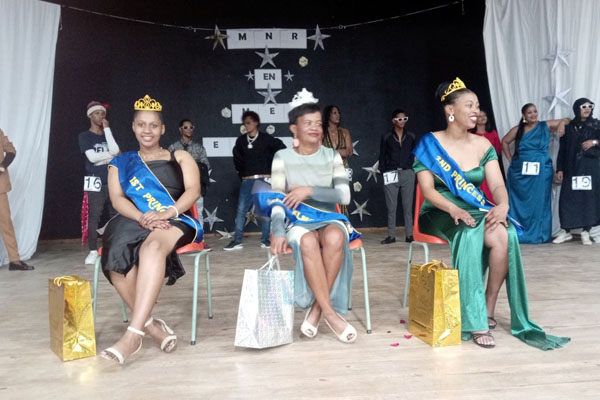
The winners of the ‘Miss Elmor Parents 2025’ beauty pageant.
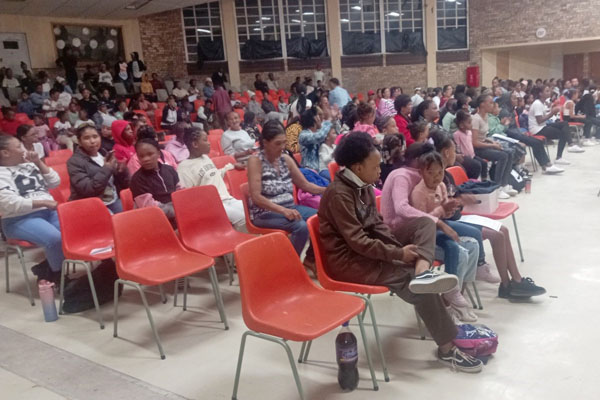
The school hall was packed with happy spectators.
FEATURED IMAGE: The Minister of Basic Education, Siviwe Gwarube, and the premier of KZN, Thamsanqa Ntuli, at a media conference about the education crisis in KZN.