
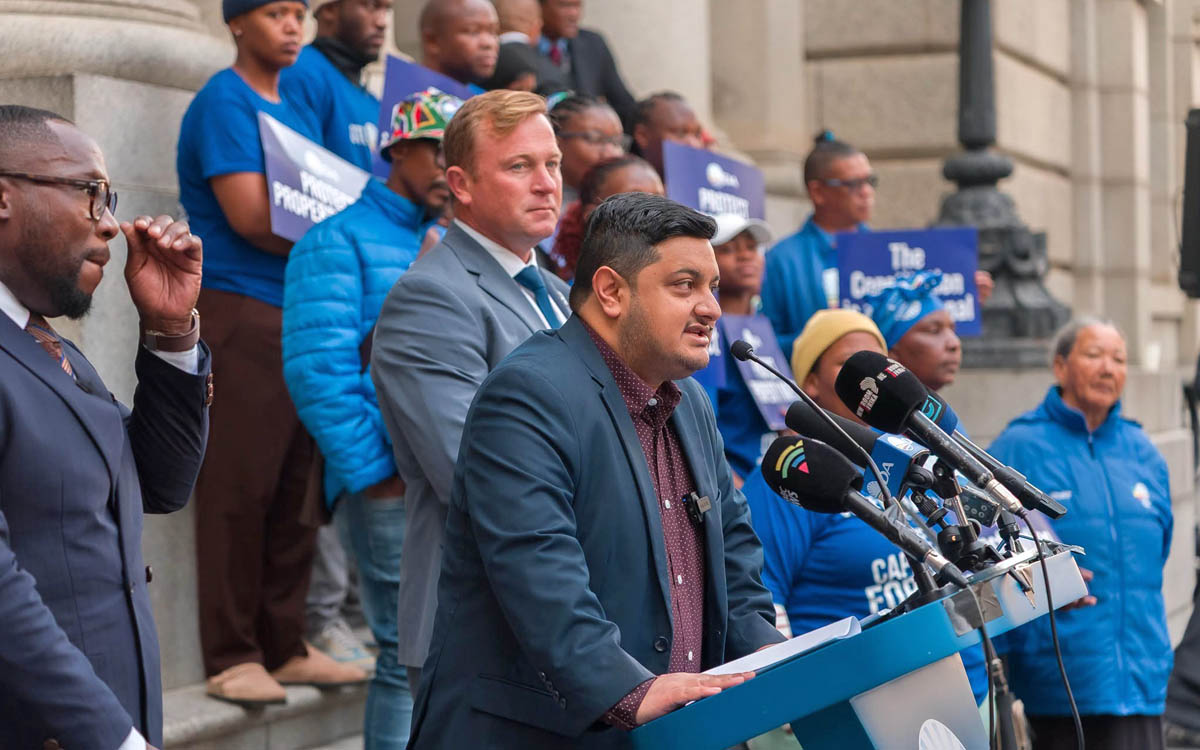
One of the biggest legal showdowns of the democratic era got under way this week when the Democratic Alliance, Afriforum, the Institute for Race Relations and at least one other organisation took to the Western Cape High Court to challenge the Expropriation Act of 2024. It was a grand show of force, and with so much riding on it, the litigants no doubt sourced the assistance of the best lawyers money can buy.
The Act has been a bone of contention for a considerable period. At the heart of the dispute is the issue of the expropriation of land, especially farmland, and the conditions under which this should be allowed.
The Constitution allows the expropriation of land under certain conditions – notably that it has to be in the ‘public interest’ — and subject to ‘just and equitable’ compensation. The Expropriation Act expands on the conditions under which land may be expropriated and the meaning of ‘just and equitable compension’, among others by allowing for ‘nil compensation’.
The complicating factor is that the constitution’s definition of ‘public interest’ includes the ‘nation’s commitment to land reform, and to reforms to bring about equitable access to all South Africa’s natural resources’, which brings the expropriation of privately owned (white) farmland into the mix.
Critics oppose the Act on the grounds that this would allow the state to expropriate farmland without compensation to previous (white) owners, which, they argue, would fundamentally contravene a cornerstone of the negotiated settlement embodied in the Constitution.
They also argue that the Act is a ‘back-door’ attempt to implement the resolution at the ANC’s 2017 elective conference which instructed the ANC to include expropriation without compensation as an instrument of law.
As far back as January last year, when President Cyril Ramaphosa first announced the signing of the Act, opponents used every opportunity to voice their disapproval, characterising this as a breach of SA’s constitutional dispensation, and the ANC as an enabler of backward policies that would culminate in another catastrophic ‘Zimbabwe’ scenario.
For the DA, it was an effective schtik on the campaign trail, effectively warning affluent voters in particular to remember that a fragmented DA vote would result in the infringement of private property rights and Zanu PF-type land seizures. City of Johannesburg mayoral candidate Helen Zille harped on this at every turn, with former federal leader John Steenhuisen in faithful agreement.
For Afriforum, it offered quite a windfall – ensuring a loyal and steadily climbing membership that reportedly pumped a cool R1.6 billion into the lobby group’s kitty between the years 2019 and 2024. Over the years, the once liberal – but now shifty – Institute for Race Relations (IRR) plunged headlong into the narrative, churning out articles and comments that were quite openly anti-expropriation but passed off as pro-free market submissions.
One could’ve believed this was in the interests of constitutional democracy, until they started coming on so frequently and so one-sidedly that it became almost impossible not to suspect some bias.
Of course, it has all worked out pretty well. Those who have found themselves spooked by the doomsday messaging have continued to fork out the membership levies, or vote in the right block on the ballot, and podcasters like Renaldo Gouws and Rob Hersov have no doubt experienced unexpected popularity in their support of getting this irksome law scrapped. One could even say that Hersov’s unashamed lies during and since his high-profile interviews in the US have garnered support from MAGA headbangers whose reach has brought South Africa troubles to an altogether different audience.
But with the Presidency, Parliament and the EFF on one hand and the aforementioned entities on the other, what is being put most to the test in these court proceedings is not just the Expropriation Act itself but the idea of the country’s constitution, and whether indeed the apex document was intended to ensure some form of restitutional justice.
During a Newzroom Afrika interview, University of the Western Cape Professor Ruth Hall has suggested that the constitution has always held the idea of transformation in mind. ‘This,’ she said, ‘is a profoundly political question. Yes, I think that the court hearings we’ll hear this week will come down to legal technicalities, but actually what’s at stake here is a very political question which is the status of private property in a very, very unequal society where the property regime that we live with is one that’s founded on injustice. And so, the question is what levers the state has to try and shift that.’
The DA clearly sees this quite differently. They question the constitutionality of expropriation with ‘nil compensation’, and what this would mean for private property rights. Also, they take umbrage with the National Council of Province’s adoption of the bill, which they argue was done without properly adhering to the law.
In the heads of argument, they state that ‘persons cannot be deprived of their property rights through an incoherent, inconsistent and irrational process under a law that was adopted pursuant to an unlawful process. To do so yields grave constitutional consequences – it sanctions, through the law, an arbitrary deprivation of property.’
Afriforum argues that the sections of the Act dealing without expropriation without compensation contravene Section 25 of the constitution ( the section in the Bill of Rights dealing with property), and should therefore declared invalid. Furthermore, they maintain that in his answering affidavits in October 2025, President Cyril Ramaphosa had acknowledged that these provisions were unconstitutional, and that they should therefore be referred back to parliament for redrafting.
According to the IRR, the fact that the compensation process set out in the Act clearly favours the state immediately renders the Act unconstitutional. They also argue that property owners’ emotional connection to the land is something that should be factored in when it comes to a decision to expropriate. Although they accept that the state has an obligation to promote land reform, this responsibility, they argue, should not be placed on the shoulders of private property owners through unfair compensation.
Over the years, black opposition political parties have been set on using the ‘land question’ to undermine the then ruling ANC’s commitment to proper economic transformation. This is one of the waves that has catapulted the EFF, MKP and like-minded entities to the echelons of power. Conversely, it is one of the most prominent issues – perhaps the most prominent — that has sown division and mistrust in broader South African society.
By the same token, one has to accept that the outcome of the court case – whichever way it goes – will continue to haunt us for years to come.
In the meantime, a question that continues to gnaw away at this writer is the following: what of those black people who aren’t looking for rural or farmland but prefer to live in urban areas, and don’t have title deeds to their homes. Technically, they don’t own the houses (many of them government-built) in which they live. Ah well, perhaps an ownership story for another day.
Featured image: DA leaders address the media and members of the public outside the Western Cape High Court. Source: DA Facebook page.