
By Destine Nde
It is widely accepted that it is far better and cheaper to prevent crime rather than having to deal with its afterwards. Besides its personal and social costs, crime is costing South Africa a fortune.
In line with this, the government has adopted an Integrated Crime and Violence Prevention Strategy. Approved by the cabinet in 2022, it is based on a second White Paper on Safety and Security, as well as a previous strategy adopted in 1996. More broadly, the whole framework is based on United Nations prescripts.
According to a government booklet, the strategy is aimed at guiding a ‘comprehensive, holistic and integrated approach to community safety, crime and violence prevention’, involving a ‘collective and collaborative approach between state and non-state actors across all three spheres of government … as well as ‘meaningful partnerships with communities and civil society’.
In line with this, it provides for ‘active public and community participation’ in crime prevention programmes and interventions’.
The Crime and Violence Prevention Strategy complements the National Strategic Plan on Gender-Based Violence and Femicide, which was adopted in 2020, and also focuses on prevention.
In the current year, R52 billion has been budgeted for the SAPS crime prevention subprogramme alone. Added to this, the Department of Social Development has a budget of R102 million to accelerate the fight against gender-based violence and femicide, with a total allocation of more than R800 million when provinces are included.
Like so many ambitious government programmes, these strategies are clearly struggling to get traction. Indeed, South Africa still has one of the highest murder rates in the world.
According to the latest quarterly statistics, 5,427 people were murdered in the three months from April to June. This was 5.9 per cent less than the same period the year before, but still meant that about 60 people were murdered every single day.
This amounts to a murder rate of 45.2 per 100,000 people – more than nine times the global average, and far higher than the average for Sub-Saharan Africa.
South Africa also has one of the highest rates of femicide and gender-based violence in the world, roughly four to six times the global average.
Numerous recent incidents have thrust South Africa’s violent record into the spotlight:
- On 22 September, attackers opened fire on people gathered in a house in the Ziko area of KwaMakhutha, south of Durban, killing 11 people and wounding three.
- On the evening of September 26, eight men armed with AK-47s and pistols opened fire on patrons outside and inside a tavern in Wedela township on the West Rand, killing 17 people and wounding 15.
- A few hours later, in the early hours of Sunday 27 September, gunmen entered a shisanyama in Lwandle, Western Cape, and opened fire on patrons. Five died at the scene, five more died later in hospital, and 11 were wounded.
- The same morning, Sunday 27 September, the body of the 11th woman killed on the East Rand since mid-July was found next to a railway line in Struisbult, Springs, Ekurhuleni.
- Later the same day, three people, reportedly including bodyguards of a taxi owner, were shot dead at a wedding in Nquthu, northern KwaZulu-Natal.
Recently, government agencies in Willowmore provided an innovative example of what can be done at the community level. On 16 October, the Department of Social Development (DSD) office in Willowmore partnered with various stakeholders to present an event titled ‘Uniting Through Sport For Safer Communities Day’.
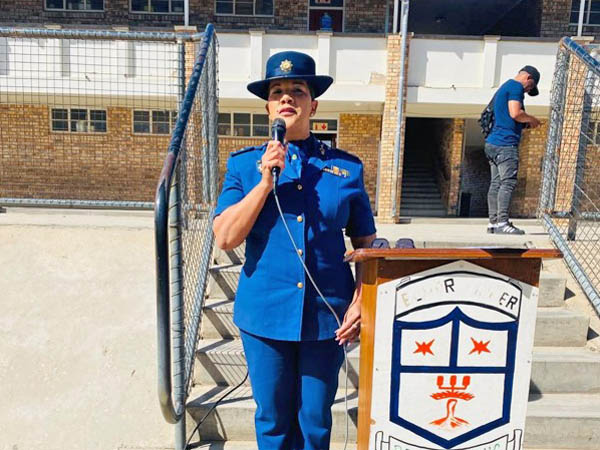
Representatives of the Departments of Basic Education and Sport, Arts & Culture, Cooperative Governance, the SAPS, the Community Police Forum, the Community Work Programme, the Dr Beyers Naudé District Municipality, religious societies, principals, learners and residents congregated at the Elmore Primêre sports complex at 8:00.
The programme began with a devotion in which Pastor T Fortune pointed out the correlation between vengeance and violent crime. ‘You kill two of theirs because they killed one of yours; then they come back for three or four of yours. It’s a vicious cycle which must be broken,’ he said, proposing forgiveness and compassion as a better way forward.
A representative of the Executive Mayor said the money spent on preventing and solving crimes should rather be spent on schools, hospitals, roads, housing, and so on. Ironically, these processes were ultimately funded by victims and traumatised communities themselves.
The DSD branch manager, Juanita Martin, spoke about the socio-economic drivers of violent crime, as well as the rising impact of climate change and geopolitical crises. Food inflation in South Africa has risen above 7 per cent, which leads to desperation, depression and substance abuse — a breeding ground for violent crimes and unwanted pregnancies.
‘Greater awareness of this could raise tolerance levels, solidarity, cooperation and mutual support in communities, which would go a long way to curbing crime’, she said.
The DSAC representative pointed out that sport was the best arena for making new friends, strengthening social cohesion and reducing stress and anxiety, which could all help to reduce crime.
Thus the invitation stated: ‘This collaborative event is aimed at using the unifying power of sports to promote positive lifestyles, discourage criminal behaviour, and strengthen relationships between various institutional departments and law enforcement agencies’.
Recounting horrific recent crimes, Lt Col Winnaar of the Willowmore SAPS said: ‘These crimes are committed among us, in our communities, and therefore we have a crucial role to play in their prevention and solution. The government is overwhelmed, so it is up to us to grab the bull by its horns’.
Many crimes were preventable. But once they had been committed, the cost of justice ran into millions, besides the incalculable costs to victims and communities.
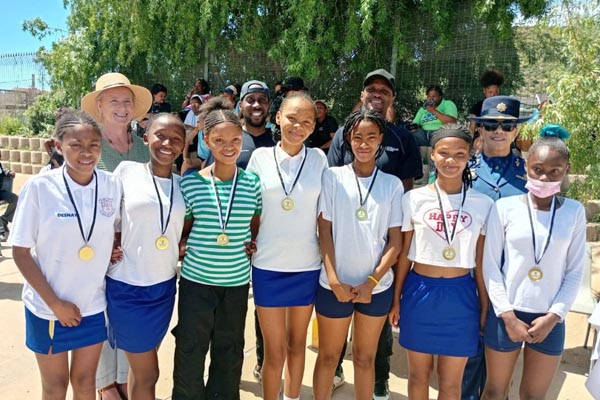
Four teams competed in netball: Elmore Primere, Bronsville Primere from Rietbron, Willowmore Senior, and Stakeholders. The proceedings then moved to the sports ground for men’s rugby and soccer.


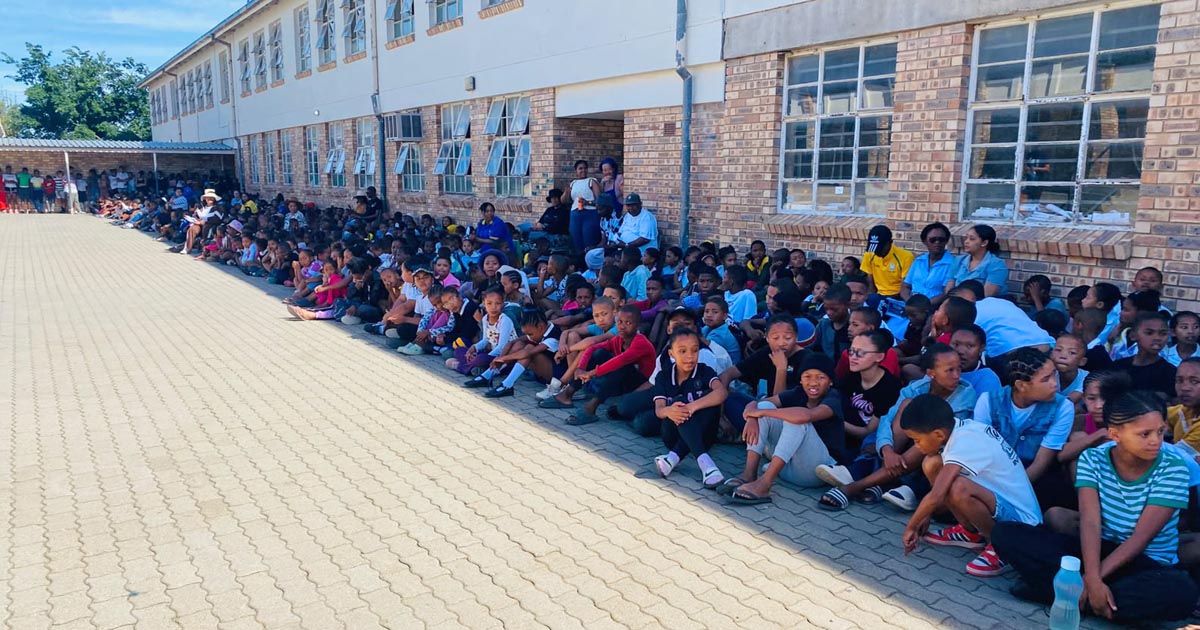
Featured image: part of the audience at the Elmore Primary School. All images: the author.