
By Destine Nde
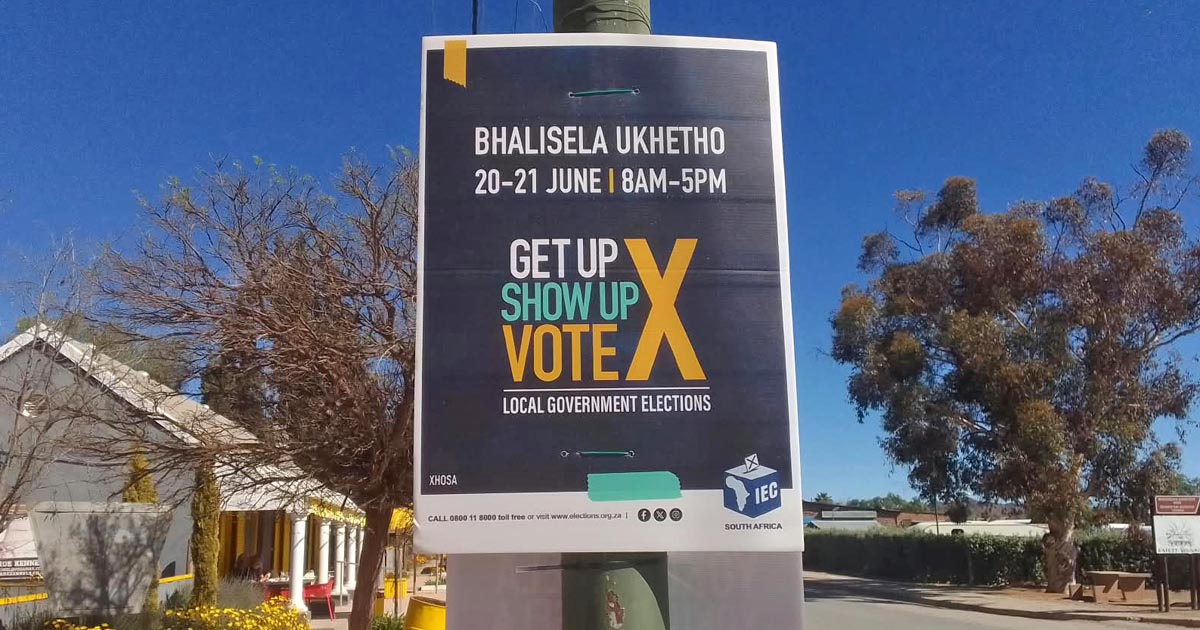
On 4 November, about 29 million South Africans will take to the polls to elect their local governments. The stakes are especially high because the ANC – which controls most municipalities in the country – is under fire for its poor performance in local governance, resulting in growing service delivery failures.
More and more voters want local governments that can, above all, provide ‘clean’ (efficient and accountable) local governance, providing the basic services that keep their towns and cities working, and are prepared to abandon their historical political loyalties in the process.
In line with this, even in small towns such as Willowmore, there has been a tremendous increase in political awarenesss and activity ahead of this year’s local government elections, now only some two months away.
From 1995 up to 2016, Willowmore had its own municipality, namely the Baviaans Local Municipality. In that year, it was absorbed (together with a few other small towns) into the much larger Dr Beyers Naudé Local Municipality, based in Graaff-Reinet, and elections in Willowmore now take place in two local wards out of 12 in the municipality as a whole. Twelve more PR seats are added, totalling a council of 24 for the Beyers Naudé municipality as a whole.
For many years, as in many other places, local politics were dominated by two rival parties: the African National Congress (ANC) and the Democratic Alliance (DA).
While other smaller parties might have put up posters, only the ANC and DA would be seen campaigning, registering voters, and monitoring the activities of the Independent Electoral Commission (IEC).
They were also the only parties that maintained permanent offices. In the run-up to elections, they would teem with workers and supporters, wearing their party colours. For weeks, black-and-yellow ANC people and their blue DA counterparts would be the busiest people in town, holding rallies, making arrangements, mobilising people to register and vote.
In fact, in the past, a day or two before elections, the ANC actually flew a small aeroplane towing an ANC banner over the town.
Since the advent of ‘political freedom’, people with an interest in politics were either affiliated with the ANC of DA, just as almost every rugby lover is either a Springbok of All Black fan. As time went on, and social problems began to reassert themselves, people started losing interest in politics, to a point where most no longer cared which party lost or won.
Then, in the local government elections of 2021, the situation began to change. The Compatriots of South Africa (CSA, a local party largely focused on land claims for some ‘coloured’ people), the Economic Freedom Fighters (EFF), and the Freedom Front Plus (FF+) joined the contest, and won one ward each.
This year, the change is tremendous. More parties have joined the fray, and they are all equally active. One can tell that they are not only here to participate, but to actually win.
The biggest wild card is the Patriotic Alliance (PA), which has shot to prominence in various parts of the country – particularly those with sizeable ‘coloured’ populations. In 2021, it failed to win a single ward in the Beyers Naudé municipality. In a by-election earlier this year, it won a seat off the ANC, garnering 40 percent of the vote, followed by the DA, the ANC and the FF+.
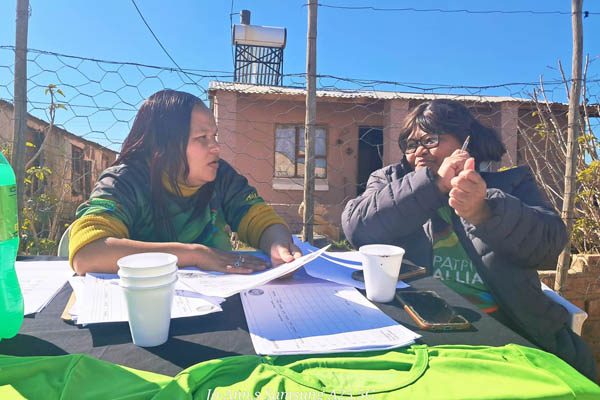
PA registration table in Willowmore.
Final voter registration for this year’s elections took place on 1 and 2 August, and for the first time in democratic South Africa, up to four other parties did exactly what the ANC and the DA used to do. The EFF, the PA, the FF+ and the CSA have also opened offices in the town, and set up stands to mobilise and register voters.
What has caused this massive leap in political awareness? Yes, despite the advent of democracy, Willowmore still faces massive social and economic problems. But towns like these have always tottered under poverty. So what has changed?
Much of this can be attributed to the ubiquity and affordability of the internet and mobile media. Previously, the way in which residents of Willowmore – and other towns making up the Beyers Naudé municipality — could stay informed was via radio and television. Only government offices, a few businesses and wealthy individuals had wi-fi, and mobile data was expensive.
But now things are different. Today, anyone with a smartphone has access to a mass of information about politics, whether local, provincial or national – the parties, their ideologies, their performance records, and their manifestos.
Anyone in Willowmore can follow rallies or debates taking place anywhere in the country – from Cape Town to Limpopo – without moving from their homes. Thus geographical barriers have been transcended. Events are no longer local but global, and political consciousness has broadened hugely, giving voters new opportunities for gaining relevant information, and taking informed decisions.
Even more consequentially, via social media, just about anyone can have a direct and often unpredictable influence in politics. A tweet in Cape Town can capture the hearts and minds of thousands in Willowmore in no time; a march in Johannesburg can spill over to Willowmore on the same day.
Indeed, influence now flows increasingly from the periphery to the centre. The distance between politicians and voters has vanished. Smartphones have fundamentally severed the links between geography, information and influence, completely reshaping public engagement and political will. Now a person in Willowmore can earn a degree from UCT without ever setting foot on campus.
Secondly, people have arguably lost sympathy for the erstwhile beloved ANC. This venerable party – which played a leading role in the ‘liberation struggle’ — has lost much of its traditional appeal, and does not hold out a convincing or coherent plan for improving its performance – and the state of the country — in the future.
Cyril Ramaphosa is due to step down as president, and no credible replacement is in sight. In fact, as Toverview has noted, the ANC has steadily lost half of its electoral support over the past 20 years, and this trend is likely to continue in November.
While the ANC has been falling, the DA in particular has been rising. Indeed, the only thing preventing it from rising to a clear majority in South African politics is the continuing perception among previously disenfrenchised people that – despite its nonracial profile — it still essentially represents predominantly white political, economic and social interests.
A week or so ago, I discussed all these issues with a former ANC local councillor, Henry Blouw. He made a very interesting point, namely that it is individuals – mayors, councillors, municipal managers, and other officials — who are failing the ANC and ruining its reputation ‘They are the ones to be held accountable for mismanagement and service delivery failures’, he said.
But is the ANC not responsible for placing them in those positions? Blouw said ‘no’, explaining: ‘South Africa has its challenges like any other country. It has among the best policies in the world. So the blame should rest more heavily on individuals than on government.’
So what could or should be done? In line with many other analysts and role players, Blouw believes in civil action – that voters should play more active roles in demanding effective and accountable governance.
‘As we speak,’ he said, ‘I’m convening a meeting to plan a march in Willowmore. I want people from the Baviaanskloof, Rietbron, Steytleville and Fullerton to come together and march to various departments – for example, to the HOD of the Paramedic Services to ask, why are there often no ambulances in time of need?
‘To ask the Police Commander, why there wasn’t there a single police van in at the Baviaanskloof police station on Wednesday last week? To ask the branch manager of SASSA, why there is only one official in the Willowmore office? And so on …’
He then left to go to the meeting, and promised to keep me updated.
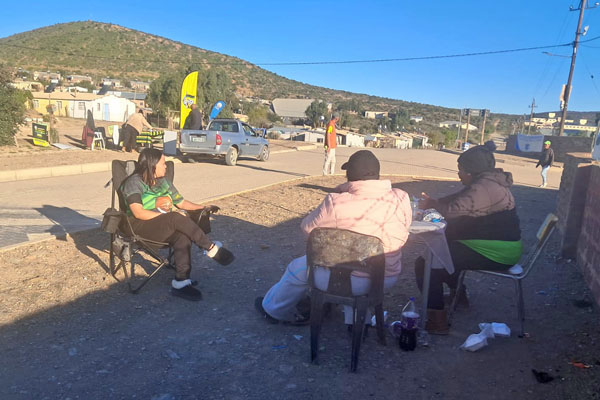
Mobilisations at the sportground.
How this civic action will translate into voter support for various parties is unclear. Whichever way this turns out, heightened political awareness at the local level is an important new trend which could only augur well for South African politics in the years to come, both at the local and eventually at the provincial and national level.
Indeed, while they might differ ideologically, many political analysts and practitioners agree that real political renewal and reform could only start at the grass roots, and then work its way upwards. Hopefully, this process will start in November.