
By R.W. Johnson
Before 1994, most South African public hospitals were run by a power structure in which the doctors were the predominant element. This had its drawbacks, and there were often complaints about the “arrogance” and “selfishness” of some doctors, but at the end of the day it did mean that the people who knew most about health and medicine were calling the shots. Moreover, this predominant role for the doctors was evident in most health systems around the world, even if the basic financial parameters were controlled by hospital administrators.
Yet after 1994 the doctors were elbowed aside in most South African public hospitals. Often, management authority migrated to trade union officials representing nurses or cleaners or to white collar workers who sometimes used their power over procurement for corrupt purposes. The problem was that most of the doctors and specialists were white or Indian, and thus it was axiomatic in ANC-ruled South Africa that their day was over. The result, as we know, has been the calamitous decline of public hospitals in most of the country.
When Aneurin Bevan started to push the British National Health Service through parliament, he tended to see the (until then) private doctors as the enemy: many were well-off and tended to be conservative. Inevitably, his NHS proposals were opposed by the British Medical Association, the doctors’ trade union. An all-out collision seemed inevitable, but in the end Bevan proposed that of the 25-member ruling body that controlled the NHS, 13 seats would be chosen by the BMA. With that, the doctors came on board. For Bevan had realised that the NHS had no chance of working if the doctors were flatly against it.
Yet this lesson has been ignored by the South African proponents of NHI. To their huge frustration, the views of doctors have simply been ignored in the design of NHI. And NHI will rob doctors of their professional independence. All doctors and all patients will be subject to centralised control by a state body whose key officials will be appointed by the minister of health. It is little wonder that surveys show that 40% of doctors will emigrate if NHI in its present form becomes law.
In effect, that huge vote of no confidence would collapse the system at its outset. Moreover, it is likely that a large proportion of the country’s upper income group, deprived of the right to continue using the private health system, would also emigrate. The result would be a huge blow both to the national economy and the fiscus, for this top group includes the top managers, professionals and entrepreneurs, who are also the highest tax-payers.
In other words, the enactment of NHI in its present form would be a self-induced national calamity comparable only to the Great Xhosa cattle killing of 1856-57.
Yet NHI – originally an SACP proposal – has become a key item of ANC ideology, and Ramaphosa has insisted that it will go ahead “whether you like it or not”. And he has just repeated that nothing will “stop the work currently under way towards implementation of the NHI” — this despite the fact that he had earlier put NHI on hold until the Constitutional Court has dealt with the 14 major court cases pending against it. Ramaphosa’s insistence is surely a sign that he recognises that NHI has become a non-negotiable ambition for key ANC factions.
Yet the fact is that NHI advocates have never yet managed to convince a finance minister that the scheme is even financially possible. This is why finance ministers have only ever allocated small amounts to the programme. Indeed, the present finance minister, Enoch Godongwana, put aside no extra money for NHI in his last budget, and commented that simply improving the current public hospitals seemed the most sensible thing to do. This is hardly surprising, since no one has yet done an official costing of NHI or come up with any proper plans for where the money would come from. The reason for this is quite clear: the ANC knows that such an exercise would reveal that NHI is unaffordable.
For there is a consensus that NHI would be hugely expensive: estimates range between its annual cost being R500 billion to R1.3 trillion. This is simply unaffordable. The extra money would have to come from taxation, and South Africa is already over-taxed to the point where tax increases actually result in reduced revenue. Moreover, NHI advocates assume that, besides the R310 billion a year which is currently spent on public health, NHI would also garner the R250 billion a year spent on private health.
But that is unlikely to be true. Not a few private health members are pensioners, and it would be difficult to tax them more heavily. And many other current private patients would emigrate rather than be forced to accept lower levels of medical care, so all tax revenue from them would be lost.
So even if NHI should survive all the court challenges to it, it seems clear that any attempt to put it into practise would be a disaster. There simply isn’t enough money available to pay for it. There are also far too few doctors and other medical specialists to provide a decent standard of care for the entire population.
The opposition of the doctors and the likelihood that many of them would emigrate is a fatal weakness. If the government were to press ahead and implement NHI as it stands, the private medical sector would be destroyed, but the then overburdened public sector would simply collapse due to insufficient personnel and finance – and that is before one takes account of the greatly increased opportunities for corruption which NHI would open up.
The result would be a catastrophic mess. Emigration by the middle classes and medical professionals would mount over the next few years, resulting in complete chaos from which the government and the country might never recover.
If one examines the introduction of national health systems in a variety of Western countries after 1945, it becomes clear that the reason why this was generally successful was that all these countries were experiencing virtually full employment due to post-war reconstruction which saw strong economic growth. What this meant was that virtually the whole population was able to contribute towards financing the new health services through the tax system.
But South Africa is in a polar opposite situation, with a real unemployment rate of 40%. The result is that with a population now approaching 70 million, it has has less than eight million tax-assessed individuals who meet the threshold to pay personal income tax. And a million top earners pay 60% of all personal income tax. This is an absurdly narrow tax base for financing a comprehensive health system.
So the question becomes, why does the ANC continue to advocate so strongly for a clearly disastrous policy? It is of course true that very few people in the ANC have any grasp of economics, and that many others are simply too ignorant to appreciate the scale of difficulties that NHI would face. It is also true that it is easy to make NHI sound very attractive to those who don’t understand the difficulties in achieving it.
That was why Panyaza Lesufi promised voters in 2024 that on the day after the election “you can go to any hospital of your choice – whether it’s a private hospital or a public hospital – and the government will pay the bill”. This was, of course, a deliberate untruth, as anyone who attempted to act upon Lesufi’s promise quickly discovered.
It is a striking fact that the government and Cosatu have both made sure that their key cadres all have access to private medical care – and there are clear indications that many of those fortunate enough to benefit from such schemes are nervous about the prospect of NHI ending that access. That is, the ANC’s propaganda about the benefits of NHI has not managed to convince many of its own.
On the other hand, there is no doubt that the promise of free medical care in the private sector has been attractive to the far larger number who currently lack such access. Should NHI actually be implemented, of course, this promise would not be fulfilled, and there would be bitter public disappointment, but for the moment the ANC is happy to rely on the promise alone.
It is difficult to believe that any intelligent person, who has followed the debate and thus learnt of the overwhelming practical difficulties that NHI would face, can still believe that the scheme makes sense. To them the ANC answers, “whatever the difficulties, the ANC is determined to make NHI work”, and to problems of NHI’s unaffordability, it says, “the money will simply have to be found to make it work”.
In effect, this attempts to reduce the feasibility of NHI to a question of the ANC’s will-power. Similarly, the ANC tries hard to reduce NHI to a moral issue: if you are not in favour of NHI, then you must be saying that poor people should not be allowed proper medical treatment. But while these are not ineffective propaganda ploys, they carefully avoid dealing with the practical facts of the matter.
So, in the end, the question of why the ANC so passionately advocates a clearly disastrous policy comes down merely to ideology. The Freedom Charter promised that “Free medical care and hospitalisation shall be provided for all” – and since public health facilities have, under ANC rule, been reduced to an abysmal state, NHI has to be the answer.
In addition, of course, the ANC believes that its mission is to transform the whole of society – so there must be nothing that is be off-limits to ANC control: the ANC must control not just the government but the judiciary, the police, the economy, the universities, the health sector, and so on.
In that sense, it is easy to see what is the besetting sin of the private medical sector. Go into any private hospital, and it is immediately apparent that it is not “transformed”. African doctors are a rarity there, and the main Cosatu unions in the hospital sector – Nehawu, Hospersa, Denosa and Samatu – do not hold sway there. And the three companies owning 80% of the country’s private hospitals – Life Healthcare, Mediclinic and Netcare – are not ANC-controlled.
The private hospitals are run by professional medical administrators, and the doctors (mainly white and Indian) are clearly still in positions of authority. The whole atmosphere is very different from most public hospitals: there is no overcrowding, the hospitals are clean, orderly and appointments have to be made, just as bills have to be paid.
Most patients are, indeed, members of private medical aids, and their financial arrangements have to be found to be adequate before the patients can be admitted. Most of the doctors are members not of Samatu but of the South African Medical Association, which has levelled many objections to the NHI proposals as they stand.
In a word, there is no sign of “transformation” here – there are no affirmative action doctors or administrators, and quality control is maintained by firm discipline and meritocratic appointments – so in the eyes of the ANC the clocks in private hospitals were stopped some time before 1994. The result is that this is still effectively an island of white control, for the ANC an offensive fact in itself. Moreover, the fact that the private hospitals are universally regarded as being far better than the public hospitals is thus seen as a sort of assertion of white supremacy.
All of which is deeply unacceptable to the ANC, and why it has dismissed out of hand all attempts to find a continuing place for the private hospitals in a future health system – until, that is, they have been “transformed”. There are, in a word, deeply atavistic feelings at work here, which surely explains the ANC’s passionate embrace of the clearly impossible NHI.
To this must be added the fact that the ANC is dying, and knows that it is dying. Its cadres have brought most of South Africa’s cities and towns to their knees, and the signs of decay and decline are everywhere. Even in Limpopo province, on paper the safest ANC stronghold of all, the party is failing, torn by tribalism, the water mafia have taken over and unemployment is through the roof.
This awareness of the movement’s now inevitable collapse only spurs the ideologues on, just as it encourages last-minute grabs for resources: the loot-before-you leave syndrome. And for the ideologues, it is provoking beyond bearing that such monuments to white South Africa as the private medical sector should outlive them.
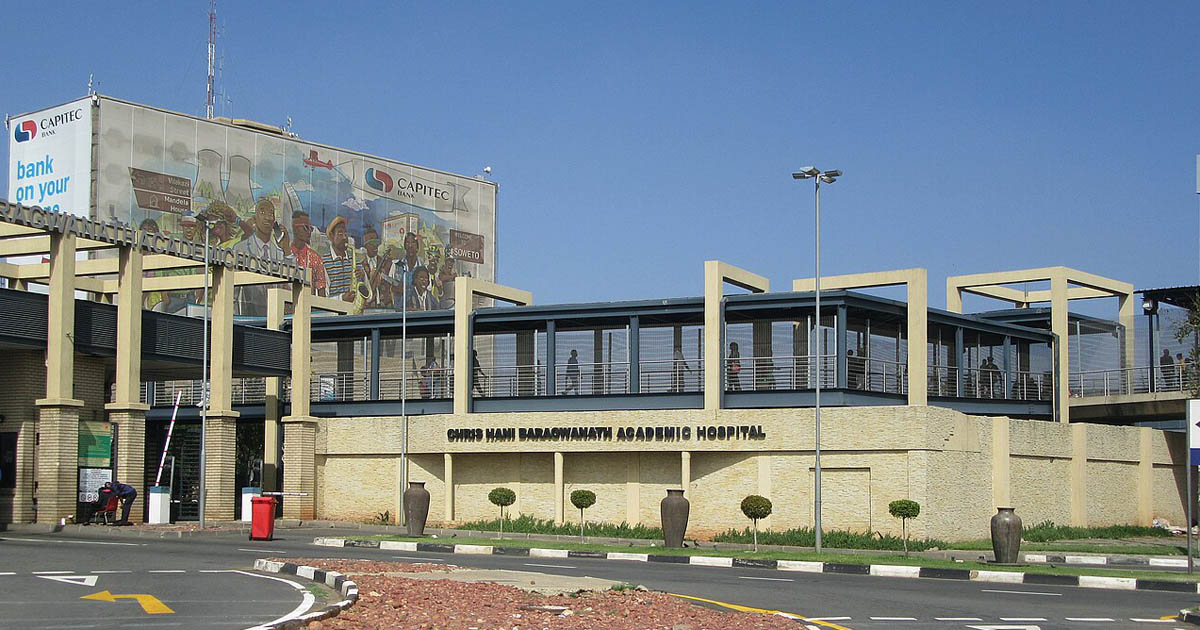
FEATURED IMAGE: The entrance to Chris Hani Baragwanath Hospital in Soweto, said to be the largest public hospital in Africa. According to Wits University, implementation of the NHI) at this hospital would present ‘significant operational, financial, and infrastructural challenges … “Bara” is central to the planned NHI, but current systemic issues raise questions about its readiness.’ (Wikipedia)
Excellent article. It’s already well established that NHI is unaffordable.
South Africa has always had a dual public-private healthcare system. In 1994, the ANC inherited a functional public healthcare system. Under the ANC’s watch, through mismanagement, incompetence and looting that system hardly exists anymore, perhaps on the same level as its counterpart in Chad.
The British NHS is not exactly a role model, reports about it are usually negative, watch Sky News, but at least the private sector was allowed to function, “Harley Street” comes to mind where my diplomat parents went for healthcare. Incidentally, my mother hailed from Colesberg. Still, the NHS would be incomparably better than NHI were it ever to come to pass which fortunately appears increasingly unlikely.
The private healthcare system in South Africa is one of the best run sectors of the economy one reason being it’s run by real professionals at all levels and not by the ANC nomenklatura. As Mr Johnson writes, that’s a problem for the ANC which wants to place the entire economy under centralised control in line with Lenin’s 1917 National Democratic Revolution.
As for NHI’s unaffordability, that’s clearly not a problem for the ANC ideologues. They are quite prepared to break down what is working in the economy before they have even set up a much worse alternative and in this regard Health Minister Aaron Motsoaledi’s fanaticism is concerning. There’s no doubt, NHI would collapse at its outset and along with it the entire healthcare sector. This would completely damage and change South Africa for the worse. Some ten million private medical aid members – mainly consisting of the seven million and aging middle class who pay most of the taxes to keep 70 million inhabitants going – would be deprived of freedom of choice and of the right to private healthcare which in practice would amount to being denied timeous, safe and competent healthcare. For these people the country would become unliveable which is why NHI should be considered as an intended and significant violation of human rights.
On 8 August 2019, then DA MP and Health Portfolio Committee member, Siviwe Gwarube, now Minister of Basic Education, posted a statement on the DA website that the NHI Fund “will be nothing more than another SOE that will be completely vulnerable to grand corruption at the expense of the nation’s entire health system”. And on 12 August 2019, then DA leader Mmusi Maimane was reported as saying that the NHI and its Fund will be “nothing but another attempt by the ANC to create a new state-owned company for the benefit of the governing elite”. Nothing has happened since then to assuage South Africans’ fear on this score.