
By Destine Nde
In the local government elections, the winds of change blowing through South African politics also reached into the small town of Willowmore in the Klein Karoo.
I spoke to many residents, both before and dujring the election. While some were apathetic or indifferent, others spoke of a desire for change.
For many, there was no dividend in voting at all. As Bradley Matiwana put it: ‘Why waste my time to empower people who don’t see me — so they can live in luxury while I live in poverty?’
For the DA’s Enchen Mapoe, it was all about change. She believed 32 years was enough time for trial and error: ‘The ANC had its time, and failed. So it’s time for the DA to also try. We all want positive change, and I strongly believe we would improve on whatever we inherit from the ANC.’
The EFF’s Jason Hendricks thought the solution lay in youth empowerment: ‘If our young people have work, more than half, in fact all, of the country’s problems will disappear. They will provide for their families, and crime and the pressure mounting on the government will vanish.’
Others were asking: is a country failing to deliver basic services and protect its citizens still worth calling a functioning democratic state? Has the time come for radical change, not also in political leadership but also our political system?
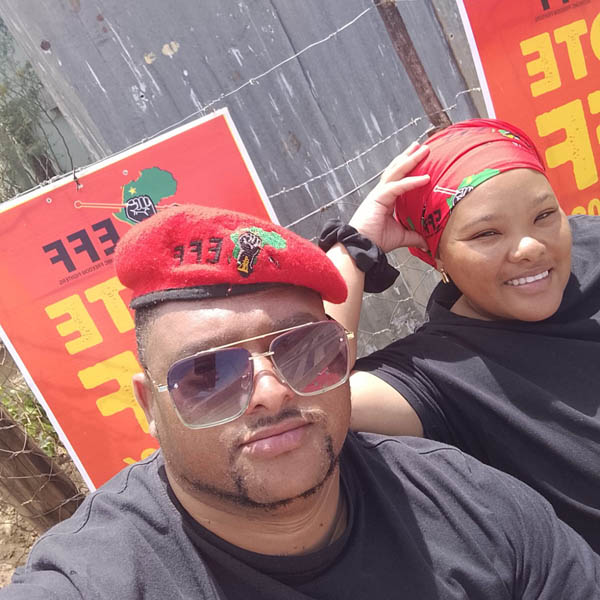
Two EFF workers on election day.
A.J. de Vos refused to vote because he believed nothing would change, adding: ‘It’s a classic revolutionary case, where the struggles of the majority are galvanised to enrich the few.’
P.J. Saaiman said: ‘South Africa is still tottering under the spell of the class struggle. A white minority owns capital, while a black elite has also begun to benefit. That’s why they’re interested in politics, because they have lots to win or lose.
Pointing at a voting station, he said: ‘Even those are there because they want to empower themselves, and they need our votes to do that. So I won’t vote because I have nothing to gain.’
Herman Potgieter was even more extreme: ‘My prayer is that no one should vote; and then we’ll see what will happen. They’re all the same. Only the party colours differ. That’s why I’ve never voted in my life.’
In the event, local turnout was 52,1% — more or less the national average — showing that a significant number of residents still retain a degree of faith in the political system. The outcome also mirrored national dynamics in other ways.
Previously the Baviaans Local Municipality, Willowmore now comprises Wards 8 and 9 in the Dr Beyers Naude Local Municipality. In 2021, the ANC won 11 seats in the 24-member council, with the DA in second place with 10. The DA formed a majority in coalition with other parties, and Councillor Ewald Loock – a veteran local politician and former mayor of the Baviaans Local Municipality — was installed as mayor. After six months, however, he was ousted and replaced by the ANC’s Willem Safers.
This time around, the DA surpassed the ANC, winning 40% of the votes. The ANC’s vote share dropped to 36%, down from 47% in 2021. This has given the DA the same ten council seats, still well short of the 13 required for an outright majority in the 24-seat council.
The PA surged to third place with 15,4% of the vote, giving it four council seats. The Freedom Front Plus rose to fourth place (2,9% of the vote), winning one seat. By contrast, the EFF – which won a seat in 2021 –declined to fifth place (2%), thereby losing its single seat.
In Willowmore, Ewald Loock won Ward 9 by a large majority, and Antony Galant, another DA candidate, decisively won Ward 9.
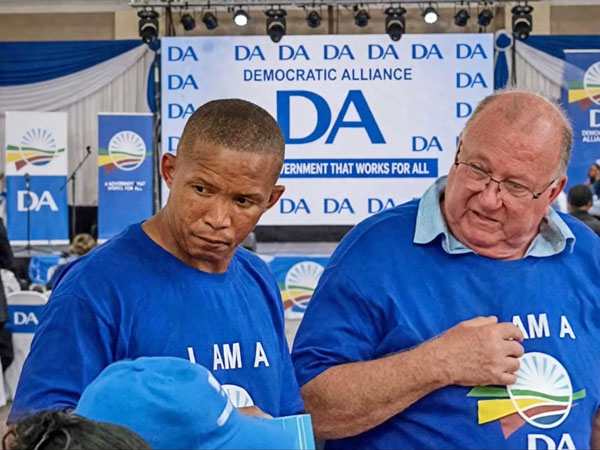
Antony Galant and Ewald Loock.
Therefore, like many others, The Dr Beyers Naude council has become ‘hung’, which means it will need to be governed by a coalition. Indeed, the election has resulted in 139 ‘hung’ councils, more than double the figure in 2021, and essentially reflecting the decline in support for the previously hegemonic ‘party of liberation’, the ANC. As elsewhere, this will result in complex local coalition negotiations.
How this will turn out will play a significant role in determining South Africa’s political future – whether another majority party will emerge, or whether coalition government will continue into the foreseeable future.
Above all, the outcomes must improve. What is at stake is not only support for particular political parties, but also people’s faith and trust in multiparty democracy.
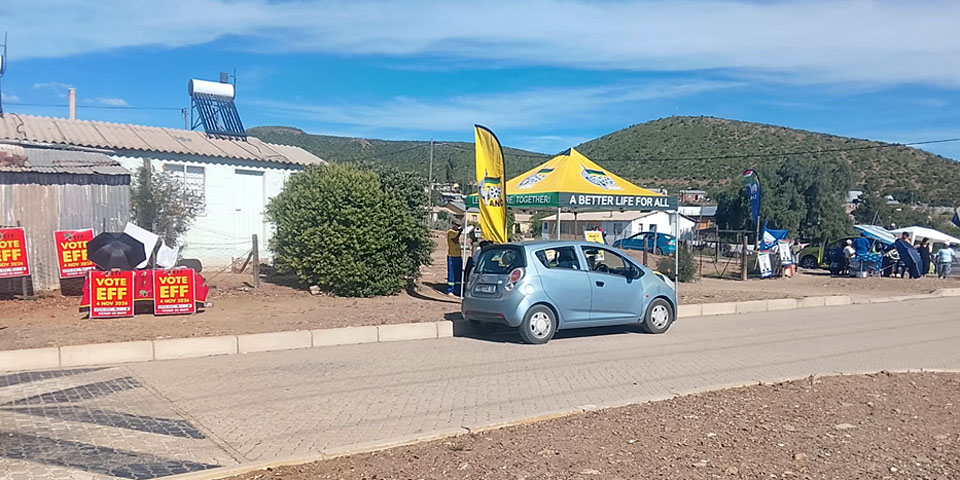
FEATURED IMAGE: Local government elections in progress in Willowmore on a hot day in early November. All images: the author.